 MortarDesk
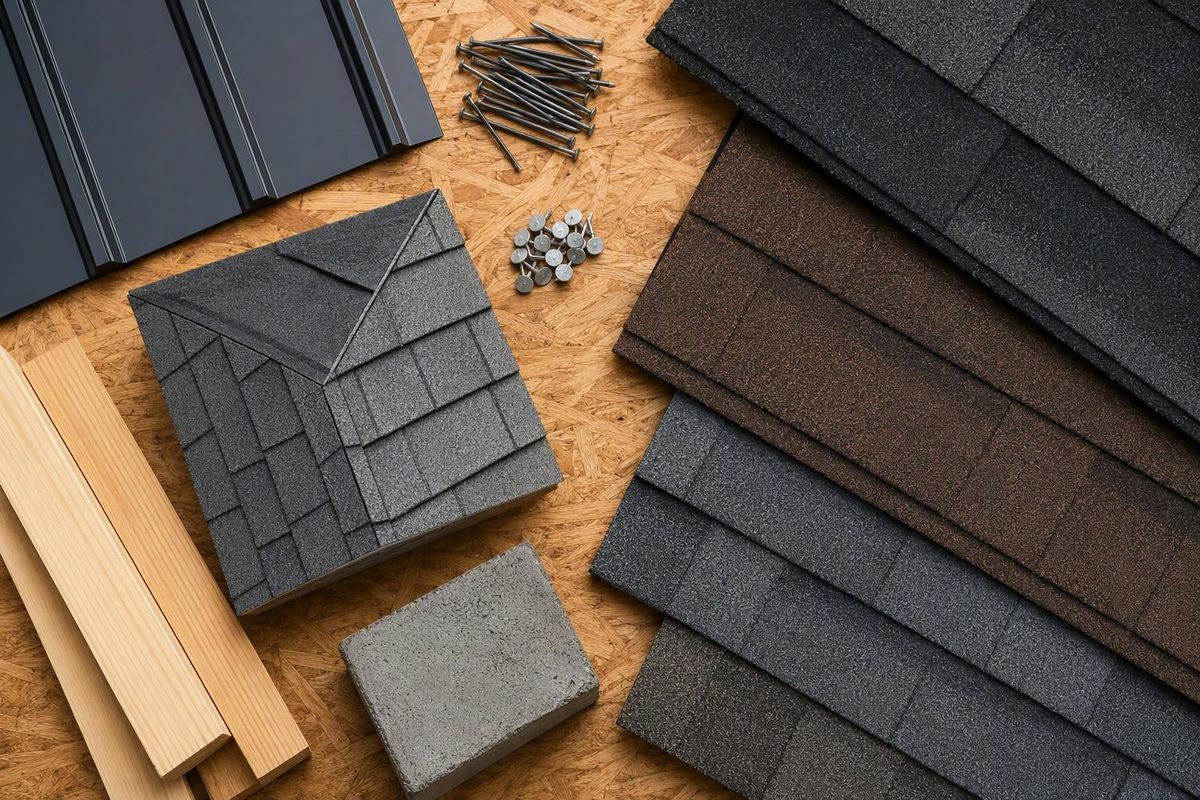
The dependable answer to “how many shingles do I need?” comes from five steps:
- Find the actual surface area of every roof plane.
- Apply a pitch factor only if your measurements are horizontal projections.
- Add a deliberate allowance for cuts and waste.
- Divide by the selected shingle’s labeled coverage.
- Round the final result up to a whole bundle.
The familiar shortcut—three bundles per roofing square—works for many asphalt shingles, but it is not a universal purchasing rule. Product coverage varies, and starter strips, hip caps, and ridge caps usually require separate calculations.
Editorial method: This guide separates measured inputs, geometric calculations, planning assumptions, and product specifications so each part of the estimate can be checked. It provides general reference information, not project approval or a guarantee against shortages or overages.
Quick answer: the shingle bundle formula
When the package states coverage in square feet per bundle, use:
Bundles needed = ceiling[actual roof area × (1 + waste rate) ÷ labeled square-foot coverage per bundle]
“Ceiling” means round up to the next whole bundle. For example, a calculated result of 63.1 means 64 bundles, not 63. This area-based method—waste-adjusted roof area divided by bundle coverage—is also used by published shingle calculators and estimating guides (RoofSnap’s shingle calculation guide).
If the product instead states bundles per roofing square, use:
Bundles needed = ceiling[(actual roof area ÷ 100) × labeled bundles per square × (1 + waste rate)]
One roofing square equals 100 square feet of actual roof surface (Omni Calculator’s roofing-square guide). Many standard asphalt products use about three bundles per square, but that is only a preliminary shortcut.
Use the unit printed by the manufacturer. If the specification says exactly three bundles per square, calculate with three bundles per square. Do not convert that figure to the rounded value of 33.3 square feet per bundle and then treat 33.3 as exact.
That distinction can affect rounding:
- Exactly three bundles per square means an exact mathematical coverage of 100 ÷ 3, or 33.333… square feet per bundle.
- “33.3 square feet per bundle” is a rounded figure.
- For 2,500 square feet, exactly three bundles per square gives 25 × 3 = 75 bundles.
- Dividing 2,500 by the rounded value 33.3 gives 75.08, which rounds up to 76.
Both methods are valid when they reproduce the manufacturer’s stated specification. They should not be mixed as though a rounded conversion were exact.
Preserve decimal values throughout the calculation. Do not round the measured area, roofing squares, or waste-adjusted area prematurely. Round up only after calculating the final package quantity.
You need four inputs:
- Roof area: The combined area of all roof planes, including overhangs.
- Measurement type: Whether the area was measured along the slope or is only a horizontal projection.
- Waste rate: A percentage chosen for the roof’s geometry and installation conditions.
- Product coverage: Square feet per bundle or bundles per square for the exact shingle being purchased.
A quick estimate for a straightforward roof might look like this:
- Actual sloped roof area: 1,800 square feet
- Waste allowance: 10%, written as 0.10
- Package coverage: 33.3 square feet per bundle
- Calculation: 1,800 × 1.10 ÷ 33.3 = 59.46
- Preliminary order: 60 bundles
That result is useful only if 1,800 square feet includes every sloped roof plane and 33.3 square feet is the selected product’s stated bundle coverage.
Roof square feet, roofing squares, bundles, and individual shingles
Roofing estimates use several related units. Keeping them separate prevents common ordering errors.
Square feet of roof surface describe the total area covered by the field shingles. If a roof has two rectangular planes, each measuring 40 feet by 18 feet along the sloped surface, its combined area is:
- Plane 1: 40 × 18 = 720 square feet
- Plane 2: 40 × 18 = 720 square feet
- Total: 1,440 square feet
Roofing squares express the same area in 100-square-foot units:
1,440 ÷ 100 = 14.4 roofing squares
A roofing square is an area unit, not necessarily a literal 10-by-10-foot section. Any collection of roof surfaces totaling 100 square feet equals one square.
Bundles are the packages in which shingles are generally purchased. Contractors and suppliers may discuss a roof in squares while the purchase order lists bundles. The connection between those units depends on the product:
- 1 roofing square = 100 square feet
- At exactly three bundles per square, one bundle represents one-third of a square
- One-third of 100 square feet is 33.333… square feet
The relationship changes when package coverage changes. A product labeled for 25 square feet per bundle requires four bundles to cover 100 square feet. One labeled for 20 square feet requires five.
Manufacturer examples show why product-level verification matters. IKO lists approximate bundle coverages of 20, 25, 32.3, and 33.3 square feet across different shingle lines (IKO’s bundle-coverage guide).
For a 2,000-square-foot roof before waste:
| Coverage specification | Calculation | Base bundles |
|---|---|---|
| Exactly 3 bundles per square | 20 × 3 | 60 |
| Exactly 4 bundles per square | 20 × 4 | 80 |
| Exactly 5 bundles per square | 20 × 5 | 100 |
| 32.3 sq. ft. per bundle | 2,000 ÷ 32.3 | 61.92, rounded to 62 |
The number of individual shingles inside a bundle is not a dependable ordering basis. Shingle dimensions, installed exposure, thickness, design, and package quantities vary. Packages with different piece counts may provide comparable coverage, while packages with similar piece counts may cover different areas.
Use individual counts only for an inventory check after confirming the relevant product specification. For purchasing, use this sequence:
Roof square feet → roofing squares if useful → product-specific bundles
Do not reverse-engineer coverage from a generic statement about how many individual shingles are in a bundle.
Choose the correct roof-area starting point
The preferred starting point is the complete actual sloped roof-surface area. If reliable plans, measurements, or a roof report already provide that value, use it directly.
Do not substitute the home’s living area. Interior floor area does not automatically account for:
- Roof slope
- Eave and rake overhangs
- Attached garages or porches
- Dormers and additions
- Intersecting roof planes
- Roof geometry outside the conditioned floor area
The building footprint is more useful than living area, but it is still a horizontal projection. A sloped roof has more surface area than its horizontal projection, so a footprint-based estimate normally requires a pitch adjustment.
Use this diagnostic:
- Measured along the roof surface: The width follows the slope from eave toward ridge. It is already a sloped dimension, so do not apply a pitch factor.
- Measured horizontally: The width comes from a plan, building footprint, attic floor, or horizontal run. Apply the appropriate pitch factor.
- Measurement type is uncertain: Determine how the figure was produced before using it. Do not assume that a document’s “roof area” means projected area or sloped area without checking its definitions.
When measuring roof planes directly, include overhangs and calculate each plane from its sloped dimensions:
Plane area = roof-surface length × sloped width
When working from horizontal building or attic dimensions, include the horizontal projection of the overhangs and convert the projected area using the roof pitch. IKO’s estimating guidance likewise distinguishes actual roof measurements from footprint-based estimates that must account for slope and soffit overhangs.
The most important rule is to apply pitch once. If a plane has already been measured along its surface, multiplying it by a pitch factor would count the slope twice and inflate the order.
Direct measurement is not appropriate in every situation. For a steep, wet, damaged, inaccessible, or complicated roof, consider architectural plans, careful ground-based dimensions, properly calibrated aerial measurements, or measurement by a qualified professional rather than climbing onto the roof. Direct roof measurement presents a safety risk, and no measurement method guarantees a perfect order (Brandon J Roofing’s roof-measurement discussion).
Whatever method you use, confirm that the result:
- Includes every roof plane
- Includes the relevant overhangs
- Identifies whether the area is projected or sloped
- Separates sections with different pitches when necessary
Measure every roof plane and account for pitch
Start by sketching the roof from above and labeling every distinct plane. A basic gable roof may have two large planes. A hip roof has more, while dormers, porches, intersecting additions, and similar features can introduce additional surfaces.
For each plane:
- Record its length.
- Record its width.
- Identify whether the width is horizontal or measured along the slope.
- Apply a pitch factor only to horizontally projected area.
- Record the adjusted surface area.
- Add all adjusted plane areas before applying waste.
A worksheet can use this structure:
| Plane | Length | Width | Measurement type | Pitch factor | Adjusted area |
|---|---|---|---|---|---|
| Front main roof | Projected/sloped | ||||
| Rear main roof | Projected/sloped | ||||
| Garage | Projected/sloped | ||||
| Porch | Projected/sloped | ||||
| Dormer left | Projected/sloped | ||||
| Dormer right | Projected/sloped | ||||
| Total |
For a rectangular roof plane:
Area = length × width
If both dimensions follow the roof surface, the result is already sloped area. If the dimensions describe a horizontal projection:
Estimated sloped area = projected area × pitch factor
Irregular roofs can be divided into manageable rectangles, triangles, trapezoids, or other sections. Calculate each section according to its geometry and then total the results. Avoid reducing a complex roof to one large rectangle if that would omit or duplicate substantial areas.
Understanding x:12 pitch
Roof pitch written as x:12 describes vertical rise for every 12 inches of horizontal run. A 6:12 roof rises 6 inches for every 12 inches of horizontal travel.
For an x:12 pitch, the geometric factor is:
Pitch factor = √(rise² + 12²) ÷ 12
For a 6:12 roof:
√(6² + 12²) ÷ 12 = √180 ÷ 12 ≈ 13.416 ÷ 12 ≈ 1.118
Therefore:
Projected area × 1.118 = estimated sloped area
Common geometric factors are:
| Roof pitch | Approximate pitch factor |
|---|---|
| 4:12 | 1.054 |
| 6:12 | 1.118 |
| 8:12 | 1.202 |
| 10:12 | 1.302 |
| 12:12 | 1.414 |
These values follow the geometric formula and align with published roof-area conversion tables (Aerial Estimation’s pitch-factor table).
Suppose a projected rectangular section measures 30 by 20 feet and has a 6:12 pitch:
- Projected area: 30 × 20 = 600 square feet
- Pitch factor: approximately 1.118
- Sloped area: 600 × 1.118 = 670.8 square feet
Do not add waste yet. Repeat the process for every plane, then add all sloped areas.
Dormers, hips, valleys, and separate additions should not be ignored. Hips and valleys are intersection lines rather than additional field areas by themselves, but they indicate intersecting planes and extra cutting. Dormer roofs may create additional shingled planes, and additions can have a different pitch from the main roof.
If two sections have different pitches, calculate them separately. Applying one average factor to sections with dissimilar pitches can distort the total.
Add waste without pretending one percentage fits every roof
Waste is extra material allowed for pieces that do not become complete field coverage. It can account for:
- Cuts at rakes, hips, valleys, and penetrations
- Overlaps and installation layout
- Damaged pieces
- Installation errors
- Pieces that cannot be reused efficiently elsewhere
A 10% to 15% allowance is a commonly suggested planning range, not a universal requirement. Roofr presents that range as a starting point for cuts, overlaps, and mistakes while emphasizing that it should be adjusted for the specific job (Roofr’s waste-factor guide).
Other supplied estimating guidance begins below 10% for some simple roofs, illustrating why no single percentage should be treated as authoritative. Select the rate according to the roof, product, layout, and installation conditions.
Factors that can increase waste include:
- Multiple hips and valleys
- Dormers and intersecting roofs
- Chimneys, skylights, vents, and other penetrations
- Intricate or irregular layouts
- Roof slope
- Product layout requirements
- Installer experience
- Damage during handling or installation
Use:
Waste-adjusted area = measured roof area × (1 + waste percentage as a decimal)
Examples:
- 8% waste: multiply by 1.08
- 10% waste: multiply by 1.10
- 12.5% waste: multiply by 1.125
- 15% waste: multiply by 1.15
For a measured roof area of 2,000 square feet:
- At 10%: 2,000 × 1.10 = 2,200 square feet
- At 15%: 2,000 × 1.15 = 2,300 square feet
A simple roof with long, regular planes may justify the lower end of a deliberately selected range. A highly cut-up roof may require more than a basic allowance. There is no useful universal maximum because the appropriate quantity depends on the job.
Waste should not compensate for missing measurements. If a porch roof was omitted, increasing a generic waste percentage does not reliably correct the estimate. Measure the porch first and then apply waste to the complete area.
Also distinguish waste allowance from spare material. An owner may choose to retain compatible unopened bundles or shingles for future repairs, but that is a separate purchasing decision. Do not conceal planned spares inside an unexplained waste rate.
Keep the waste-adjusted area unrounded. Divide it by the package coverage and round up only after reaching the final bundle result.
Use the package coverage—not a generic bundle count
Before purchasing, find one of these specifications for the exact field shingle:
- Square feet covered per bundle, or
- Bundles required per roofing square
If coverage is stated in square feet per bundle:
Bundles = waste-adjusted area ÷ labeled square feet per bundle
If coverage is stated in bundles per square:
Bundles = waste-adjusted roofing squares × labeled bundles per square
Round the final result up to a whole bundle.
Three bundles per square is common for many standard asphalt products, but it is not universal. Manufacturer examples include approximate coverages of 20, 25, 32.3, and 33.3 square feet per bundle, creating materially different orders for the same roof.
The arithmetic is:
- 25 square feet per bundle: 100 ÷ 25 = 4 bundles per square
- 20 square feet per bundle: 100 ÷ 20 = 5 bundles per square
- 33.3 square feet per bundle: 100 ÷ 33.3 ≈ 3.003 bundles per square
The last value is slightly above three because 33.3 is rounded. If the manufacturer instead states exactly three bundles per square, use that exact specification rather than converting it to 33.3.
For a waste-adjusted area of 2,500 square feet:
| Package specification | Calculation | Bundles to order |
|---|---|---|
| Exactly 3 bundles per square | 25 squares × 3 | 75 |
| 33.3 sq. ft. per bundle | 2,500 ÷ 33.3 = 75.08 | 76 |
| 32.3 sq. ft. per bundle | 2,500 ÷ 32.3 = 77.40 | 78 |
| 25 sq. ft. per bundle | 2,500 ÷ 25 = 100 | 100 |
| 20 sq. ft. per bundle | 2,500 ÷ 20 = 125 | 125 |
These inputs reflect the range of approximate coverage figures shown in IKO’s product examples; the selected product’s current specification must control the purchase (IKO’s product coverage examples).
The generic three-bundle shortcut would be seriously inadequate for a product designed to cover only 25 or 20 square feet per bundle.
Do not replace coverage data with the number of individual shingles in a package. Piece count does not establish installed coverage unless dimensions, exposure, layout, and installation requirements are also known. The package coverage already reflects the intended installation pattern.
Before buying, check:
- Exact manufacturer and product name
- Field-shingle coverage per bundle
- Bundles per square, if stated
- Required installation exposure
- Whether the coverage figure is exact or approximate
- Starter-product coverage
- Hip- and ridge-cap coverage
- Whether accessory shingles are separate products
If generic guidance conflicts with the current product specification, use the manufacturer’s specification. Also confirm that the supplied packages are the same product line used in the calculation rather than a visually similar substitute.
Worked examples: from measurements to whole bundles
These examples are planning estimates. Each depends on complete dimensions, an appropriate waste assumption, and the selected product’s current coverage specification.
Example 1: actual sloped roof area
Assumptions:
- Actual measured sloped area: 2,400 square feet
- Waste allowance: 10%
- Package coverage: 33.3 square feet per bundle
No pitch multiplier is used because the starting measurement already represents the sloped roof surface.
Step 1: Starting area
2,400 square feet
Step 2: Pitch factor
Not applicable
Step 3: Sloped area
2,400 square feet
Step 4: Add waste
2,400 × 1.10 = 2,640 square feet
Step 5: Convert to roofing squares
2,640 ÷ 100 = 26.4 squares
Step 6: Divide by package coverage
2,640 ÷ 33.3 = approximately 79.28 bundles
Step 7: Round up
Order 80 field-shingle bundles
Do not round 26.4 squares to 27 before dividing by coverage. That would replace the working area with 2,700 square feet and could inflate the order.
Example 2: horizontal projected footprint at 6:12 pitch
Assumptions:
- Horizontal projected area, including overhangs: 2,000 square feet
- Roof pitch: 6:12
- Pitch factor: approximately 1.118
- Waste allowance: 10%
- Package coverage: 33.3 square feet per bundle
Step 1: Starting projected area
2,000 square feet
Step 2: Apply the pitch factor
2,000 × 1.118 = 2,236 square feet
Step 3: Sloped roof area
Approximately 2,236 square feet
Step 4: Add waste
2,236 × 1.10 = 2,459.6 square feet
Step 5: Convert to roofing squares
2,459.6 ÷ 100 = 24.596 squares
Step 6: Divide by package coverage
2,459.6 ÷ 33.3 = approximately 73.86 bundles
Step 7: Round up
Order 74 field-shingle bundles
Pitch is necessary because the 2,000-square-foot starting value is horizontal. It would not be applied if that figure already described the sloped surface.
Example 3: the same measured roof with specialty-product coverage
Use the same measured roof as Example 1 but change the package coverage:
- Actual sloped area: 2,400 square feet
- Waste allowance: 10%
- Package coverage: 25 square feet per bundle
Step 1: Starting area
2,400 square feet
Step 2: Pitch factor
Not applicable
Step 3: Waste-adjusted area
2,400 × 1.10 = 2,640 square feet
Step 4: Roofing squares
2,640 ÷ 100 = 26.4 squares
Step 5: Divide by package coverage
2,640 ÷ 25 = 105.6 bundles
Step 6: Round up
Order 106 field-shingle bundles
If the three-bundles-per-square shortcut were used instead:
26.4 × 3 = 79.2, rounded to 80 bundles
That would be 26 bundles below the product-specific result. The shortcut fails because a 25-square-foot bundle provides one-quarter of a roofing square rather than one-third.
Summary of the examples
| Example | Starting measurement | Pitch adjustment | Waste-adjusted area | Coverage | Unrounded result | Order |
|---|---|---|---|---|---|---|
| Measured roof | 2,400 sq. ft. sloped | None | 2,640 sq. ft. | 33.3 sq. ft./bundle | 79.28 | 80 |
| Projected footprint | 2,000 sq. ft. horizontal | × 1.118 | 2,459.6 sq. ft. | 33.3 sq. ft./bundle | 73.86 | 74 |
| Specialty product | 2,400 sq. ft. sloped | None | 2,640 sq. ft. | 25 sq. ft./bundle | 105.6 | 106 |
These totals cover field-shingle packages only. They do not automatically include starters, caps, underlayment, flashing, fasteners, or sealants.
Calculate starters and hip or ridge caps separately
A field-shingle bundle total may not include the products used at roof edges, hips, and ridges. Treat those materials as separate line items unless the selected roofing system explicitly says otherwise.
For starter products, measure the total linear feet of edges where the manufacturer requires starter. Depending on the system, these may include:
- Eaves
- Rakes
- Other designated starting edges
Do not assume every edge receives the same treatment. Follow the selected system’s instructions.
Use:
Starter packages = required starter length ÷ labeled linear-foot coverage per package
Round up to a whole package.
For hip and ridge caps, measure the combined length of:
- Horizontal ridges
- Sloping hips
Then use:
Cap packages = total ridge and hip length ÷ labeled linear-foot coverage per package
Again, round up to a whole package.
For example, if the roof requires 185 linear feet of starter and the selected package is labeled for 100 linear feet:
185 ÷ 100 = 1.85 Order 2 starter packages
If the roof has 92 linear feet of hips and ridges and the cap package is labeled for 30 linear feet:
92 ÷ 30 = 3.07 Order 4 cap packages
Those figures are illustrations, not universal coverage rates. Accessory coverage depends on the product and installed exposure. Published estimating guidance likewise recommends measuring eaves and rakes for starters and hips and ridges for caps, then using the corresponding package coverage (ESX’s shingle-estimating guide).
Keep the quantities separate:
| Material | Measurement basis | Calculation |
|---|---|---|
| Field shingles | Square feet of roof surface | Area ÷ coverage per bundle |
| Starter shingles | Linear feet of required edges | Edge length ÷ coverage per package |
| Hip and ridge caps | Linear feet of hips and ridges | Hip/ridge length ÷ coverage per package |
This separation prevents two opposite mistakes: omitting accessories because the field total appears complete, or adding accessory packages while also counting that material as field coverage.
Underlayment, fasteners, flashing, drip-edge components, ventilation products, and sealants are also separate calculations. They are outside the field-shingle bundle total and can use different measurement units and installation rules.
Final order check: assumptions, limits, and verification
Before placing the order, work through this checklist:
- [ ] Every roof plane has been identified and included.
- [ ] Eave and rake overhangs are represented in the area.
- [ ] Each measurement is marked as projected or sloped.
- [ ] Pitch has been applied to projected measurements only.
- [ ] Sections with different pitches have been calculated separately.
- [ ] The waste allowance was selected consciously.
- [ ] The exact product’s coverage has been entered in its stated unit.
- [ ] Rounded coverage figures have not been substituted for exact bundles-per-square specifications.
- [ ] Field shingles, starters, and hip or ridge caps are separate.
- [ ] Decimal values were preserved through the calculation.
- [ ] The final package quantities were rounded up.
- [ ] Current manufacturer instructions have been checked.
- [ ] Applicable local requirements have been checked.
The most consequential estimating mistakes are:
- Using floor area directly. Living area does not automatically equal roof area.
- Omitting planes. Porches, garages, dormers, and additions can materially change the total.
- Applying pitch twice. Sloped measurements should not receive another pitch multiplier.
- Assuming every product uses three bundles per square. Coverage varies by product.
- Mixing rounded and exact coverage units. Three bundles per square is not exactly the same input as 33.3 square feet per bundle.
- Omitting waste. Geometric area does not include cutting and handling losses.
- Ordering by individual shingle count. Piece count is not a substitute for installed coverage.
- Including accessories implicitly. Starter and cap products may require separate packages.
A basic worksheet may be inadequate for roofs with many dormers, valleys, penetrations, irregular planes, uncertain dimensions, or multiple pitches. More detailed plans, properly calibrated aerial measurements, or qualified professional measurement may be appropriate. None guarantees that an order will have no shortage or overage.
Check the exact manufacturer’s current instructions for:
- Package coverage
- Suitable roof-slope range
- Required underlayment and related details
- Installed exposure
- Starter and cap requirements
- Installation methods
- Warranty conditions
Also check the requirements that apply in the project’s location. A material calculation does not establish code compliance, product suitability, warranty compliance, or approval by an inspector.
The order of operations remains:
Identify the measurement type → total every roof plane → apply pitch once if needed → add waste → divide by labeled coverage → round the final bundle count up
The three-bundles-per-square rule is useful for an early estimate, but the selected product’s specification should govern the purchase. Calculate accessory products separately, and use a safer, more detailed measurement method when the roof is complex, uncertain, or unsafe to access.
About Mortar Desk explains its role as a building-material reference publisher. Mortar Desk is not a contractor or engineering adviser and does not provide individualized project approval.
Frequently asked questions
How many bundles of shingles cover one roofing square?
One roofing square equals 100 square feet of roof surface. Many standard asphalt-shingle products use approximately three bundles per square, but the exact rate varies by product (Owl Roofing’s bundles-per-square guide).
Use the coverage shown on the current packaging or manufacturer literature. If the specification says exactly three bundles per square, calculate with that unit rather than converting it to a rounded 33.3-square-foot figure.
How many shingles are in a bundle, and should I use that number to order?
The number varies with shingle dimensions, thickness, design, manufacturer, and package configuration. Do not use a generic piece count as the basis for an order.
Order by the stated square-foot coverage per bundle or bundles per roofing square. Individual piece count can help check a delivered package, but it does not replace installed coverage.
Do I multiply by a pitch factor if I measured the roof itself?
Not if the dimensions were measured along the sloped roof surface. Those measurements already include the effect of pitch.
Apply a pitch factor only when starting with a horizontal projection, such as a footprint, attic-floor area, plan dimension, or horizontal run. Applying it to sloped area would count pitch twice.
How much extra should I add for shingle waste?
A 10% to 15% allowance is a commonly suggested starting range, not a fixed requirement. Roof geometry, product layout, penetrations, slope, handling, and installer experience can change the appropriate rate (Roofr’s waste-factor guidance).
Use:
Waste-adjusted area = measured roof area × (1 + waste rate)
Keep the result unrounded until it has been converted into the final number of bundles.
Are starter shingles and ridge caps included in my bundle estimate?
Not necessarily. A field-shingle calculation covers the main roof planes and may exclude starter strips and hip or ridge-cap products.
Measure required starter edges in linear feet and divide by the starter package’s labeled coverage. Measure hips and ridges separately and divide by the cap product’s labeled coverage. Round each accessory quantity up and keep it separate from the field-shingle total.