 MortarDesk
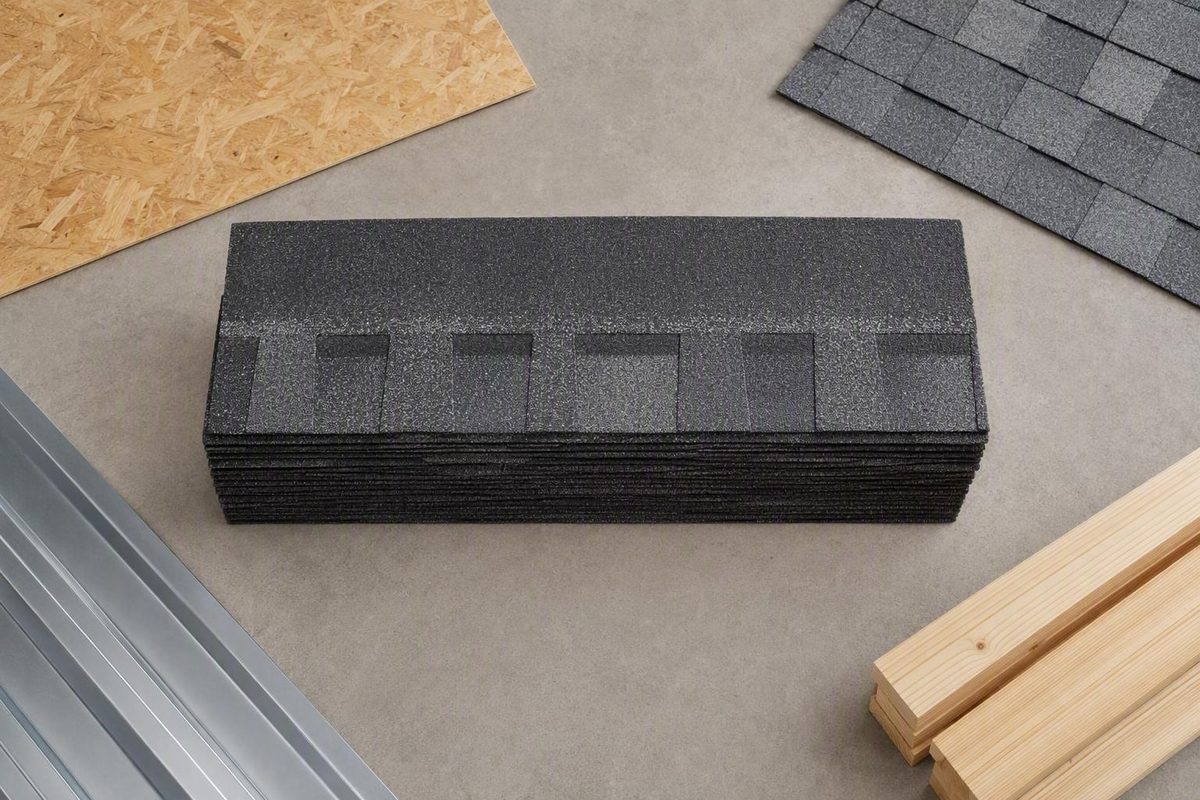
Quick answer: a typical bundle covers about 33.3 square feet
A typical bundle of standard asphalt shingles covers about 33 to 33.3 square feet. That applies when the selected product is packaged at three bundles per roofing square; it is a planning rule, not a universal bundle specification.
One roofing square is an area measurement equal to 100 square feet of actual roof surface. For a product requiring three bundles per square, the basic relationship is:
100 square feet ÷ 3 bundles = approximately 33.3 square feet per bundle
The IKO guide to shingle bundle coverage confirms the 100-square-foot definition, the common three-bundle arrangement, and the existence of products with different coverage.
Here is the quick conversion:
| Manufacturer-listed packaging | Implied coverage per bundle |
|---|---|
| 3 bundles per roofing square | About 33.3 sq. ft. |
| 4 bundles per roofing square | 25 sq. ft. |
| 5 bundles per roofing square | 20 sq. ft. |
These figures come from dividing one 100-square-foot roofing square by the required number of bundles. They do not mean that every bundle described as asphalt, architectural, premium, heavyweight, or luxury provides the same installed coverage.
Before ordering, check the selected product’s wrapper or manufacturer data sheet. Look for either:
- Square feet of coverage per bundle, or
- Bundles required per roofing square
Use that printed figure instead of automatically dividing the roof area by 33.3. If the wrapper says four bundles per square, treating each bundle as 33.3 square feet would understate the material requirement.
Bundles, roofing squares, and individual shingles are different measurements
Three terms often become mixed together during roofing estimates:
- A bundle is a packaged sales and handling unit.
- A roofing square is an area unit equal to 100 square feet of roof surface.
- A shingle count is the number of individual pieces in a bundle.
A bundle is not inherently a fixed unit of area. Many standard asphalt products are packaged so that three bundles cover one square, but manufacturers can place more or less installed coverage in each package. The useful question is therefore not simply “How many bundles?” but “How much installed area does each bundle of this exact product cover?”
Individual piece count varies too. Published examples place 3-tab bundles at approximately 26 to 29 shingles and architectural bundles at approximately 20 to 22 shingles, but those figures are illustrations rather than purchasing specifications. Shingle size, thickness, weight, and design can all change the number of pieces in a package, as shown in these bundle-count examples.
Piece count is a poor primary ordering metric because shingles overlap during installation. Only the specified exposure contributes to the finished surface; the remaining portion is covered by the next course. Multiplying each shingle’s nominal length by its width and then by the number of pieces will not reliably establish installed coverage.
Two bundles can therefore contain different numbers of shingles while providing similar installed coverage. Conversely, bundles with comparable piece counts can cover different areas if their dimensions, designs, or specified exposures differ.
Bundle weight has the same limitation. A heavier package may contain thicker or denser shingles, but its weight does not establish how many square feet it covers after the required overlaps are made.
For ordering field shingles, use these inputs in descending order of usefulness:
- Manufacturer-listed square feet per bundle
- Manufacturer-listed bundles per roofing square
- The 33.3-square-foot rule of thumb, but only before a product has been selected
Treat piece count, nominal dimensions, and package weight as product characteristics—not substitutes for an installed-coverage specification.
Why some bundles cover 25 or 20 square feet instead
The 33.3-square-foot figure is not universal. Heavier, luxury, and specialty products may place less installed coverage in each bundle. Category names alone, however, do not establish the required number of bundles.
The conversion remains straightforward:
- At four bundles per square: 100 ÷ 4 = 25 square feet per bundle
- At five bundles per square: 100 ÷ 5 = 20 square feet per bundle
That does not mean every premium product uses four bundles or every luxury product uses five. Category-level descriptions are too broad to serve as final ordering specifications. The wrapper or manufacturer data sheet for the exact product resolves the question.
A manufacturer-specific example shows the possible range:
| IKO product | Approximate coverage per bundle | Equivalent packaging basis |
|---|---|---|
| Royal Estate | 33.3 sq. ft. | About 3 bundles per square |
| Cambridge | 33.3 sq. ft. | About 3 bundles per square |
| Dynasty | 33.3 sq. ft. | About 3 bundles per square |
| Nordic | 33.3 sq. ft. | About 3 bundles per square |
| Marathon Plus AR | 32.3 sq. ft. | Product-specific requirement |
| Crowne Slate | 25 sq. ft. | 4 bundles per square |
| Armourshake | 20 sq. ft. | 5 bundles per square |
IKO identifies these as approximate values in its product-by-product coverage table. They demonstrate why “one bundle equals 33.3 square feet” cannot be applied indiscriminately. The figures are specific to the listed IKO products and should not be transferred to similarly named shingles or products from another manufacturer.
Packaging may express the same information in either direction. A wrapper might state “33.3 square feet per bundle,” or it might specify “three bundles per square.” Those descriptions represent approximately the same packaging basis. If the wrapper instead specifies four bundles per square, use 25 square feet per bundle when a square-foot conversion is needed.
The practical rule is simple: convert from the number supplied for the selected product. Do not infer coverage solely from labels such as 3-tab, dimensional, architectural, designer, premium, heavyweight, or luxury.
Measure roof surface area—not house floor area
The area required for a shingle estimate is the actual sloped roof surface, not the home’s interior floor area and not necessarily its horizontal building footprint.
Pitch makes a sloped roof plane larger than its flat projection. Garages, porches, additions, overhangs, and separate roof sections can create further differences between the home’s stated floor area and the surface that will receive shingles.
When dimensions have been measured directly along the sloped roof planes, use this workflow:
- Divide the roof into measurable planes.
- Measure the length and width of each rectangular plane.
- Multiply length by width to find the plane’s area.
- Calculate triangular or other irregular sections according to their geometry.
- Add the areas of all included planes.
A simple gable roof may consist mainly of two rectangular planes. More complicated roofs require a more detailed breakdown. Hips, valleys, dormers, intersecting gables, irregular edges, and penetrations can complicate both measurement and the use of cut pieces.
If only the horizontal footprint is available, adjust it for pitch. This generally involves multiplying the projected area by a slope factor appropriate to the roof pitch. There is no single multiplier for every roof: low-slope and steep-slope planes have different relationships between projected area and actual surface area. A roof containing several pitches may require separate calculations for each group of planes.
Do not apply pitch twice. If the dimensions already represent the actual sloped lengths and widths of the roof planes, adding another pitch multiplier will overstate the surface area.
Existing documents can provide useful starting points:
- Architectural drawings may show roof dimensions or areas.
- Previous roofing paperwork may include a roof-area estimate.
- Material schedules may identify the number of roofing squares previously used.
Those records must still match the current structure and scope. An addition, altered overhang, excluded porch, previous measurement error, or different treatment of waste can make an older quantity unsuitable for a new estimate.
The objective at this stage is not to decide how many bundles to buy. It is to establish a defensible roof-surface area before converting that area into product quantities.
Two formulas for converting roof area into bundles
Once the actual roof surface area and product coverage are known, use the formula that matches the information printed on the package.
Formula 1: Coverage per bundle
When the wrapper lists square feet per bundle:
Bundles needed = roof surface area ÷ manufacturer-listed square feet per bundle
Suppose a 1,200-square-foot roof will use a product whose wrapper states 25 square feet per bundle:
1,200 ÷ 25 = 48 base bundles
Formula 2: Bundles per roofing square
When the wrapper lists bundles per square:
Bundles needed = (roof surface area ÷ 100) × manufacturer-listed bundles per square
For the same 1,200-square-foot roof using a four-bundle-per-square product:
(1,200 ÷ 100) × 4 = 48 base bundles
Both formulas produce the same result because four bundles divide one 100-square-foot roofing square into four 25-square-foot bundle increments.
Waste-adjusted formula
To incorporate a selected planning allowance:
Bundles needed = roof surface area × (1 + waste rate) ÷ coverage per bundle
Express 10% as 0.10, making the multiplier 1.10. Express 15% as 0.15, making the multiplier 1.15.
Apply waste only once. Either:
- Increase the roof area and then divide by bundle coverage, or
- Calculate the base bundle quantity and multiply it by the waste factor
Do not increase both the roof area and the resulting bundle total. That would apply the allowance twice.
Always round the final result up to a whole bundle. If the calculation produces 49.1 bundles, the planning quantity is 50 because 49 whole bundles cannot satisfy the remaining calculated coverage. Manufacturer-provided coverage and whole-bundle rounding are also built into this roofing-material calculator.
There is a small arithmetic trap when using the rounded 33.3 figure. Dividing 1,000 by 33.3 produces:
1,000 ÷ 33.3 ≈ 30.03
Rounding that result up would suggest 31 bundles. But if the manufacturer expressly rates the product at three bundles per square, a 1,000-square-foot roof is exactly 10 squares:
1,000 ÷ 100 = 10 squares 10 × 3 = 30 base bundles
The discrepancy occurs because 33.3 is a rounded representation of one-third of 100. When the label provides a bundles-per-square rate, calculate from that rate rather than treating 33.3 as an exact number.
A short decision path keeps the estimate consistent:
- Determine the actual roof surface area.
- Read the selected product’s wrapper or data sheet.
- Choose the formula matching the listed coverage format.
- Add one appropriate planning allowance.
- Round the final result up to a whole bundle.
Worked bundle estimates for common roof areas
The examples below assume:
- The stated area is actual roof surface area, not floor area.
- The hypothetical product requires three bundles per 100-square-foot roofing square.
- Waste percentages are planning allowances applied once.
- Every fractional final quantity is rounded up to a whole bundle.
The three-bundles-per-square premise and its standard area conversions are summarized in this bundle-to-square reference.
| Roof surface area | Roofing squares | Base bundles | With 10% | With 15% | With 20% |
|---|---|---|---|---|---|
| 1,000 sq. ft. | 10 | 30 | 33 | 35 | 36 |
| 1,500 sq. ft. | 15 | 45 | 50 | 52 | 54 |
| 2,000 sq. ft. | 20 | 60 | 66 | 69 | 72 |
The 20% column is included as an upper planning example for some complicated roofs, not as a default allowance. Guidance that discusses waste of up to approximately 20% also emphasizes that the product and roof design affect the appropriate figure (River City Roofing).
1,000-square-foot example
Convert the area into roofing squares:
1,000 ÷ 100 = 10 squares
Multiply by three bundles per square:
10 × 3 = 30 base bundles
With a 10% allowance:
30 × 1.10 = 33 bundles
At 15%, the result is 34.5, which rounds up to 35. At 20%, the result is 36.
1,500-square-foot example
Convert the area:
1,500 ÷ 100 = 15 squares
Find the base quantity:
15 × 3 = 45 bundles
Apply the selected allowance:
- 10%: 45 × 1.10 = 49.5 → 50 bundles
- 15%: 45 × 1.15 = 51.75 → 52 bundles
- 20%: 45 × 1.20 = 54 bundles
2,000-square-foot example
Convert the area:
2,000 ÷ 100 = 20 squares
Find the base quantity:
20 × 3 = 60 bundles
Apply the allowance:
- 10%: 60 × 1.10 = 66 bundles
- 15%: 60 × 1.15 = 69 bundles
- 20%: 60 × 1.20 = 72 bundles
Comparison with a four-bundle-per-square product
A 1,000-square-foot roof contains 10 roofing squares. If the selected product requires four bundles per square:
10 × 4 = 40 base bundles
That is 10 more base bundles than the three-bundle-per-square example, even though both products cover the same total roof area. The difference lies in packaging and installed coverage per bundle.
This table is illustrative rather than a final order schedule. Exact quantities depend on the verified roof area, selected product, roof complexity, chosen planning allowance, and separately packaged accessory materials.
Add waste without treating one percentage as universal
A base coverage calculation assumes every unit of listed coverage translates neatly into the finished roof field. Actual projects involve end cuts, transitions, overlaps, layout adjustments, and pieces that cannot always be reused efficiently.
About 10% to 15% is a commonly suggested planning range for many roofs, but it is not a guaranteed requirement. The appropriate allowance depends on the roof and product, as noted in RoofSnap’s roof-shingle calculation guidance.
Some complicated roofs may justify an allowance approaching 20%. That upper figure is still a planning allowance, not a universal rule; guidance supporting a 10% to 20% range also says roof geometry and product specifications affect the result (Angi).
Factors that can increase waste include:
- Multiple hips and valleys
- Dormers and intersecting gables
- Irregular or short roof planes
- Numerous penetrations
- Repeated end cuts
- Layout constraints
- Damaged pieces or installation errors
A large, simple gable roof may use material more efficiently than a smaller roof divided into many short planes. Roof area alone therefore does not determine the proper waste factor.
Use this sequence:
- Establish the actual roof surface area.
- Select a waste rate suited to the roof’s complexity and the purpose of the estimate.
- Apply that rate once.
- Divide by the exact product coverage.
- Round up to a whole bundle.
For example, a verified 1,500-square-foot roof with a selected 15% planning allowance has a waste-adjusted area of:
1,500 × 1.15 = 1,725 square feet
If the product is explicitly packaged at three bundles per square, the equivalent calculation is:
15 squares × 3 bundles × 1.15 = 51.75 → 52 bundles
Do not assume the field-shingle estimate includes every asphalt-shingle product needed for the roof. Starter shingles and ridge-cap materials may be supplied separately or require their own calculations. Main-field coverage does not automatically provide the correct lineal quantity for eaves, rakes, hips, or ridges.
Avoid hiding accessory requirements inside an arbitrary waste percentage. A field-shingle waste allowance addresses expected consumption of the selected field product. Starter and ridge requirements depend on details such as edge and ridge lengths and the accessory product’s listed coverage.
Final pre-order checklist and limits of the estimate
Before using the result to compare prices or place an order, verify each item below:
- [ ] Confirm the roof’s actual sloped surface area.
- [ ] Identify every garage, porch, addition, overhang, and roof plane included in the scope.
- [ ] Confirm the exact shingle manufacturer and product line.
- [ ] Read the wrapper or data sheet for square feet per bundle or bundles per square.
- [ ] Discard the 33.3-square-foot assumption if the product lists a different figure.
- [ ] Select a waste allowance that reflects roof complexity.
- [ ] Apply the waste factor once.
- [ ] Calculate starter shingles separately where required.
- [ ] Calculate ridge-cap materials separately where required.
- [ ] Round the field-shingle quantity up to a whole bundle.
- [ ] Record the assumptions so competing estimates can be compared on the same basis.
Recording the manufacturer and product line matters because visually similar shingles can have different packaging and coverage. “Architectural shingle” is not a sufficiently precise purchasing specification when the exact product is known.
Do not substitute bundle weight, nominal shingle dimensions, or piece count for the printed installed-coverage figure. Those characteristics may help identify or compare products, but they do not account for specified exposure and overlap.
The resulting quantity remains a general material estimate. It is not a final purchase specification, an on-site roof measurement, an installation plan, a warranty interpretation, a code determination, or an individualized recommendation.
Mortar Desk publishes general building-material reference information. Its description of its role makes clear that it is not a contractor and does not provide engineering advice. The purpose here is to clarify units, assumptions, and arithmetic so that product specifications and quotations can be checked consistently.
The qualified answer is therefore: one typical standard asphalt-shingle bundle covers about 33.3 square feet, but the product label—not the rule of thumb—determines the usable figure. A dependable estimate starts with actual pitched roof area, uses the listed coverage or bundles-per-square rate, adds one appropriate waste allowance, rounds up to whole bundles, and checks starter and ridge materials separately.
Frequently asked questions
How many bundles of shingles cover 100 square feet?
For a standard asphalt-shingle product packaged at three bundles per roofing square, three bundles cover 100 square feet. One roofing square equals 100 square feet, so each bundle represents approximately 33.3 square feet (bundle-to-square conversion reference).
If the selected product requires four or five bundles per square, it will take four or five bundles, respectively, to cover the same 100-square-foot area. Check the wrapper rather than assuming that three bundles are always sufficient.
Does every bundle of shingles cover 33.3 square feet?
No. Approximately 33.3 square feet is typical only when three bundles make one roofing square. A four-bundle-per-square product represents 25 square feet per bundle, while a five-bundle-per-square product represents 20 square feet per bundle (Quality Exteriors).
Coverage may instead be printed directly as square feet per bundle. Always use the specification for the selected manufacturer and product line.
How many bundles are needed for a 2,000-square-foot roof?
If 2,000 square feet is the actual roof surface area and the selected product requires three bundles per square:
2,000 ÷ 100 = 20 squares 20 × 3 = 60 base bundles
The quantity becomes 66 bundles with 10% waste, 69 with 15%, or 72 with 20%. A product requiring four bundles per square would instead need 80 base bundles before waste. These quantities follow the bundles-per-square calculation method; the appropriate allowance still depends on the roof (calculation example).
Should I calculate shingles from the house footprint or the pitched roof area?
Use the actual pitched roof surface area. The building footprint is a horizontal projection, while roof slope increases the surface being covered. Garages, porches, additions, overhangs, and multiple roof planes can create further differences between the home’s stated area and the shingled area.
If only footprint dimensions are available, apply an appropriate pitch multiplier to each relevant roof section. Do not apply a pitch multiplier when the measurements already represent the sloped roof planes. This distinction between footprint and slope-adjusted roof area is demonstrated by the Omni roof-shingle calculator.
Are starter shingles and ridge caps included in the field-shingle bundle estimate?
Not automatically. A field-shingle calculation estimates material for the main roof planes. Starter shingles and ridge caps may be separate products with their own coverage specifications and quantity calculations.
Check the selected roofing system and calculate those accessories separately where required rather than assuming ordinary field-shingle coverage includes them.