 MortarDesk
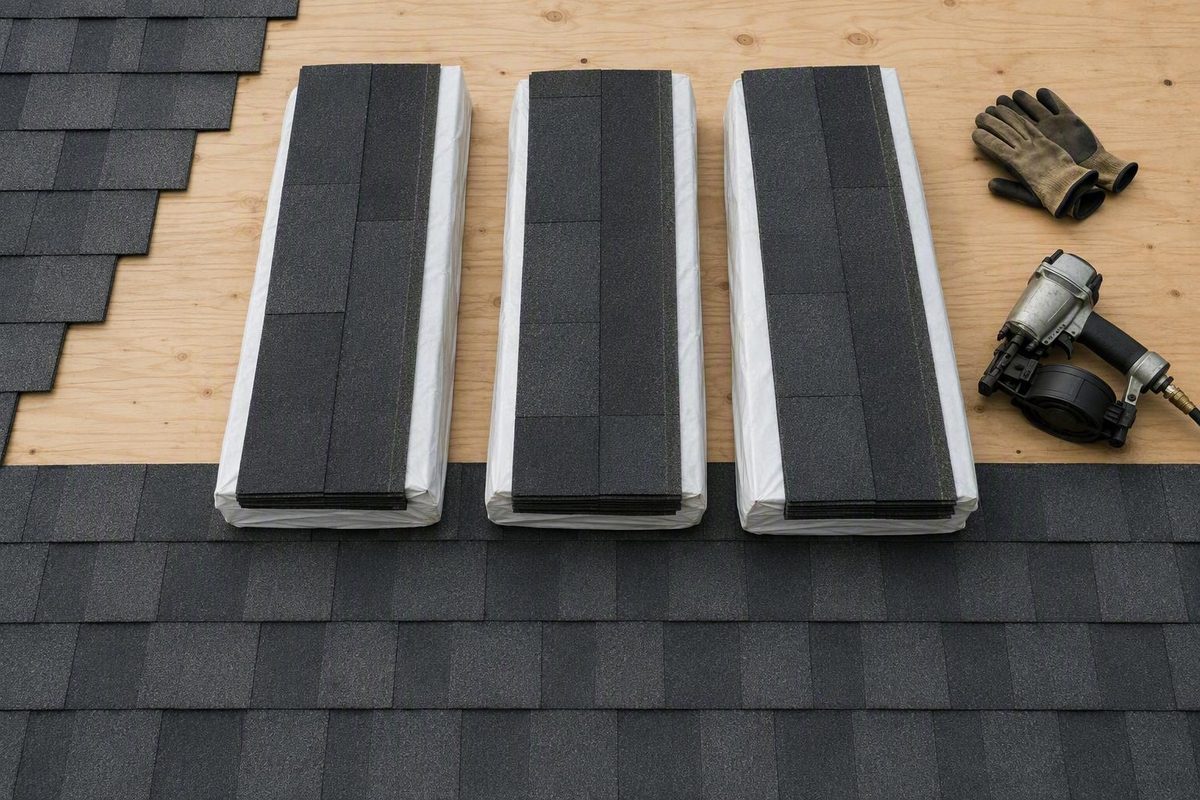
Quick answer: Usually three bundles make one roofing square
Most standard asphalt shingles require three bundles to cover one roofing square. One roofing square equals 100 square feet of actual roof surface, so each bundle in a typical three-bundle product covers approximately 33 to 33.3 square feet. This is the usual answer to “how many shingle bundles are in a square,” but it is a starting point rather than a universal product specification. IKO confirms the common three-bundle ratio and documents product-specific exceptions.
Quick answer
- 1 roofing square = 100 square feet
- Typical standard asphalt product = 3 bundles per square
- Typical standard bundle = about 33.3 square feet
- Final authority = coverage printed on the wrapper or current manufacturer data sheet
Heavier, luxury, and specialty shingles can require four or five bundles to cover the same 100-square-foot area. A bundle may contain thicker, differently sized, or differently packaged shingles, so its installed coverage can be lower even though it is still called one bundle.
That distinction matters when ordering. If a 20-square roof is estimated at three bundles per square but the selected product actually requires four, the base estimate will be short by 20 bundles before waste:
20 squares × 3 bundles = 60 bundles
20 squares × 4 bundles = 80 bundles
Shortfall = 20 bundles
Terms such as “architectural,” “designer,” “premium,” and “luxury” do not establish exact coverage. Products within the same broad category may be packaged differently.
Use the three-bundle rule for a preliminary estimate only. Once the product has been selected, replace the assumption with one of these figures from its wrapper or current technical documentation:
- Square feet of coverage per bundle
- Bundles required per roofing square
- Any product-specific instruction that modifies the basic bundle count
If the wrapper states that one bundle covers 25 square feet, four bundles are required to cover 100 square feet. If it states approximately 20 square feet, the base requirement is about five bundles per square. Product-specific coverage takes precedence over a generic rule or calculator default.
Roofing squares, bundles, and coverage are different measurements
A roofing square is a unit of area. It is not necessarily a square-shaped section of roof, and it is not a package of shingles. A roof measuring 18 roofing squares has 1,800 square feet of roof surface:
18 squares × 100 square feet = 1,800 square feet
A bundle is a manufacturer’s package. Manufacturers divide shingles into packages that are easier to transport, stock, and handle than all the material required for a complete roofing square. A bundle is therefore a packaging unit, while a roofing square is always an area unit.
A coverage figure connects the two. It states how much roof area one properly installed bundle is intended to cover. For a typical three-bundle product:
- Roofing square: 100 square feet
- Bundle coverage: approximately 33.3 square feet
- Bundles per square: approximately three
These figures are not interchangeable with the number of individual shingles in a package. Dimensions, exposure, thickness, design, and packaging vary by product. One bundle can contain more pieces than another while providing the same installed coverage—or contain a similar number of pieces while covering a different area.
For estimating purposes, square-foot coverage per bundle is more dependable than individual shingle count. IKO advises buyers to use the coverage printed on the wrapper because the number of shingles in a bundle varies by product.
Bundle weight is not a coverage measurement either. Weight can reflect thickness, construction, granule content, shingle dimensions, or packaging. Without the product’s coverage specification, weight does not reliably establish how many bundles make a square.
The practical difference is clear:
| Label coverage | Calculation for one square | Base requirement |
|---|---|---|
| 33.3 sq. ft. per bundle | 100 ÷ 33.3 | About 3 bundles |
| 25 sq. ft. per bundle | 100 ÷ 25 | 4 bundles |
For a 1,500-square-foot roof, those two products produce substantially different base quantities:
1,500 ÷ 33.3 ≈ 45.05 bundles
1,500 ÷ 25 = 60 bundles
Coverage means installed coverage, not the total physical area of loose shingles placed edge to edge. Shingles overlap according to their installation design. Multiplying the full length and width of one shingle by the number of pieces in a bundle can therefore overstate useful roof coverage.
Two formulas for calculating the number of bundles
There are two useful formulas. The first applies to a standard product confirmed to use three bundles per square. The second uses the selected product’s stated bundle coverage and is preferable whenever that information is available.
Formula 1: Standard three-bundle product
Base bundles = roof area in square feet ÷ 100 × 3
For a 1,000-square-foot roof:
1,000 ÷ 100 = 10 roofing squares
10 × 3 = 30 base bundles
The same standard relationship can be expressed as roofing squares multiplied by three. The standard bundle-to-square conversion is documented here.
Formula 2: Product-specific bundle coverage
Base bundles = actual roof area in square feet ÷ stated coverage per bundle
If a product covers 25 square feet per bundle and the roof has 1,500 square feet of actual surface area:
1,500 ÷ 25 = 60 base bundles
This method is more reliable because it uses the selected product’s specification directly. It also works when coverage does not divide evenly into 100 square feet or when the product does not use a whole-number bundle ratio.
A calculator should therefore allow bundle coverage to be changed rather than treating 33.3 square feet as a fixed value. Omni Calculator describes both the standard three-bundle method and the configurable coverage method.
Before-waste bundle chart
The chart below shows base field-shingle quantities before waste. The three-bundle column applies only to products packaged at three bundles per square. The four-bundle column shows why the selected product specification matters.
| Actual roof area | Roofing squares | Base bundles at 3 per square | Base bundles at 4 per square |
|---|---|---|---|
| 500 sq. ft. | 5 | 15 | 20 |
| 1,000 sq. ft. | 10 | 30 | 40 |
| 1,200 sq. ft. | 12 | 36 | 48 |
| 1,500 sq. ft. | 15 | 45 | 60 |
| 2,000 sq. ft. | 20 | 60 | 80 |
| 2,500 sq. ft. | 25 | 75 | 100 |
These are base quantities, not final purchase recommendations. The measured roof area must be accurate, the selected product must use the stated ratio, and installation waste must be added separately.
Reverse conversion: Bundles back to squares
For a product confirmed to use three bundles per square:
Approximate roofing squares = number of bundles ÷ 3
Then:
Approximate covered square feet = number of bundles ÷ 3 × 100
For example:
30 bundles ÷ 3 = 10 roofing squares
10 squares × 100 = 1,000 square feet
This reverse calculation is useful when checking existing stock or comparing a proposed order with the measured roof area. It represents nominal coverage before waste. For a four- or five-bundle product, change the divisor to the product’s stated bundles-per-square figure.
When to round
Shingles are purchased in whole bundles, so a fractional final order must be rounded up. However, do not automatically round the base requirement before adding waste. Preserve the unrounded base figure, apply the selected allowance, and then round the resulting order quantity up once.
For example, if product-specific coverage produces 37.15 base bundles and the selected allowance is 10%:
37.15 × 1.10 = 40.865
Final estimate = 41 whole bundles
Rounding the base quantity first changes the result:
37.15 rounded up = 38
38 × 1.10 = 41.8
Final estimate = 42 whole bundles
The second calculation adds a package solely because rounding occurred too early. Unless the product documentation requires another method, retain decimal precision through the waste calculation and round up only at the end.
Use roof surface area, not the home’s floor area
Bundle calculations must use the area of the sloped roof surface. A home’s interior floor area or horizontal footprint is not automatically its roof area. Pitch, overhangs, additions, attached porch roofs, dormers, and other architectural features can make the shingled surface different from the floor area below.
Pitch increases surface area relative to a horizontal footprint. As the slope becomes steeper, the distance measured along the roof plane becomes longer even when the horizontal span remains unchanged.
There are two valid ways to establish the area used in the bundle formula.
Path 1: Measure the sloped roof planes
Measure the length and sloped width of each roof plane, calculate the area of each plane, and add the results. For a rectangular plane:
Plane area = length × sloped width
Measure triangular and irregular sections separately with the appropriate geometric method. Dormers, porch roofs, additions, and intersecting sections should not be silently absorbed into one building-footprint rectangle.
This method already accounts for pitch because the dimensions represent the sloped surfaces. Do not apply a pitch multiplier afterward. Doing so would adjust for the same slope twice and overstate the roof area.
Path 2: Begin with the horizontal footprint
If only horizontal plan measurements are available, calculate the relevant footprint and adjust it for roof pitch. Pitch-based estimating tools use a slope multiplier to convert horizontal footprint area into estimated roof-surface area. RoofSnap distinguishes footprint area from pitch-adjusted roof area in its calculation method.
This approach can support a preliminary estimate, but it depends on accurate pitch and footprint inputs. If different roof sections have different slopes, applying one multiplier to the entire building can produce a misleading result. Calculate those sections separately.
Break complex roofs into separate sections
A simple gable roof may be represented by two rectangles. A more complicated roof should be divided into manageable planes or sections, including:
- Main roof planes
- Dormer roofs
- Porch and addition roofs
- Intersecting wings
- Triangular or clipped sections
- Other separately measured areas
Hips, valleys, penetrations, and irregular boundaries also affect how efficiently shingles can be laid. They can influence both measurement accuracy and the amount of material lost to cutting.
A worksheet keeps the calculation auditable:
| Roof section | Shape | Measured or pitch-adjusted area |
|---|---|---|
| Main front plane | Rectangle | ___ sq. ft. |
| Main rear plane | Rectangle | ___ sq. ft. |
| Dormer planes | Rectangles/triangles | ___ sq. ft. |
| Porch roof | Rectangle | ___ sq. ft. |
| Other sections | As measured | ___ sq. ft. |
| Total actual roof area | ___ sq. ft. |
Use the total actual roof area in the bundle formula. Do not substitute advertised living area unless it has independently been shown to equal the roof surface area.
Measurement and access safety
Do not climb onto or attempt to measure a roof when access is unsafe. Height, steep pitch, damaged surfaces, weather, and complicated geometry can make direct measurement hazardous. Professional measurement may be appropriate for a steep, high, damaged, or complex roof. This Old House’s estimating guide includes roof-access safety precautions.
This article provides general estimating information. It is not an individualized roof survey, structural assessment, installation plan, or engineering recommendation.
When three bundles per square is the wrong number
Many standard three-tab and architectural asphalt products use three bundles per roofing square. However, category names such as architectural, premium, designer, and luxury do not establish exact coverage. Coverage is determined at the product-line level.
The dependable decision rule is:
Identify the exact product, then use the coverage stated on its current wrapper or manufacturer data sheet.
Manufacturer-specific examples demonstrate the possible variation. IKO lists these approximate figures for products in its own asphalt-shingle range:
| IKO product | Approximate coverage per bundle | Approximate requirement for 100 sq. ft. |
|---|---|---|
| Royal Estate | 33.3 sq. ft. | About 3 bundles |
| Cambridge | 33.3 sq. ft. | About 3 bundles |
| Dynasty | 33.3 sq. ft. | About 3 bundles |
| Nordic | 33.3 sq. ft. | About 3 bundles |
| Crowne Slate | 25 sq. ft. | About 4 bundles |
| Armourshake | 20 sq. ft. | About 5 bundles |
IKO also lists Marathon Plus AR at approximately 32.3 square feet per bundle and describes one square as three bundles plus two shingles. These are approximate, product-specific figures for the cited IKO range; they are not universal specifications for similarly named products from other manufacturers. IKO’s product coverage table provides the underlying figures.
Marathon Plus AR illustrates why a generic three-package shortcut can miss an important product detail:
3 bundles × 32.3 square feet = approximately 96.9 square feet
The manufacturer’s statement about the additional shingles therefore matters when assembling a complete square.
Visual appearance does not resolve the question. Two products described as dimensional or premium may have different installed coverage. Likewise, neither bundle weight nor the number of loose shingles provides a dependable substitute for the stated coverage.
When reviewing a wrapper or technical sheet, look for wording such as:
- “Coverage per bundle”
- “Bundles per square”
- “Square feet per package”
- “Minimum bundles required per square”
- A product-specific note about additional shingles
If the documentation supplies both square-foot coverage and bundles per square, compare the two as a cross-check. Small differences can result from rounded approximate coverage. If the figures appear materially inconsistent, confirm the current specification with the manufacturer or supplier before ordering.
Do not transfer one manufacturer’s product figures to another brand merely because the shingles look similar. The examples demonstrate variation; they do not establish coverage for products outside the cited range.
Add waste separately, then round up
The nominal bundle count is not the final purchase quantity. Three bundles per square describes base field coverage for a standard product. It does not automatically include material lost to cuts, damaged pieces, unusable offcuts, or complicated roof geometry.
General estimating guidance commonly suggests adding about 10% to 15%, while recognizing that the appropriate allowance depends on the roof and product. Owl Roofing presents that general range and identifies hips, valleys, dormers, penetrations, and cuts as waste factors.
Treat the range as guidance, not a guarantee. A simple roof with long, regular planes may produce less waste than one with:
- Multiple hips and valleys
- Dormers
- Numerous penetrations
- Short or interrupted courses
- Irregular edges
- Intersecting sections
- Extensive fitting and trimming
A complex roof may require more than the usual range, but there is no universally correct percentage for every design and product. Where geometry is difficult, a detailed takeoff is more dependable than automatically choosing a broad percentage.
Correct calculation sequence
Use this order:
- Calculate the actual sloped roof area.
- Calculate the unrounded base bundle requirement.
- Multiply the base requirement by the selected waste factor.
- Round the result up to the next whole bundle.
For 10% waste:
Order estimate = base bundles × 1.10
For 15% waste:
Order estimate = base bundles × 1.15
Worked example: 1,500-square-foot roof with 15% waste
Assume the roof has 1,500 square feet of actual sloped surface and the selected product uses three bundles per square.
1. Calculate the base quantity:
1,500 ÷ 100 × 3 = 45 base bundles
2. Add 15%:
45 × 1.15 = 51.75 bundles
3. Round up once:
Final order estimate = 52 whole bundles
The nominal field coverage is 45 bundles. The waste-adjusted estimate is 52. Keeping those figures separate makes the order easier to check.
Second example: 1,000 square feet with 10% waste
For a confirmed three-bundle product:
1,000 ÷ 100 × 3 = 30 base bundles
30 × 1.10 = 33 bundles
Because the waste-adjusted result is already a whole number, the estimate remains 33 bundles.
Why rounding order matters
Suppose product-specific coverage produces 45.2 base bundles. Applying 10% before rounding gives:
45.2 × 1.10 = 49.72
Final estimate = 50 bundles
Rounding the base quantity first changes the answer:
45.2 rounded up = 46
46 × 1.10 = 50.6
Final estimate = 51 bundles
The premature rounding adds another package. Keep the base quantity unrounded until after the allowance has been applied.
Repair stock is a separate choice
Material intentionally retained for future repairs is separate from nominal field coverage and anticipated installation waste. If repair stock is desired, show it as its own line:
Base field bundles
+ installation waste allowance
+ separately chosen repair stock
= total purchase quantity
This format distinguishes material expected to be consumed during installation from material intentionally retained afterward.
Final ordering checklist: field shingles and separate accessories
Before placing an order, work through the estimate from measurement to product verification. A visible calculation is easier to audit than one unexplained bundle total.
-
Confirm the actual sloped roof area. Add measured roof-plane areas or correctly adjust a horizontal footprint for pitch. Do not apply a pitch adjustment twice.
-
Identify the exact shingle product. Record the manufacturer and product line. A broad category such as “architectural shingle” is not enough to establish coverage.
-
Read the coverage specification. Find square feet per bundle, bundles per square, or another manufacturer-provided coverage statement.
-
Calculate the unrounded base field quantity. Use the formula that matches the available product information:
text
   Roof area ÷ 100 × stated bundles per square
or:
text
   Roof area ÷ stated coverage per bundle
-
Add the selected waste allowance. Choose an allowance that reflects the roof geometry and cutting requirements rather than treating one percentage as universal.
-
Round up once at the end. Retain decimal precision through the base and waste calculations, then convert the final result to whole bundles.
-
List accessories separately. Confirm whether starter strips and ridge-cap shingles are separate products. Check each accessory’s own coverage information and the relevant project dimensions rather than assuming it is included in the field-shingle total. Roofing estimating guidance specifically cautions that starters and ridge caps may be additional.
-
Cross-check the arithmetic. When the manufacturer supplies both coverage formats, compare:
text
   Roofing squares × stated bundles per square
with:
text
   Total roof area ÷ stated coverage per bundle
Rounded coverage figures may produce small differences. A large discrepancy is a reason to recheck the inputs.
-
Change generic calculator defaults. A calculator set to 33.3 square feet per bundle will understate the order for a product covering 25 or 20 square feet. Replace the default with the selected product’s coverage.
-
Preserve the specification used. Photograph the wrapper or save the current technical data sheet. Record the roof-area source, product coverage, selected waste allowance, arithmetic, and calculation date so the estimate can be checked before purchase.
Keep separate material lines for field shingles, starter products, ridge-cap shingles, and other dedicated accessories. Their requirements depend on the selected products and project dimensions, so there is no single universal accessory quantity.
Frequently asked questions
How many bundles of shingles do I need for a 2,000-square-foot roof?
If 2,000 square feet is the actual sloped roof area and the selected shingles use three bundles per square:
2,000 ÷ 100 = 20 roofing squares
20 × 3 = 60 base bundles
The base requirement is 60 bundles before waste. Adding 10% produces 66 bundles, while adding 15% produces 69 bundles. Cox Roofing documents the underlying 20-square and 60-bundle conversion.
Do not use 60 automatically if 2,000 square feet is only the home’s floor area or the selected product has different coverage.
Do architectural shingles always require three bundles per square?
No. Many standard architectural asphalt shingles use three bundles per square, but “architectural” is a broad category rather than a coverage specification. Other products may use four or five bundles or have coverage that does not translate neatly into a whole-number ratio.
Check the exact wrapper or current manufacturer data sheet. Do not infer coverage from appearance, weight, shingle count, or the architectural label alone.
How many roofing squares will 30 standard bundles cover?
For a product confirmed to use three bundles per square:
30 bundles ÷ 3 = 10 roofing squares
10 squares × 100 = 1,000 square feet
Thirty bundles therefore provide approximately 1,000 square feet of nominal coverage before waste. The answer changes if the selected product does not use three bundles per square.
What do I do if the package lists coverage other than 33.3 square feet per bundle?
Use the package figure:
Base bundles = actual roof area ÷ package coverage per bundle
For example, a 1,200-square-foot roof using a product labeled for 32.3 square feet per bundle has an unrounded base requirement of:
1,200 ÷ 32.3 ≈ 37.15 bundles
Apply the selected waste allowance to 37.15 and then round the final result up. Do not force the product into a three-bundle calculation when its stated coverage differs.
Are starter strips and ridge caps included in the field-shingle bundle estimate?
Not necessarily. The field-shingle calculation estimates bundles used across the main roof planes. Starter strips and ridge-cap shingles may be separate products with their own coverage information and quantity requirements.
Confirm the selected roofing system’s requirements and list each accessory separately. Do not assume that the field-shingle total includes starters, ridge caps, or other dedicated materials.
The practical rule is simple: begin a preliminary standard-asphalt estimate with three bundles per 100-square-foot roofing square, then replace that assumption with the selected product’s stated coverage. Use actual sloped roof area, retain the unrounded base quantity, add an appropriate waste allowance, round up once, and verify accessories separately.
Mortar Desk publishes general building-material reference information, not individualized measurements, contracting services, material supply, or engineering advice. Product specifications can change, and project-specific measurements may require independent confirmation.