 MortarDesk
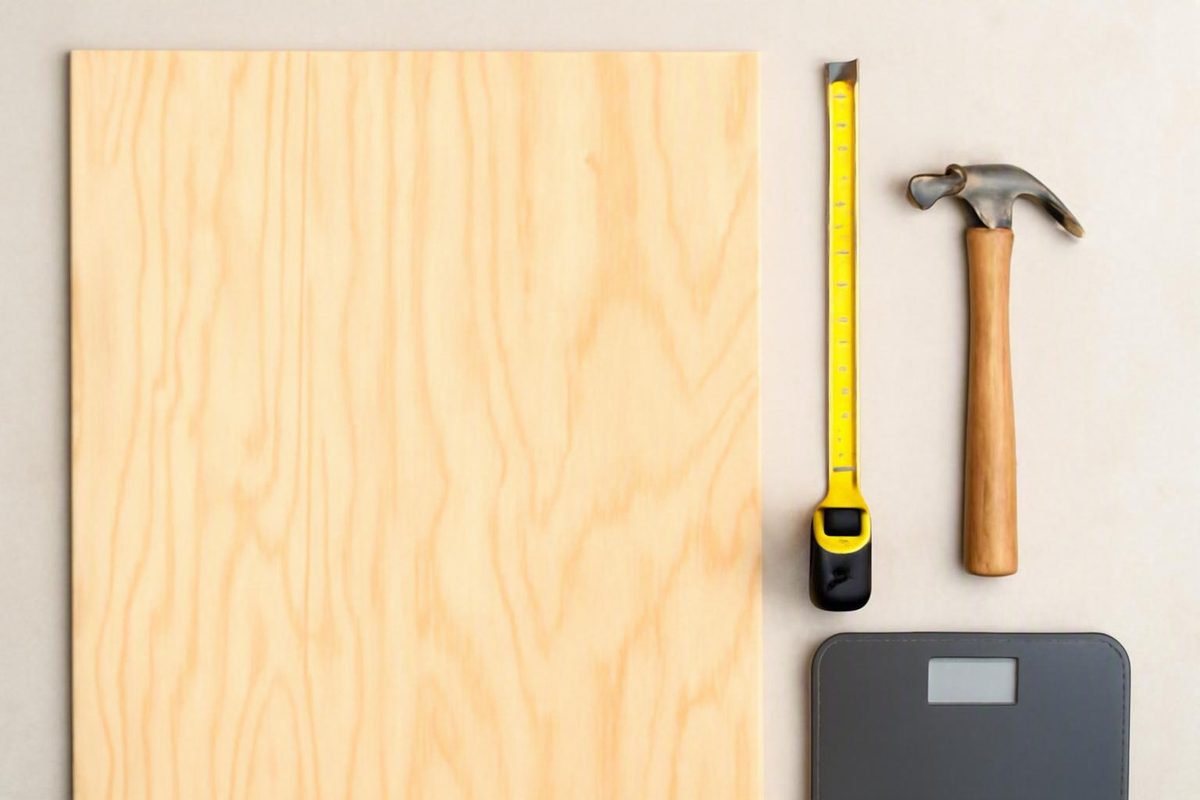
A practical weight guide for full and cut plywood panels
Quick answer: the typical weight of a 4×8 sheet
A full 4-by-8-foot sheet of nominal 3/4-inch plywood has a face area of 32 square feet and typically weighs about 60–70 lb (27–32 kg). This is an approximate planning range, not a specification for every panel. Species, core construction, adhesive, treatment, moisture, and actual thickness can all change the result (see CHANTA Group’s 4×8 plywood weight guide).
For common veneer-core constructions, a broader working range is approximately 60–80 lb. Many softwood panels fall toward the lower end, while hardwood, Baltic birch, and marine constructions tend to fall higher.
The practical answer is:
- Typical 4×8 nominal 3/4-inch plywood: approximately 60–70 lb
- Broader veneer-core planning range: approximately 60–80 lb
- Dense-core example: approximately 85–90 lb for some MDF-core panels
- Other outliers: possible because construction and current condition vary
Some individual 3/4-inch panels can weigh more than 80 lb. MDF-core panels are one documented example; treatment, additional resin, or absorbed moisture can also add weight, but none of those factors justifies adding a universal number of pounds to every sheet (compare Inch Calculator’s plywood weight estimates).
The word “sheet” is incomplete unless its dimensions are known. A 2×4 panel, 4×4 half-sheet, 5×5 Baltic birch panel, and 4×8 full sheet contain different amounts of material. If thickness and construction remain unchanged, a panel with half the face area will weigh approximately half as much.
Use these ranges for early purchasing, handling, and cut-list estimates. When an exact weight affects transport, equipment selection, ordering, or another product-specific calculation, check the documentation for the exact panel or weigh the individual sheet.
3/4-inch plywood weight by panel type
Plywood categories overlap substantially in weight. A softwood panel can be heavier than expected because of moisture, treatment, resin content, or dense veneers. A hardwood-faced panel may contain relatively light inner plies. The following figures are therefore aggregated planning estimates, not measured specifications or a strict lightest-to-heaviest ranking.
| Panel construction | Estimated 4×8 weight | Approximate kilograms | Interpretation |
|---|---|---|---|
| Softwood pine or fir plywood | 60–65 lb | 27–29 kg | A useful baseline for common veneer-core construction and sheathing |
| Hardwood plywood | 65–75 lb | 29–34 kg | Often somewhat heavier, although its core may still contain softwood |
| Baltic birch plywood | About 70–72 lb | 32–33 kg | A narrow comparison centered on a published 71.5 lb estimate, not a universal range |
| Marine plywood | 70–80 lb | 32–36 kg | Commonly toward the upper end of conventional veneer-core estimates |
| MDF-core panel | 85–90 lb | 39–41 kg | A dense composite-core product that should be kept separate from conventional veneer-core plywood |
The softwood, hardwood, marine, and MDF-core ranges are consistent with one supplier guide listing approximately 60–65 lb, 65–75 lb, 70–80 lb, and 85–90 lb, respectively, for nominal 3/4-inch 4×8 panels. The publisher presents these as generalized averages rather than exact SKU weights (review the supplier’s construction-specific estimates).
Softwood plywood provides the most useful starting point for the familiar “about 60 pounds” answer. Pine- or fir-based panels are commonly estimated at approximately 60–65 lb for a 4×8 sheet. However, softwood plywood is a broad category. Veneer species, treatment, moisture, core quality, adhesive, and finished thickness can move an individual panel outside that interval.
Hardwood plywood can reasonably be estimated at approximately 65–75 lb, but published guidance is not uniform. Another commercial guide gives a broader 70–80 lb estimate for 3/4-inch hardwood plywood, illustrating why a range is more defensible than one supposedly exact average (compare Demeter’s softwood and hardwood estimates).
A hardwood face does not prove that the complete panel is made from hardwood. Many decorative panels use thin oak, maple, or birch face veneers over inner plies made from different species. Total weight reflects the faces, crossbands, core, adhesive, finish, and moisture—not simply the species named on the shelf label.
Baltic birch plywood is often placed around 70–72 lb for a nominal 3/4-inch 4×8 comparison because a published chart lists 71.5 lb. That is a point estimate from a generalized reference chart, not a tested range for every Baltic birch product (see the originating type-by-type plywood chart).
Before applying a 4×8 estimate, confirm the actual length, width, thickness, and construction of the product being purchased.
Marine plywood commonly falls around 70–80 lb in generalized estimates. The marine label does not establish one fixed density. Veneer species, ply arrangement, adhesive system, product standard, moisture, and actual panel dimensions still matter.
MDF-core panels deserve a separate category. They may have wood veneers on their faces, but the dense fiberboard core differs substantially from conventional all-veneer construction. An approximate 85–90 lb range for a 4×8 nominal 3/4-inch MDF-core panel is useful for planning, but it should not be substituted for the 60–80 lb veneer-core range.
The main lesson is not that every hardwood sheet outweighs every softwood sheet. It is that complete panel construction matters more than a broad face label.
Why nominal 3/4 inch may measure 23/32 inch
Nominal thickness is the designation used to identify a product category. Actual thickness is the finished dimension measured on the material itself.
Nominal 3/4-inch plywood commonly measures approximately 23/32 inch, or 0.71875 inch, rather than a true 0.75 inch. A 23/32-inch panel is therefore exactly 1/32 inch thinner than true 3/4 inch. Sanding, compression, finishing, panel category, and manufacturing processes can all affect the finished dimension (see the actual-versus-nominal plywood thickness chart).
That does not mean every panel sold as 3/4 inch measures exactly 23/32 inch. Manufacturers and panel constructions can use different target dimensions and tolerances. Factory-applied overlays or coatings may also affect the final measured thickness.
If a panel must fit a groove, dado, edge profile, existing assembly, or another close-fitting detail, measure the actual sheet rather than designing solely from the nominal label.
The distinction also affects theoretical weight calculations. A true 0.75-inch panel contains slightly more volume than an otherwise identical 23/32-inch panel. The difference is modest for rough planning but can matter when a calculation is expected to agree closely with a product specification.
An 18 mm panel is close to 23/32 inch but not identical:
- 18 mm is approximately 0.709 inch.
- 23/32 inch is approximately 0.719 inch.
- True 3/4 inch is 0.750 inch.
An 18 mm panel should therefore not automatically be assigned the dimensions or weight of every product sold under a nominal 3/4-inch designation.
Mortar Desk’s guide to nominal versus actual material sizes explains the broader principle: the product name identifies what the material is called, while measurement establishes its physical size.
Use three practical rules:
- When fit matters, measure the panel.
- When product weight matters, check the exact specification.
- When estimating, state whether the calculation assumes true 3/4 inch, 23/32 inch, or 18 mm.
What makes two same-size sheets weigh different amounts?
Two panels can both be labeled 4×8 and nominal 3/4 inch yet have noticeably different weights. Plywood is an assembled wood product, not a single material with one universal density. Its weight reflects all the wood, adhesive, resin, treatment, moisture, coatings, and manufacturing choices within the sheet.
Wood species and veneer density are major variables. Denser veneers generally add more weight than less-dense veneers of the same dimensions. The complete core still matters more than the face veneer alone. A panel sold with an oak, maple, or birch face may use different species in its crossbands and inner plies.
Core construction can create an even larger difference. Conventional veneer-core plywood consists primarily of layered wood veneers. Composite-core products may substitute MDF or another dense engineered material for part or all of the core. Specialty lightweight products may instead use lower-density cores or adhesive systems. Panels with similar exterior dimensions can consequently contain very different amounts and densities of material.
Ply count and arrangement also matter. Changing the number of plies changes the balance among wood layers, glue lines, and veneer thicknesses. Core gaps, overlaps, patches, and repairs introduce additional variation.
Adhesives and resins contribute mass.
Treatments can increase weight. Pressure-treated plywood contains preservatives, and exterior or specialty panels may use different adhesive systems or protective treatments. The effect depends on the product, process, retention, and current condition, so there is no supported fixed number of pounds to add to every treated sheet.
Moisture is another important variable. Wood and wood-based panels can absorb moisture during storage or exposure, increasing their current weight. No universal percentage should be applied because moisture conditions and panel constructions differ. A sheet stored in damp conditions may not match a dry catalog estimate even if its label and dimensions remain unchanged.
Actual thickness and manufacturing variation complete the picture. One nominal 3/4-inch panel may be slightly thicker than another or may contain denser veneers and more adhesive. General industry guidance likewise identifies species, moisture, adhesive type, and ply density as contributors to panel weight (see ProWood’s summary of plywood weight factors).
Plywood grade alone is not enough to predict a precise weight. Treat grade as one part of product identification, not as a substitute for a weight specification.
How to estimate the weight of a cut plywood panel
If a cut piece comes from the same full sheet—or has the same thickness and construction—you can estimate its weight by scaling according to face area.
For a 4×8 reference sheet:
Estimated cut-panel weight = Full-sheet weight × Cut-panel area ÷ 32 ft²
The denominator is 32 square feet because:
4 ft × 8 ft = 32 ft²
This method assumes reasonably uniform construction throughout the panel. It works well for cut-list planning, although patches, edge treatments, attached hardware, localized moisture, or substantial voids can prevent an exact proportional result.
One published building-materials guide lists nominal 3/4-inch plywood at a typical 1.9 lb per square foot, corresponding to 60.8 lb over 32 square feet. The guide does not identify a species, grade, or measurement method, so this should be treated as a baseline rather than a universal rate (see the guide’s plywood weight table).
Do not automatically apply 1.9 lb per square foot to hardwood, Baltic birch, marine, treated, MDF-core, damp, or other relatively heavy panels. When a product-specific full-sheet weight is available, scale from that figure instead.
4×4 half-sheet example
A 4×4 panel has an area of:
4 ft × 4 ft = 16 ft²
That is half the area of a 4×8 sheet:
16 ÷ 32 = 0.5
Using a full-sheet estimate of 60–70 lb:
60 × 0.5 = 30 lb
70 × 0.5 = 35 lb
The estimated weight is therefore 30–35 lb, assuming the 4×4 piece has the same thickness, core, and condition as the referenced full sheet.
2×4 quarter-sheet example
A 2×4 panel has an area of:
2 ft × 4 ft = 8 ft²
That is one-quarter of the full sheet:
8 ÷ 32 = 0.25
Applying the same 60–70 lb baseline:
60 × 0.25 = 15 lb
70 × 0.25 = 17.5 lb
Rounded for practical planning, the estimated weight is 15–18 lb.
Nonstandard 30×60-inch example
Convert the dimensions to feet:
- 30 inches = 2.5 feet
- 60 inches = 5 feet
Calculate the area:
2.5 ft × 5 ft = 12.5 ft²
Find its share of a full 4×8 sheet:
12.5 ÷ 32 = 0.390625
Apply the 60–70 lb full-sheet baseline:
60 × 0.390625 ≈ 23.4 lb
70 × 0.390625 ≈ 27.3 lb
The 30×60-inch panel would therefore weigh approximately 23–27 lb.
The same method works better with a verified product weight. If documentation for the exact panel lists a full-sheet weight, substitute that figure for the generic range. This preserves the combined effect of the product’s veneers, core, adhesive, treatment, and finish.
Do not use area scaling when the reference panel has a different thickness or core. A 2×4 piece of MDF-core material cannot be estimated reliably from a softwood veneer-core full-sheet weight merely because both products are labeled 3/4 inch. Establish a new full-sheet or per-square-foot baseline for the actual material.
An alternative estimate using volume and density
Plywood weight can also be estimated from panel volume and an assumed material density:
Estimated weight = Panel volume × Assumed density
For a simplified example using true 4×8×3/4-inch dimensions, first convert the thickness to feet:
0.75 ÷ 12 = 0.0625 ft
Then calculate volume:
4 ft × 8 ft × 0.0625 ft = 2 ft³
Using an example density of 35 lb per cubic foot:
2 ft³ × 35 lb/ft³ = 70 lb
A commercial plywood guide uses this same 2-cubic-foot volume and 35-lb-per-cubic-foot assumption to produce a 70 lb estimate. The density is an illustrative assumption, not a universal property of plywood (review the example calculation).
The method is sensitive to both inputs. If the panel is 23/32 inch rather than a true 3/4 inch, its theoretical volume is:
4 × 8 × 23/32 ÷ 12 ≈ 1.917 ft³
At the same assumed density:
1.917 × 35 ≈ 67.1 lb
That is approximately 67 lb rather than 70 lb. A different density assumption, however, can change the result more than the thickness adjustment.
This is the main limitation of the method: plywood has no single reliable generic density. Species, veneer arrangement, core material, adhesive, treatment, and moisture all affect the effective density of a finished panel.
Use the volume-and-density approach when:
- The density of the particular construction is known or can be reasonably estimated.
- The panel has nonstandard dimensions that make volume a convenient basis.
- A preliminary comparison is sufficient.
- The assumed thickness and density are stated clearly.
Use area scaling when a dependable full-sheet weight is already available for the same product. It requires fewer assumptions and preserves the product’s combined construction characteristics.
For the current weight of an individual panel, direct weighing is more reliable. Neither a density calculation nor a generalized table should be represented as an exact product measurement.
How to verify exact weight before buying or moving panels
Start with the manufacturer’s technical sheet, product data sheet, or exact-SKU specification. Match the entire product description rather than relying on a generic listing for “3/4 plywood.”
Confirm:
- Panel length and width
- Nominal thickness
- Stated or measured actual thickness
- Face and core construction
- Treatment or exposure classification
- Overlays or factory-applied finishes
- Stated net panel weight
- Any tolerance or moisture condition associated with that weight
If the figure comes from a retailer, determine whether it describes the net panel weight, an approximate catalog weight, or packaged shipping weight. Packaging, protective material, pallets, and bundled quantities can make a shipping figure unsuitable for estimating one bare sheet.
Catalog values and comparison tables remain estimates unless they identify an exact product and relevant measurement conditions. Even a manufacturer’s representative value may not capture the current moisture or sheet-to-sheet variation of a particular panel. Use the manufacturer specification for the product’s stated weight and direct weighing for the current weight of the individual sheet.
Record comparison information consistently:
| Field | What to record |
|---|---|
| Panel size | For example, 48×96 inches |
| Nominal thickness | For example, 3/4 inch |
| Actual thickness | As stated or measured |
| Construction | Softwood veneer core, hardwood veneer core, Baltic birch, MDF core, or other |
| Treatment | Untreated, pressure-treated, overlay, or specialty treatment |
| Published weight | Net panel weight, if available |
| Weight source | Manufacturer sheet, retailer estimate, or direct measurement |
| Condition | Dry, damp, recently stored outdoors, or another relevant condition |
For multiple sheets, multiply the verified weight for that product rather than a generic 60–70 lb average. Allow capacity for normal product and moisture variation instead of assuming every panel will match a catalog figure exactly.
Generic estimates should not replace applicable payload limits, equipment specifications, workplace procedures, or project-specific calculations. This guide does not establish an individualized lifting limit or determine whether a particular person, vehicle, rack, or structure can accommodate a panel.
Direct weighing is the strongest final check when a small difference materially affects purchasing, transport, handling arrangements, or another calculation. Use a scale and weighing method suitable for the panel’s dimensions and expected mass, and exclude packaging when the objective is net sheet weight.
Mortar Desk publishes general building-material reference information rather than individual engineering or transport advice. Specifications vary and can change, so the documentation for the exact product should control when a stated product weight is required.
Frequently asked questions
How much does a 4×8 sheet of 3/4-inch plywood weigh?
A full 4×8 sheet of nominal 3/4-inch plywood typically weighs approximately 60–70 lb (27–32 kg). A broader range of roughly 60–80 lb is useful when the specific veneer-core construction is unknown (compare the published construction ranges).
Softwood panels are often near the lower end, while hardwood, Baltic birch, and marine constructions tend to be higher. MDF-core panels can reach approximately 85–90 lb. Treatment or moisture can add weight, but the amount depends on the product and its current condition.
How much does a half-sheet or 2×4 piece of 3/4-inch plywood weigh?
Using a 60–70 lb full-sheet baseline, a 4×4 half-sheet has half the face area and weighs approximately 30–35 lb. A 2×4 piece has one-quarter of the full sheet’s area and weighs approximately 15–18 lb.
Area scaling from the cited 60.8-pound total gives 30.4 pounds for a 4×4 piece and 15.2 pounds for a 2×4 piece Building materials weights guide.
For a specific product:
Cut weight = Verified full-sheet weight × Cut area ÷ 32
Is 23/32-inch plywood the same as 3/4-inch plywood?
Not dimensionally. A true 3/4 inch is 0.75 inch, while 23/32 inch is 0.71875 inch. The difference is 1/32 inch (compare the actual and nominal dimensions).
However, 23/32-inch plywood is commonly sold under the nominal 3/4-inch designation. Because actual dimensions vary by product and manufacturer, measure the panel when fit is important.
Does wet or pressure-treated plywood weigh more?
It can. Absorbed moisture adds mass, and pressure-treated plywood contains preservatives that can make it heavier than a comparable untreated panel. Adhesive, resin, treatment process, storage conditions, and current moisture content all influence the result.
There is no dependable universal percentage or fixed number of pounds to add. Check the specification for the treated product and weigh the individual sheet if its current weight matters.
What is the most reliable way to find a plywood panel’s exact weight?
For the product’s stated weight, check the manufacturer’s technical documentation for the exact SKU. Confirm that the figure applies to the correct dimensions, thickness, construction, and net panel rather than packaged shipping weight.
For the current weight of an individual panel, weigh that panel directly. This captures moisture and sheet-to-sheet variation that a generic table or representative catalog value may not reflect.
Conclusion
A standard 4×8 sheet of nominal 3/4-inch plywood generally weighs about 60–70 lb (27–32 kg), while roughly 60–80 lb is a more flexible planning range across common veneer-core constructions.
Identify the panel’s dimensions, actual thickness, and complete construction before applying a category estimate. Scale cut pieces by area only when the thickness and material remain unchanged. For an exact stated product weight, use the specification for the exact SKU; for the current weight of a particular sheet, weigh it directly.