 MortarDesk
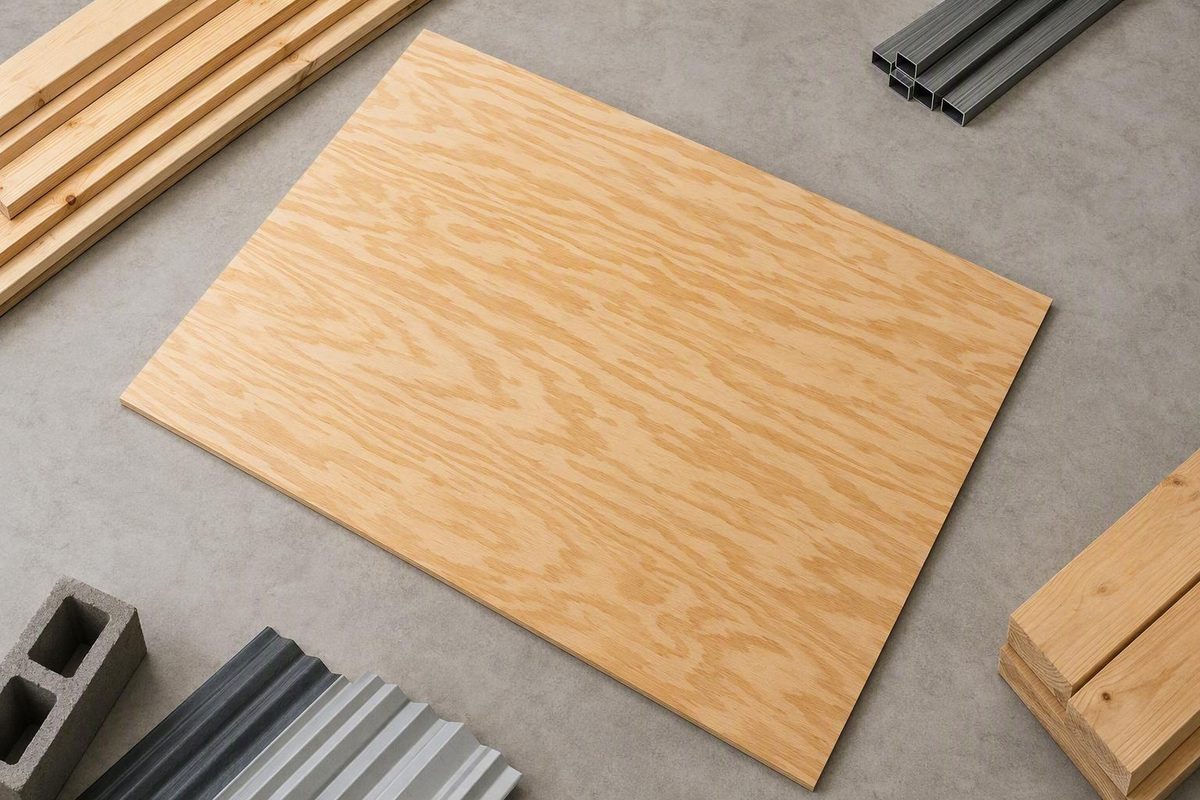
The short answer: typical plywood sheet weights
A typical 4 ft × 8 ft sheet of 3/4-inch softwood plywood weighs approximately 60–70 lb, or about 27–32 kg. That is the most useful quick estimate for ordinary softwood plywood when the exact product is unknown. A manufacturer’s planning guide gives the same range while emphasizing that core type, moisture, and construction can change the result.See the 4×8 plywood weight estimates from Chanta Group.
This article uses 4 ft × 8 ft as its reference size because that is the common format behind most published plywood weight tables. A sheet of that size covers 32 square feet.
For broad orientation, common 4×8 panels can run from the low 20s in pounds for thin softwood plywood to around 100 lb or more for thick or dense constructions.
There is no universal answer to “how much does a sheet of plywood weigh?” until you identify at least:
- Length and width
- Nominal, labeled, or measured thickness
- Core and veneer construction
- Approximate material density
- Treatments, resins, or overlays
- Moisture condition
Every number below is therefore a planning estimate, not a guaranteed specification for a named product. General estimates are useful for purchasing, preliminary delivery planning, shop organization, and cut-piece calculations. When the result will be compared with a rated, structural, shipping, or legal limit, use product-specific information or a measured weight.
4×8 plywood weight chart by thickness
The following chart combines published softwood-plywood estimates with calculations based on disclosed planning densities. Its wider ranges accommodate different products and assumptions; the endpoints are not manufacturing tolerances or independently tested limits.
| Nominal thickness | Common actual-thickness label, where supported | Approximate 4×8 softwood plywood weight | Approximate kilograms | Planning note |
|---|---|---|---|---|
| 1/4 in | Product-dependent | 20–27 lb | 9.1–12.2 kg | Thin panels still vary by face, core, and resin content |
| 3/8 in | 11/32 in | 34–41 lb | 15.4–18.6 kg | Denser cores can move a sheet toward the upper end |
| 1/2 in | 15/32 in | 40–55 lb | 18.1–24.9 kg | Actual thickness and core density explain much of the spread |
| 5/8 in | Product-dependent | 48–68 lb | 21.8–30.8 kg | Resin, moisture, treatments, or overlays may add weight |
| 3/4 in | 23/32 in | 60–82 lb | 27.2–37.2 kg | About 60–70 lb is most representative of ordinary softwood plywood |
| 1 in | Product-dependent | 91–109 lb | 41.3–49.4 kg | Thick or dense panels can exceed 100 lb |
Chart methodology: The lower and common-case figures reflect published estimates such as approximately 22 lb at 1/4 inch, 40.5 lb at 1/2 inch, and 61 lb at 3/4 inch.Review the source estimates by thickness at Inch Calculator. The upper figures principally reflect calculations using a broader softwood planning density of approximately 34–41 lb/ft³.See the disclosed density range and calculated 4×8 weights from Kim Bong Wood.
How to read the chart
Begin with the row for the panel’s thickness, but do not choose a point within the range arbitrarily. Match the estimate to whatever you know about the product:
- For an ordinary 3/4-inch softwood sheet, 60–70 lb is the practical starting range.
- A denser core, heavy resin loading, treatment, overlay, or elevated moisture content may produce a heavier panel.
- Hardwood-faced, birch, marine, and specialty panels should not automatically be placed within the softwood range.
- If the supplier publishes a sheet mass, use that instead of the general chart.
- If only density is available, calculate weight from actual dimensions and that density.
The chart’s sources use different methods. Some report representative or average sheet weights; others calculate weight from broad density ranges. Those methods can overlap without producing identical answers.
The chart also avoids false precision. A result such as 68.0 lb can be exact for the dimensions and density entered into a formula, yet still fail to describe the sheet on a store cart. The arithmetic may be exact while the inputs remain estimates.
How plywood type changes the weight
Plywood categories describe more than density. A category may refer to face species, core species, veneer arrangement, adhesive system, durability, appearance, or intended exposure. Two panels sold under the same broad category can therefore have meaningfully different weights.
One published guide gives this comparison for 3/4-inch, 4 ft × 8 ft sheets:
| Plywood category | Approximate planning weight |
|---|---|
| Softwood plywood | 61 lb |
| Hardwood plywood | 67.5 lb |
| Baltic birch plywood | 71.5 lb |
| Marine plywood | 75 lb |
These are comparative estimates from one guide, not universal category specifications.See the guide’s 4×8 comparison by plywood type.
Softwood plywood
Basic softwood plywood commonly uses species such as pine or fir. For an ordinary 3/4-inch, 4×8 sheet, 60–70 lb is a practical expectation.
“Softwood plywood” is still a broad label. It does not identify one species, core arrangement, grade, glue system, moisture condition, or density. A dense softwood core or heavier adhesive loading can move an individual panel outside the usual range.
Hardwood plywood
Hardwood plywood often weighs more than ordinary softwood plywood of the same dimensions, but it does not always do so. A hardwood panel may use thin decorative hardwood face veneers over inner plies made from softwood or another lower-density species.
The face species therefore does not determine the density of the entire panel. Core construction materially affects total weight, and two products with similar-looking hardwood faces may differ considerably.
As a broad planning tendency, some 3/4-inch hardwood or birch products fall around 65–75 lb, while denser constructions can reach 70–80 lb or more. These are category-level estimates rather than guaranteed weights.
Baltic birch plywood
A planning figure in the low 70s in pounds can be reasonable for a 3/4-inch sheet.
Check the sheet dimensions before comparing it with a 4×8 chart.
Marine plywood
Marine grade describes construction and durability characteristics rather than one universal density. Veneer species, ply arrangement, resin system, thickness, and manufacturer still affect the final weight.
Some planning guides place 3/4-inch marine plywood at approximately 70–80 lb per 4×8 sheet, compared with about 60–65 lb for pine or fir plywood and 65–75 lb for some birch products of the same stated size and thickness.Chanta Group presents these as general estimates affected by core, moisture, and manufacturing.
Marine plywood should therefore be treated as a product category, not as a fixed weight specification.
Dense-core and specialty panels
Dense-core plywood may weigh substantially more than ordinary veneer-core softwood plywood. Treated, film-faced, laminated, and otherwise overlaid panels may also be heavier because they contain additional material, resin, treatment chemicals, or surface layers.
These are tendencies, not rules. A specialty panel designed around a lightweight core or resin system may weigh less than a conventional product. Without product-level documentation, it is more accurate to say that a specialty construction may change or increase weight than to assign it a fixed figure.
Why two apparently identical sheets can weigh different amounts
Two panels can share the same nominal length, width, thickness, and grade while having different measured weights. Several variables contribute to that difference.
Sheet dimensions and actual thickness
When construction and density remain the same, weight rises directly with volume. A larger sheet weighs more than a smaller one, and a thicker sheet weighs more than a thinner one.
A nominal 3/4-inch panel has about three times the material volume of a nominal 1/4-inch panel with the same length and width. Actual panel thickness, however, may differ from the nominal product name.
Veneer and core species
Wood species have different densities, and plywood may combine several species in one panel.
A hardwood face does not prove that a panel has a hardwood core. Likewise, two softwood panels can differ because they use different species or veneer combinations.
Core structure and ply arrangement
Plywood can be built with different numbers and thicknesses of veneers. Core configuration, joints, voids, veneer quality, and repairs can influence how much wood and adhesive occupy a given panel volume.
Ply count alone is not a reliable weight predictor. A panel with more plies may use thinner veneers or different species, so the number of layers must be considered alongside the rest of the construction.
Adhesive, resin, and compression
Glue type and quantity contribute to panel density. Manufacturing pressure can compress veneers and change the amount of material contained in the finished volume.
A lightweight core or resin system may reduce weight. A dense core, greater resin loading, or additional surface treatment may increase it. The direction and magnitude of the difference depend on the named product rather than one universal plywood rule.
Treatments and overlays
Preservative treatment, film faces, decorative laminates, and other overlays add material. Their effect depends on treatment retention, overlay thickness, resin system, and the base panel.
A general plywood chart cannot reliably quantify that addition without a product specification. Where an overlay or treatment matters, consult the technical data for the complete panel rather than estimating only the untreated plywood substrate.
Moisture
Plywood that has absorbed moisture generally weighs more than the same panel in a drier condition. The change depends on its initial moisture level, exposure, wood species, adhesive system, panel condition, and the amount of moisture retained when weighed.
There is no defensible universal percentage to add to every plywood estimate. Moisture is best treated as a source of uncertainty unless product-specific guidance or a direct measurement is available.
Grade
Grade alone is not a dependable weight predictor. It can describe face appearance, defects, repairs, or veneer quality, but it does not uniquely define core species, adhesive loading, density, or moisture condition.
Fewer voids or different veneers can influence weight, yet two panels of the same grade can still have different constructions. Grade is one part of the product description, not a substitute for density or published panel mass.
Variation is not necessarily a calculation error
A correctly applied average-density formula can disagree with the panel in front of you. The formula answers:
What would a panel of this volume weigh at the assumed density?
It does not establish that the actual panel has that density. That distinction is why a transparent range is usually more useful than a single decimal-place answer.
How to calculate plywood weight from dimensions and density
When a sheet is not listed in the chart, estimate its weight from volume:
Weight = length × width × actual thickness × density
All dimensions must be converted to compatible units before multiplying.
Imperial formula
When density is expressed in pounds per cubic foot:
Weight in pounds = length in feet × width in feet × (thickness in inches ÷ 12) × density in lb/ft³
Dividing the thickness by 12 converts inches to feet.
Example: nominal 4×8×3/4-inch softwood plywood
First calculate the nominal volume:
Volume = 4 ft × 8 ft × (0.75 in ÷ 12)
       = 2 ft³
Using an assumed density of 35 lb/ft³:
Weight = 2 ft³ × 35 lb/ft³
       = 70 lb
A plywood calculator using that density applies the same volume-times-density method and identifies the result as an average-density estimate rather than a product specification.See the calculator’s formula and 35 lb/ft³ assumption.
If the assumed density is instead 34 lb/ft³:
Weight = 2 ft³ × 34 lb/ft³
       = 68 lb
The difference between 68 and 70 lb does not mean that one calculation is incorrect. It shows how the result changes with the assumed density.
A density of 34–35 lb/ft³ is a useful generic assumption for ordinary softwood plywood when no better information is available. It falls within the softwood planning densities used for the main chart, but it is not a universal plywood density. Do not automatically apply it to hardwood, birch, marine, treated, dense-core, or overlaid products.
Density sensitivity for the same nominal sheet
A nominal 4×8×3/4-inch sheet has a volume of 2 ft³. Its calculated weight therefore changes as follows:
| Assumed density | Calculated weight |
|---|---|
| 30 lb/ft³ | 60 lb |
| 34 lb/ft³ | 68 lb |
| 35 lb/ft³ | 70 lb |
| 40 lb/ft³ | 80 lb |
| 45 lb/ft³ | 90 lb |
| 50 lb/ft³ | 100 lb |
These are arithmetic scenarios, not claims that every plywood product is available at each listed density. They demonstrate why different guides can produce different answers for identical nominal dimensions.
A better way to present calculator results
A useful plywood weight calculator should display:
- The dimensions entered
- Whether the thickness is nominal, labeled, or measured
- The calculated volume
- The density assumption
- The resulting estimated weight
- A warning that construction and moisture can change the result
Without those inputs, an answer such as “70 lb” appears more certain than it is.
When available, replace a generic density with:
- A product-specific density from a technical data sheet
- A published mass per panel
- A supplier-confirmed sheet weight
- The measured weight of a representative panel
Weight per square foot, cut pieces, and nonstandard sheet sizes
A 4 ft × 8 ft sheet covers:
4 ft × 8 ft = 32 ft²
Divide its full-sheet weight by 32 to obtain an approximate weight per square foot.
Derived softwood plywood weight per square foot
The following figures are calculated from the main chart’s planning ranges. They are not measured product data.
| Nominal thickness | 4×8 planning range | Derived weight per square foot |
|---|---|---|
| 1/4 in | 20–27 lb | 0.63–0.84 lb/ft² |
| 3/8 in | 34–41 lb | 1.06–1.28 lb/ft² |
| 1/2 in | 40–55 lb | 1.25–1.72 lb/ft² |
| 5/8 in | 48–68 lb | 1.50–2.13 lb/ft² |
| 3/4 in | 60–82 lb | 1.88–2.56 lb/ft² |
| 1 in | 91–109 lb | 2.84–3.41 lb/ft² |
For comparison, a published building-material guide also reports plywood weights per square foot for several common labeled thicknesses, though its figures represent particular planning values rather than the broader ranges used here.See the source plywood weight-per-square-foot table.
For example, a 68 lb, 4×8 panel works out to:
68 lb ÷ 32 ft² = 2.125 lb/ft²
That value can be used to estimate cuts from the same panel.
Cut-piece formula
When thickness and construction remain unchanged:
Cut-piece weight = full-sheet estimate × cut-piece area ÷ full-sheet area
For a 4×8 reference sheet:
Cut-piece weight = full-sheet estimate × cut-piece area ÷ 32
Suppose the full sheet is estimated at 68 lb and the required piece measures 2 ft × 6 ft:
Cut-piece area = 2 ft × 6 ft
               = 12 ft²

Estimated weight = 68 lb × 12 ÷ 32
                 = 25.5 lb
Kerf and edge trimming remove some material, but area scaling is generally adequate for preliminary planning.
Half sheet
A half sheet has half the area of the full sheet, so it weighs approximately half as much when thickness and construction remain the same.
If the full sheet estimate is 60–70 lb:
Half-sheet estimate = 30–35 lb
This applies whether the sheet is divided into two 4×4 pieces or two 2×8 pieces. Each piece has 16 square feet of area.
A 5×5 sheet compared with a 4×8 sheet
A 5×5 panel has 25 square feet of area:
25 ÷ 32 = 0.78125
It therefore has 25/32 of the area, or approximately 78%, of a 4×8 sheet. If thickness, density, core, treatment, overlay, and moisture are comparable, it should weigh about 78% as much.
Using a 68 lb reference:
68 lb × 25 ÷ 32 = 53.1 lb
A 4×10 sheet compared with a 4×8 sheet
A 4×10 panel has 40 square feet of area:
40 ÷ 32 = 1.25
It has 125% of the area of a 4×8 sheet and should weigh about 125% as much when construction and thickness match.
Using the same 68 lb reference:
68 lb × 40 ÷ 32 = 85 lb
Published plywood planning guidance uses these same 25/32 and 40/32 area relationships for comparable 5×5 and 4×10 panels.See the nonstandard sheet-size calculations.
Stack calculations
For multiple identical sheets:
Estimated stack weight = estimated weight per sheet × number of sheets
For 20 sheets estimated at 68 lb each:
68 lb × 20 = 1,360 lb
That is a material estimate, not a payload or storage approval. For a vehicle, trailer, rack, shelf, floor, hoist, or other rated equipment, use a verified per-sheet weight and account separately for pallets, packaging, restraints, and other materials.
When area scaling does not work
Do not scale by area alone when the second panel has a different:
- Thickness
- Core species or core design
- Veneer arrangement
- Treatment
- Overlay
- Resin system
- Moisture condition
In those cases, calculate each panel using its own volume and density or use its published mass.
Metric plywood weights and calculations
A 1220 × 2440 mm panel is close to a 4 ft × 8 ft sheet, but it is not identical. Four feet equals 1219.2 mm, and eight feet equals 2438.4 mm, so the metric panel is slightly larger in both directions.
Likewise, 18 mm is similar to but thinner than 3/4 inch. Three-quarters of an inch equals 19.05 mm. These differences matter in close volume calculations.
Typical 1220×2440×18 mm planning weights
General supplier estimates for this metric size include:
- About 28 kg for some poplar-core panels
- About 28 kg for some pine-core panels
- Approximately 35–37 kg for denser birch constructions
One supplier table lists 28 kg for poplar and pine and 37 kg for birch at 1220 × 2440 × 18 mm, while explaining that core, glue, compression, and moisture affect density.See Yalong Wood’s metric panel examples and density discussion.
Another guide estimates a 1220 × 2440 × 18.5 mm softwood sheet at approximately 27.67 kg. That is another planning point, not a universal softwood-plywood specification.See the metric softwood estimate from Inch Calculator.
Metric formula
When density is expressed in kilograms per cubic meter:
Kilograms = length in meters × width in meters × thickness in meters × density in kg/m³
Convert millimeters to meters by dividing by 1,000.
Metric example: 18 mm poplar or pine assumption
Assume a density of 520 kg/m³:
Length = 1220 mm ÷ 1000 = 1.220 m
Width = 2440 mm ÷ 1000 = 2.440 m
Thickness = 18 mm ÷ 1000 = 0.018 m
Calculate the volume:
Volume = 1.220 × 2.440 × 0.018
       = 0.05358 m³
Then calculate mass:
Estimated mass = 0.05358 m³ × 520 kg/m³
               = 27.86 kg
Rounded for planning, the panel is about 28 kg.
Denser birch example
Using the same dimensions with an assumed birch-plywood density of 650 kg/m³:
Estimated mass = 0.05358 m³ × 650 kg/m³
               = 34.83 kg
That is approximately 35 kg. The comparison shows why dimensions alone do not determine weight: the same 18 mm panel volume produces about 28 kg at 520 kg/m³ and about 35 kg at 650 kg/m³.
For precise work, do not substitute “4×8×3/4” for “1220×2440×18 mm.” Enter the actual metric dimensions and thickness.
Nominal thickness versus actual thickness
Nominal plywood thickness is a product designation, not necessarily the measured thickness of every panel. A panel sold as 3/4 inch may carry a 23/32-inch label, while nominal 1/2-inch plywood may be labeled 15/32 inch.A published building-material table uses these 23/32- and 15/32-inch labels.
A printed fractional label should also be distinguished from a measurement of the particular sheet. Manufacturing variation, sanding, coatings, and measurement location can affect the observed thickness.
For a broader explanation of why product names and measured dimensions can differ, see Mortar Desk’s guide to nominal versus actual material sizes.
Weight effect of 23/32 inch versus 3/4 inch
At an assumed density of 35 lb/ft³, the nominal calculation is:
Volume = 4 × 8 × (0.75 ÷ 12)
       = 2 ft³

Weight = 2 × 35
       = 70 lb
Now use 23/32 inch, which equals 0.71875 inch:
Volume = 4 × 8 × (0.71875 ÷ 12)
       = 1.9167 ft³

Weight = 1.9167 × 35
       = 67.1 lb
Under the same density assumption, changing only the thickness reduces the estimate by approximately 2.9 lb.
That does not mean every sheet labeled 23/32 inch weighs 67.1 lb. It means a 4×8 panel with that exact thickness would have that calculated weight if its average density were exactly 35 lb/ft³.
Which thickness should you enter?
Use the best information available, in this order:
- A measured thickness for the specific panel
- The product’s stated actual or category thickness
- A printed fractional thickness label
- Nominal thickness, clearly identified as an assumption
Measure the panel when a close estimate matters. The broader principle applies across building materials: the name printed on a product is not always a literal measurement of the item in front of you.
When an estimate is enough—and when to verify the exact product
The chart and formulas are suitable for:
- Rough purchasing estimates
- Comparing plywood thicknesses
- Preliminary delivery planning
- Organizing material in a shop
- Estimating cut-piece weights
- Comparing nonstandard sheet areas
- Preparing an initial stack-weight estimate
They are less suitable when the result will be used directly against a rated or legal limit.
Obtain better product evidence for:
- Vehicle payload calculations
- Roof-rack or trailer loading
- Structural dead-load calculations
- Rated shelving or storage racks
- Floor or equipment load limits
- Shipping declarations and freight documents
- Any decision close to a stated maximum
For those uses, obtain the named product’s technical data sheet, ask the supplier for a verified sheet weight, or weigh a representative panel. For multiple sheets, multiply the verified per-sheet weight by the quantity, add pallets and packaging where applicable, and compare the complete result with every relevant rating.
A general chart does not establish that a particular sheet is safe for one person to lift. It also does not determine how many sheets a vehicle, roof rack, trailer, shelf, floor, or structure can support.
Note on OSB, MDF, and particleboard
OSB, MDF, and particleboard are distinct engineered sheet products, not types of plywood.
Plywood is made from bonded wood veneers. Because their materials and manufacturing processes differ, a plywood density assumption should not be transferred to them.
Use a chart or technical data sheet for the relevant product category—and preferably for the named panel.
Frequently asked questions
How much does a 4×8 sheet of 3/4-inch plywood weigh?
A typical 4×8 sheet of 3/4-inch softwood plywood weighs approximately 60–70 lb, or 27–32 kg. Broader planning estimates can extend to about 82 lb when denser assumptions or less typical constructions are included.Demeter’s planning guide gives 60–70 lb for ordinary 3/4-inch softwood plywood.
Use 60–70 lb for a quick ordinary-softwood estimate. Check product data if the panel is hardwood, birch, marine, treated, overlaid, wet, or built around a dense core.
How much does a 4×8 sheet of 1/2-inch plywood weigh?
A practical softwood planning range is approximately 40–55 lb, or 18–25 kg, for a 4×8 sheet. Published common-case estimates often place ordinary softwood panels around 40–45 lb, while broader density calculations can produce higher results.See the published 40–45 lb common-case range.
Actual thickness matters. A nominal 1/2-inch panel may be labeled 15/32 inch, so a calculation based on a full 0.500 inch can overstate its volume.
What does plywood weigh per square foot?
It depends on thickness and construction. For a known 4×8 sheet, divide its total weight by 32 ft².
Using the planning ranges in this article, approximate softwood-plywood values are:
- 1/4 inch: 0.63–0.84 lb/ft²
- 3/8 inch: 1.06–1.28 lb/ft²
- 1/2 inch: 1.25–1.72 lb/ft²
- 5/8 inch: 1.50–2.13 lb/ft²
- 3/4 inch: 1.88–2.56 lb/ft²
- 1 inch: 2.84–3.41 lb/ft²
These are derived planning ranges rather than measured product specifications. The calculation follows the standard volume-times-density method used for plywood and other wood products.See the disclosed material-weight calculation method.
Does wet or moisture-exposed plywood weigh more?
Usually, yes. Plywood that has absorbed moisture generally weighs more than the same panel in a drier condition.
There is no single percentage that applies to every panel. The change depends on core species, adhesive, initial moisture level, exposure, panel condition, and how much moisture remains. If moisture exposure is substantial and weight matters, weigh the panel or use product-specific guidance instead of applying a universal surcharge.
Are OSB, MDF, and particleboard the same as plywood?
No. They are separate engineered sheet products.
Each product should be estimated using its own density or technical data rather than a plywood chart.
For a typical 4 ft × 8 ft, 3/4-inch softwood plywood sheet, allow roughly 60–70 lb as the practical starting point. Treat that figure and the thickness chart as planning estimates. For another size, scale a genuinely comparable panel by area or calculate its volume and multiply by an appropriate, disclosed density.
When the answer affects payload, structural loading, rated storage, shipping, or handling near a limit, replace the general estimate with product-specific technical data or a measured weight.
Mortar Desk publishes general building-material reference information. It is not a contractor and does not provide engineering or individualized load-planning advice; more detail is available on the About Mortar Desk page.