 MortarDesk
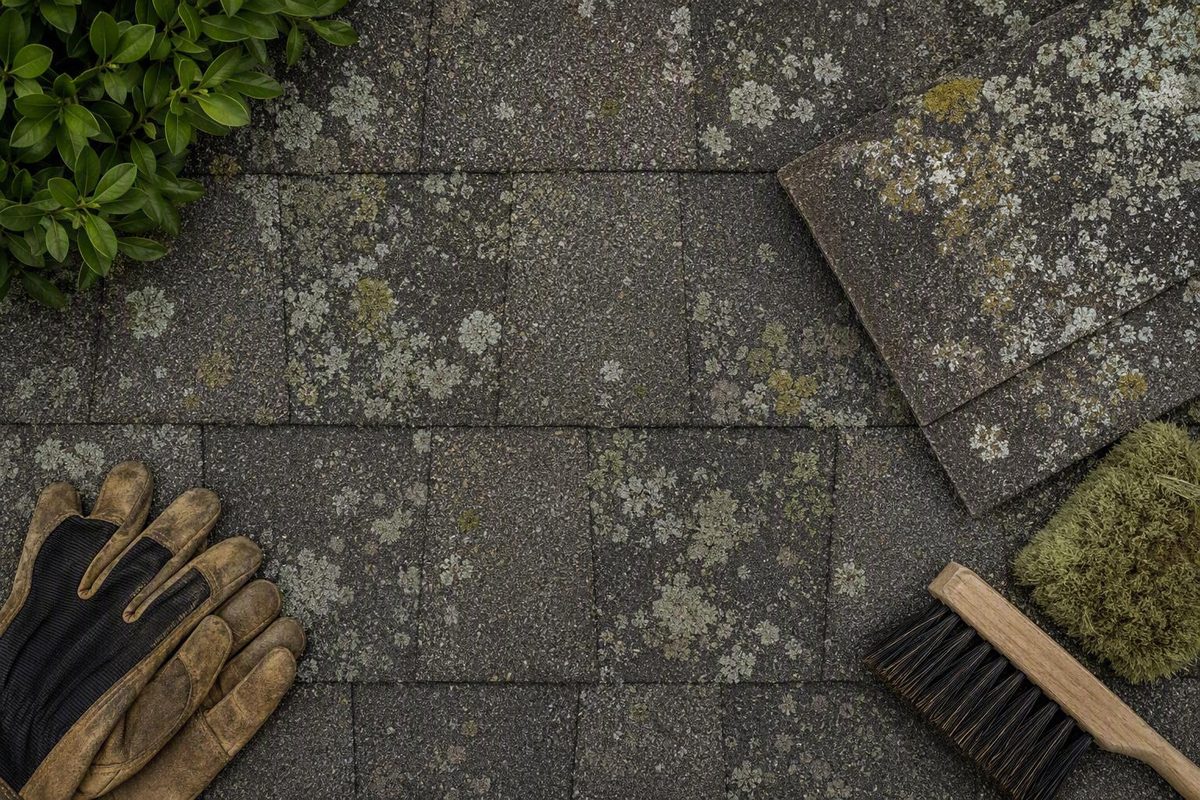
The short answer: lichen may contribute to wear, but the damage is not reliably quantified
Established lichen deserves attention, but its presence does not automatically mean an asphalt-shingle roof is leaking, structurally unsound, or due for replacement. Inspectors, contractors, cleaning businesses, and home-improvement publications associate firmly bonded colonies with localized granule loss and gradual surface weathering. The available evidence does not, however, show that every colony damages otherwise sound shingles or establish a typical reduction in roof life.
The most defensible concern is localized surface wear combined with the risk of aggressive removal. Asphalt shingles rely on a mineral-covered surface to protect the material below. Because lichen may bond tightly to that surface, peeling, scraping, stiff brushing, pulling, or blasting it away can remove protective granules with the growth. A trade article written by a home inspector describes that strong bond and removal risk, although its broader explanations of lichen damage are not supported by testing or quantified field data (Working RE’s discussion of algae, moss, and lichen on shingles).
Natural release after treatment should be understood differently. When dead growth loosens over time, a dark or granule-depleted patch may become visible beneath it. That does not prove the release caused the damage. The exposed area may reflect some combination of lichen-associated weathering, shingle age, prior cleaning, treatment, or earlier mechanical disturbance.
Lichen is therefore better treated as a possible gradual maintenance and longevity concern than as an automatic roofing emergency. A few bonded patches on shingles that otherwise appear intact present a different situation from widespread granule depletion, lifted tabs, damaged valleys or flashing, or moisture inside the building. The roof’s overall condition matters more than the mere presence of the organism.
The strongest practical conclusion concerns what not to do. Tightly attached growth can resist immediate removal, and enough force to make the roof look clean in one visit may also strip away its protective surface. Fast cosmetic results are not evidence that a cleaning method was safe.
There is no well-supported universal figure for:
- How many years lichen removes from shingle life
- What percentage of a roof must be covered before damage occurs
- How much granule loss can be attributed to lichen rather than age or cleaning
- When lichen-covered shingles must be repaired or replaced
- How long treated lichen will take to release in every climate
Claims about exact lifespan reductions, damage percentages, or mandatory replacement thresholds should be treated cautiously unless they come from testing applicable to the specific shingle product and conditions.
The evidence is uneven. Roofing-industry guidance directly supports avoiding pressure washing on asphalt shingles. Most lichen-specific explanations, by contrast, come from inspectors, contractors, cleaning vendors, and one published homeowner experience. These sources can identify recurring field concerns, but repetition across commercial pages is not equivalent to controlled research.
That limitation supports a measured response: identify the growth, document the roof safely, check the shingle manufacturer’s current instructions, and avoid turning a possible gradual problem into immediate mechanical damage.
Confirm that the growth is lichen—not algae, moss, or ordinary staining
Lichen is a partnership between a fungus and an alga. On a roof, it commonly appears as a patch bonded closely to the surface rather than as a loose layer that can simply be swept away.
Possible colors include:
- Gray or gray-green
- Pale green
- White
- Yellow
- Orange
Its shape may be flat, crust-like, coin-shaped, leafy, or slightly raised. Colonies can be circular or have irregular borders. From a distance, mature lichen may look like pale spots painted onto the roof.
That appearance differs from two other common types of roof growth:
- Algae usually appears as dark discoloration or black-to-brown streaks running down the roof slope.
- Moss forms soft, puffy, sponge-like clumps or thicker mats, often near shingle edges, seams, valleys, and trapped debris.
- Lichen generally presents as a firm crust or spot that appears fused to the granulated surface.
Identification matters because the organisms do not attach in the same way. Instructions intended for algae staining cannot automatically be treated as lichen-removal instructions. Guidance for loosening moss may likewise fail to account for lichen’s tight bond to shingle granules.
More than one type of growth may be present. Dark streaks can surround crusty colonies, while moss may occupy shaded seams or valleys nearby. A mixed roof should not be assigned one treatment merely because its most visible growth has been identified.
Do not test a suspected colony by scraping it with a fingernail, tool, or brush. Instead:
- Take an overview photograph from the ground.
- Use optical zoom to capture several representative patches.
- Photograph both shaded and exposed roof planes.
- Note whether each mark is a streak, soft mat, raised clump, or bonded crust.
- Compare photographs taken in dry and damp conditions if both are available.
- Request a qualified inspection when photographs are inconclusive.
Do not climb onto a steep, wet, brittle, or growth-covered roof merely to identify a spot. A contractor guide recommends using photographs first and seeking professional help for steep roofs or growth in difficult locations such as valleys (roof-growth identification and access guidance). Ground-level photography, a safe window view, or a qualified inspection is preferable to touching the growth.
What lichen-related shingle damage may look like
The visible surface of an asphalt shingle is covered with mineral granules. These form the exposed weathering layer and help shield the asphalt-containing material beneath from sunlight and the elements. Where granules are lost, darker asphalt or other parts of the shingle construction may become more exposed.
Possible observations after a colony releases include:
- A localized dark or “bald” area
- A patch that differs in color from the surrounding shingle
- A circular or irregular zone with fewer granules
- Exposed asphalt within the former colony outline
- Loose granules in a nearby drainage path or gutter
The colony and the mark beneath it are not the same thing. A pale, crusty, firmly attached spot is the organism. A dark circular or irregular area remaining after release may be an exposed or granule-depleted part of the shingle.
Surface wear can remain hidden while lichen is attached. In one published homeowner account, patches of missing granules became visible after treated lichen and moss gradually detached. The observation supports inspecting the exposed areas, but it cannot determine whether the loss resulted from the organism, shingle age, previous wear, treatment, or another cause (Fine Homebuilding’s lichen and moss remediation account).
Do not attribute every bare patch to living lichen. Other possible contributors include:
- Normal aging and weathering
- Previous pressure washing or abrasive cleaning
- Scraping, pulling, or peeling away growth
- Hail or another impact
- Earlier repairs
- Product or installation conditions
The available evidence cannot allocate causation among these factors. Even when a bare area matches the outline of a former colony, the shingle may already have been weathered before the lichen became established.
Look beyond isolated spots when evaluating the roof. Broader concerns that justify professional assessment include:
- Extensive granule depletion across a roof plane
- Numerous areas of exposed asphalt or shingle base
- Lifted, curled, cracked, or displaced shingle edges
- Loose or missing tabs
- Deterioration in valleys
- Damaged or displaced flashing
- Interior staining, dampness, or peeling finishes
None of these conditions proves that lichen caused the deterioration. They matter because they may affect the roof’s ability to shed water regardless of the original cause. An inspection should evaluate the roofing system as a whole rather than treating each colony as an isolated cosmetic mark.
Separate supported risks from plausible but unproven damage mechanisms
The clearest recurring lichen-specific concern is the combination of strong attachment and mechanical removal. When a colony is bonded to the granulated surface, pulling or abrading it away can take granules with it.
Several other mechanisms are frequently proposed:
- Organic acids may weather or etch the surface.
- Colonies may retain moisture against the roof.
- Growth may slow drying or retain heat.
- Moisture may freeze and thaw around an irregular surface.
- Lichen may exploit an already rough or granule-depleted area.
These explanations may justify caution, but the supplied sources do not include lichen-specific testing that measures their contribution under real asphalt-roof conditions. Vendor and contractor pages assert some of these mechanisms without independent measurements, standardized comparisons, or quantified field results.
Freeze-thaw cycling is best treated as a possible compounding factor in frost-prone climates, not as a predictable damage formula. The evidence does not establish how much additional lichen-related wear it causes or how quickly that wear develops.
Conditions commonly associated with biological roof growth include:
- Shade
- Nearby trees
- Retained leaves or needles
- Persistent dampness
- Slow-drying valleys
- Areas behind chimneys or near penetrations
- Rough or aged roof surfaces
North-facing planes are often discussed because they may receive less direct sunlight and remain damp longer. These are tendencies, not universal rules. A Wisconsin cleaning contractor reports observing lichen on aged asphalt in open, sunny areas as well as moss on more shaded slopes, illustrating that exposure patterns vary by site and organism (commercial field observations on moss and lichen).
It is also difficult to separate cause from marker. Lichen might:
- Contribute to localized weathering;
- Prefer a surface that is already rough, aged, or granule-depleted;
- Indicate that part of the roof dries slowly; or
- Reflect a combination of those conditions.
The available evidence does not establish the relative contribution of each possibility. A lichen-covered roof should therefore be evaluated both for biological growth and for pre-existing shingle condition.
Stronger claims should be rejected unless product-specific evidence becomes available. It has not been established here that root-like structures penetrate asphalt shingles in a way that inevitably causes failure. Nor is there sufficient evidence to say lichen inevitably causes pitting, warping, leaks, structural damage, or premature replacement.
Inspect without creating more damage—and do not diagnose hail from spot shape alone
Begin with documentation rather than removal. A consistent record can show whether colonies are spreading, whether shingle edges are changing, and what the roof looked like before any treatment.
A useful documentation checklist includes:
- Dated photographs of each roof plane
- Wide views showing the distribution of growth
- Zoomed images of representative colonies and bare spots
- Notes on roof slope and orientation
- Areas of heavy shade or slow drying
- Nearby branches
- Leaves, needles, or other visible debris
- Valleys, eaves, gutters, flashing, and penetrations
- Lifted, curled, loose, or missing shingles visible from a safe location
- Interior ceiling or wall staining
- Attic dampness, if the attic can be inspected safely
- Dates of recent storms, cleaning, repairs, or other roof work
Use the same safe vantage points for follow-up photographs. Consistent framing is more useful than repeatedly climbing onto the roof for close-ups. If the roof cannot be observed adequately without hazardous access, or if deterioration appears extensive, arrange a qualified inspection.
Lichen-related marks can complicate a hail assessment. Shape alone is not a reliable diagnosis.
Hail can also create spatter on a stained roof. That contrast indicates that hail struck the stained surface; it does not, by itself, establish functional shingle damage (AAA Roof Technologies’ explanation of roof growth and hail spatter).
The evidence available here does not supply objective criteria sufficient to distinguish every lichen scar from genuine hail damage. A circular mark, cluster of spots, lighter spatter, or recent storm should therefore not be described as proof of an insurance-covered loss. When the distinction affects a repair or claim decision, retain the pre-treatment photographs and seek evaluation from a qualified roof professional or the appropriate insurance inspector.
Why pressure washing, scraping, and immediate removal are high-risk choices
Asphalt shingles should not be pressure-washed. The Asphalt Roofing Manufacturers Association states that pressure washing causes granule loss and is likely to contribute to premature roof-system failure (ARMA’s cleaning guidance for asphalt roofing systems).
That warning applies even if the roof looks dramatically cleaner afterward. A pressure washer can remove staining and growth while also removing the protective granulated surface. Cosmetic improvement does not demonstrate that the shingles were left intact.
Other forceful methods pose a similar lichen-specific problem:
- Scraping concentrates force along a tool edge.
- Peeling transfers the colony’s bond directly to the surface below.
- Stiff brushing abrades both the growth and the shingle.
- Pulling by hand can detach a bonded patch suddenly.
A tool marketed for roof cleaning may still be inappropriate if it relies on abrasion. The objective is not simply to use less force than a pressure washer; it is to avoid mechanically separating tightly bonded growth from a vulnerable surface.
Low pressure alone does not make a process safe. A complete evaluation must also consider:
- Compatibility with the specific shingle
- Cleaner formulation and concentration
- Application method
- Dwell time
- Whether rinsing is required or prohibited
- Volume and direction of rinse water
- Roof age and condition
- Flashing, gutters, coatings, and adjacent finishes
- Landscaping and runoff
- Warranty requirements
- Local environmental rules
There is therefore no universal “safe PSI” threshold here. Nor should the label soft washing be treated as automatic proof of safety.
| Method | Principal concern | Lower-risk direction |
|---|---|---|
| Pressure washing | Direct granule loss and possible roof-system damage | Do not pressure-wash asphalt shingles |
| Dry scraping, peeling, or stiff brushing | Bonded lichen may take granules with it | Avoid immediate mechanical detachment |
| Unverified chemical treatment | Incompatible chemistry, excessive concentration, runoff, finish damage, or warranty conflict | Verify the cleaner and process with the shingle manufacturer |
| Manufacturer-compatible low-pressure treatment | Still requires correct handling and site protection | Kill the growth and permit gradual weather-assisted release when approved |
The important distinction is between killing the organism and forcing it off immediately. A lower-risk process accepts that dead growth may remain visible while its bond weakens. Trying to complete removal in one session can turn a gradual maintenance issue into immediate surface damage.
A manufacturer-first treatment and follow-up plan
Start with the manufacturer of the installed shingles, not with a generic cleaning recipe or a contractor’s preferred chemical. If possible, identify the product from purchase records, packaging, contractor documentation, warranty papers, or recognizable product markings.
Check the manufacturer’s current instructions for:
- Approved and prohibited cleaners
- Permitted application equipment
- Dilution or concentration limits
- Temperature and weather restrictions
- Dwell-time requirements
- Rinsing instructions
- Protection of metal components and adjacent materials
- Required contractor involvement
- Warranty exclusions or notification requirements
If the product cannot be identified, that uncertainty is a reason to proceed conservatively or request professional assessment.
ARMA publishes a bleach-and-water procedure for algae and moss on asphalt roofing. It does not present that procedure as lichen-specific approval. An algae-or-moss recipe should not be extended to lichen without confirmation from the manufacturer of the installed shingles.
Where the manufacturer permits treatment, the commonly recommended harm-reduction approach is to:
- Use only compatible chemistry and approved application equipment.
- Apply the treatment without mechanically disturbing the colonies.
- Allow the treatment to kill the growth.
- Leave firmly bonded material in place.
- Let ordinary rainfall and weathering loosen it gradually.
- Monitor the exposed shingle surface as release occurs.
- Avoid scraping persistent remnants.
Most lichen-specific support for this approach is commercial or anecdotal rather than experimental. Its practical logic is that gradual release avoids the concentrated mechanical force required for immediate removal.
Set realistic expectations. Lichen may change color or die before it disappears. A colony that remains visible is not necessarily still alive, and persistent dead material does not prove that treatment failed.
In one homeowner’s published account, treated growth showed visible browning and graying after several months, while complete die-off and detachment took more than a year. That is one observation from one roof, not a guaranteed schedule for another climate, organism, treatment, or shingle product (Fine Homebuilding’s reported treatment timeline).
Do not respond to slow progress by increasing force. Before considering another application, determine whether the manufacturer permits it and whether the visible patch is living lichen, dead residue, or an exposed shingle scar.
Any treatment plan should address access, slippery work surfaces, protective equipment specified by the product label, overspray, landscaping, gutters, flashing, drainage routes, and runoff. Commercial guidance also recognizes fall, slip, uneven-cleaning, and landscaping risks associated with roof chemicals; hiring a contractor does not eliminate the need to verify the product and procedure (roof-treatment safety considerations).
Professional assessment is preferable when:
- The roof is steep or difficult to access
- Lichen is established in valleys
- Shingle edges are lifting or curling
- Shingles appear old, brittle, cracked, or loose
- Granule loss already appears substantial
- There are signs of interior moisture
- Hail damage is disputed
- Product identification or cleaner compatibility is uncertain
- Runoff cannot be managed appropriately
Ask a contractor to identify the cleaner, concentration, application equipment, rinse method, runoff controls, and applicable manufacturer instructions. Professional service does not make every chemical or process compatible by default.
Monitor, treat, inspect, or repair: choosing the next step
There is no evidence-based replacement threshold based solely on lichen coverage, roof age, or a stated percentage of granule loss. The next step should reflect access risk, shingle condition, moisture evidence, and manufacturer guidance.
Monitor when patches are limited, shingles appear intact from a safe observation point, no interior moisture signs are present, and you are still identifying the growth or checking product instructions. Monitoring means taking dated photographs and watching for change; it is not an individualized diagnosis that the roof is sound.
Consider compatible treatment when lichen is established, the roof otherwise appears serviceable, and the shingle manufacturer permits an appropriate method. Treatment should prioritize killing the organism and allowing gradual release rather than achieving immediate visual uniformity.
Arrange a professional inspection when:
- Safe observation is not possible
- The roof is steep
- Growth occupies valleys or surrounds penetrations
- Shingles are lifting, curling, loose, or brittle
- Granule depletion appears extensive
- Asphalt or another part of the shingle construction is exposed
- Flashing or drainage details appear damaged
- Interior moisture is present
- Hail damage is disputed
- Product identification or chemical compatibility is uncertain
A roof being old is not, by itself, proof that replacement is required. Age becomes relevant when considered alongside condition, leakage, repair history, material deterioration, and the practicality of localized repair.
Consider repair or replacement according to the roof’s overall ability to shed water—not merely the presence of lichen. Leakage, widespread deterioration, failed flashing, damaged valleys, loose shingles, exposed shingle construction, and whether individual areas can reasonably be repaired all matter.
A useful decision sequence is:
- Confirm that the material is probably lichen.
- Document its extent without unsafe roof access.
- Check for moisture and broader shingle deterioration.
- Identify the shingle product where possible.
- Review the manufacturer’s current maintenance instructions.
- Choose monitoring, compatible treatment, professional inspection, or repair according to the roof’s condition.
- Photograph the same areas after treatment or at regular monitoring intervals.
No supported rule says that a particular colony count, coverage percentage, roof age, or amount of visible granule loss automatically mandates replacement. A limited patch on an otherwise intact roof calls for a different response from widespread growth on brittle shingles with damaged valleys and interior moisture.
Mortar Desk publishes general building-material reference information. It is not a contractor and does not provide individualized engineering or roofing advice. Product instructions, local requirements, and qualified on-site findings should control decisions for a particular roof.
Reduce recurrence by helping the roof shed debris and dry
Maintenance cannot guarantee that lichen will never return, but it can make some roof areas less favorable to biological growth.
Remove accumulated leaves, needles, twigs, and other loose debris without grinding growth into the shingle surface. Avoid abrasive sweeping, forceful brushing, and tools that catch shingle edges. Use a qualified service where safe access is not available.
Keep gutters and drainage paths clear so water can leave the roof and eaves. Watch valleys, areas behind chimneys, and locations around penetrations where debris tends to collect. Correcting a recurring debris pocket may be more useful than repeatedly treating the growth it supports.
Where appropriate, trim branches that touch the roof, deposit heavy debris, or substantially restrict sunlight and airflow. Large or hazardous limbs should be handled by a qualified tree professional. Better light and airflow may improve drying, but they do not guarantee permanent lichen prevention.
When the roof is eventually replaced, options worth investigating include algae-resistant shingles or preventive features integrated into the new roofing system. Availability, suitability, installation details, and expected performance depend on the product and local conditions.
Zinc or copper strips require particular caution. ARMA says they may be considered during roof replacement but does not recommend retrofitting them onto an existing asphalt-shingle roof because exposed fasteners may leak and disturbing sealed shingle bonds may increase wind-damage risk (ARMA’s prevention and retrofit guidance).
A practical recurring routine is straightforward:
- Take seasonal or annual photographs from consistent safe locations.
- Check for new crusty patches, dark streaks, or moss mats.
- Observe valleys, eaves, and visible shingle edges.
- Keep gutters and accessible drainage points clear.
- Remove loose debris non-abrasively.
- Watch ceilings and accessible attic areas for moisture.
- Compare new photographs with the earlier record.
- Avoid unnecessary roof access.
Lichen deserves attention, not panic. It may be associated with localized granule loss and gradual weathering, but exact damage rates and lifespan effects remain unknown. The most avoidable immediate hazard is forceful removal—especially pressure washing, scraping, peeling, or stiff brushing. Confirm the organism, document the roof safely, follow the specific shingle manufacturer’s instructions, allow any approved treatment to work gradually, and obtain a qualified inspection when access is unsafe or the roof shows widespread deterioration or moisture.
Frequently asked questions
Does lichen always damage asphalt shingles?
No. Field and commercial sources associate established lichen with localized granule loss and surface weathering, but the evidence does not show that every colony damages otherwise sound shingles.
Lichen may contribute to wear, favor an already aged or rough surface, indicate slow-drying conditions, or reflect a combination of those factors. Its presence is not automatic proof of leakage, structural failure, or a need for replacement.
Can I pressure-wash or scrape lichen off my roof?
Pressure washing should not be used on asphalt shingles. Scraping, peeling, pulling, and stiff brushing are also risky because tightly bonded lichen may detach protective granules with the colony. Contractor guidance similarly warns against high-pressure washing and mechanical removal of bonded growth (lichen-removal risk guidance).
If treatment is appropriate, verify the specific shingle manufacturer’s instructions and favor an approved process that kills the colony and allows gradual release. Do not assume every service described as soft washing is compatible.
How long does treated lichen take to fall off?
There is no guaranteed timeline. Treatment may kill lichen before its bond to the roof weakens, so dead material can remain visible for months.
One published homeowner experience reported visible changes after several months and more than a year for complete die-off and detachment. That anecdote is not a universal estimate. Persistent dead material does not necessarily mean more treatment or mechanical force is required.
Can lichen damage look like hail damage?
Yes. A released colony may reveal a circular or irregular granule-depleted area that resembles an impact mark. Hail may also remove dark staining and leave lighter spatter spots, but that color contrast does not by itself prove functional shingle damage or an insurance-covered loss (hail-spatter distinction).
Spot shape, spatter, or the timing of a storm should not be treated as conclusive. Disputed marks require qualified evaluation in context.
Are bleach, soft washing, or zinc and copper strips safe for asphalt shingles?
Not universally. Cleaner compatibility depends on the specific shingle product, chemical formulation, concentration, application method, dwell time, rinsing instructions, roof condition, runoff controls, and warranty terms. “Soft washing” identifies a broad low-pressure category; it does not certify every chemical or procedure as safe.
ARMA’s supplied bleach procedure directly addresses algae and moss, not lichen, so it is not blanket approval for lichen treatment. Zinc or copper may be considered as part of a replacement roofing system, but retrofitting strips onto existing shingles can disturb sealed bonds or require exposed fasteners. Confirm any chemical, equipment, or metal-strip detail with the shingle manufacturer before proceeding.