 MortarDesk
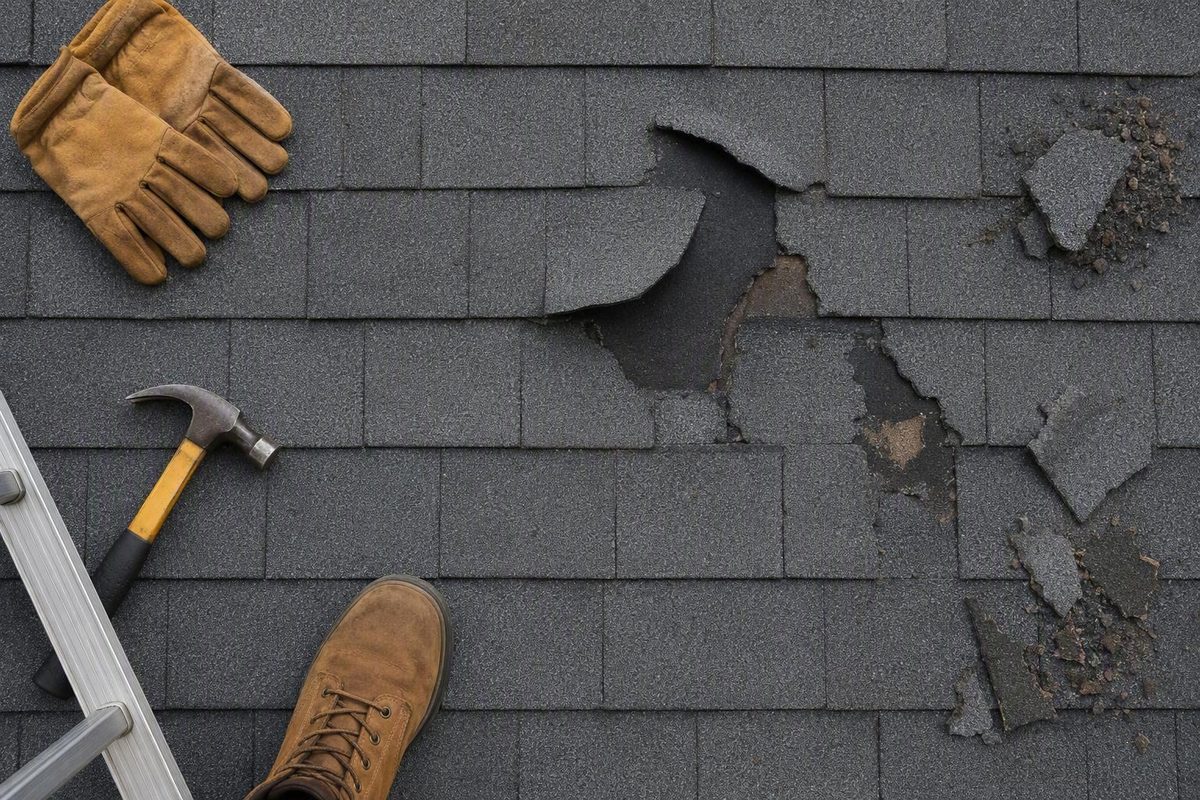
Wind damage to roof shingles is not limited to pieces blown into the yard. Wind can lift shingle edges, separate adhesive bonds, crease or tear shingles that remain attached, disturb flashing, and create openings through which water may enter. A shingle can also settle back into place after a storm while retaining damage that is difficult to see from the ground.
Visible symptoms are reasons to investigate, not proof of what caused the damage. The safest approach is to observe from the yard and indoors, document conditions, limit additional water damage without taking rooftop risks, and obtain a written assessment from a qualified local roofing professional.
What to do first when you suspect wind damage
Use this sequence after the storm:
- Confirm that conditions around the house are stable enough for observation.
- Keep people and pets away from hanging branches, gutters, roofing, or other visibly loose materials.
- Inspect only from the ground and safely accessible indoor areas.
- Photograph visible exterior and interior conditions.
- Contain interior water where this can be done without entering a hazardous area.
- Arrange professional help for active leakage, extensive material loss, exposed decking, sagging, or uncertain structural conditions.
Do not walk on a roof that is wet, visibly damaged, or structurally uncertain. Roofing-manufacturer guidance similarly warns homeowners not to climb onto a wet or visibly damaged roof because concealed structural problems may be present (GAF post-storm safety guidance).
Prompt professional attention is appropriate when you can see:
- Active water entry that cannot be contained from a safe indoor location
- Large areas of missing roofing
- Exposed roof decking
- A sagging roofline, roof deck, or ceiling
- Possible movement of the roof structure
- Hanging gutters, sheet metal, branches, or roofing materials
- Damage that leaves occupied areas exposed to the weather
If temporary rooftop protection is needed, ask a qualified professional to provide it. Homeowners should not climb onto a questionable roof simply to cover it.
When immediate conditions permit, photograph the property before temporary or permanent work begins. Do not delay measures needed to protect occupants or limit additional water entry solely to obtain better photographs. Record what was visible, what work was performed, when it occurred, and why it was necessary. Keep invoices and preserve removed roofing material when the contractor can do so without creating another hazard.
Specifications change, and applicable codes vary by locality, as explained in the Mortar Desk site description.
How wind can damage shingles without removing them
Asphalt shingles generally depend on two forms of restraint:
- Mechanical attachment: Fasteners connect the shingles to the roof deck.
- Adhesive bonding: Seal strips bond overlapping shingle courses together after installation.
When wind catches an exposed edge, uplift stresses both the adhesive bond and the mechanically attached area. Possible outcomes, from less obvious to more severe, include:
- Temporary lifting of an edge
- Separation of the adhesive bond
- A fold or horizontal crease where the shingle bent
- A crack or tear near an attachment point
- Partial detachment while some fasteners remain engaged
- Loss of a tab, ridge cap, or complete shingle
A lifted shingle does not necessarily remain raised. It may settle into approximately its former position after the gust passes, even though it has developed a crease, tear, loosened attachment, or compromised seal. Manufacturer educational guidance describes how wind uplift can loosen shingle bonds and produce creases that reduce water-shedding performance even when the shingle remains on the roof (GAF overview of roof storm damage).
Seal disruption or creasing may matter before an interior leak appears. Damage can increase susceptibility to wind-driven rain or a later storm without producing immediate dripping. Conversely, the absence of a current leak does not establish that every shingle, flashing detail, or underlying component is sound.
Eaves, rakes, corners, ridges, and other roof-perimeter areas are commonly described as vulnerable to uplift. Transitions around chimneys, vents, walls, and adjoining roof planes also merit attention. Damage in one of these locations does not prove wind causation; aging, workmanship, movement, debris, and earlier repairs remain possible explanations.
There is no dependable universal wind-speed threshold at which every shingle roof becomes damaged. Performance varies with the product, fastening, seal condition, workmanship, roof geometry, orientation, age, exposure, debris, temperature, rainfall, gust pattern, and pre-storm condition. Weather data can show that wind occurred nearby, but it cannot establish what happened to a particular shingle.
A symptom guide for possible wind damage
The following matrix separates observations from possible explanations. It is a preliminary recognition guide, not a diagnostic method. Manufacturer guidance identifies missing or disturbed shingles, damaged flashing and drainage components, interior moisture, and attic changes as conditions warranting further assessment.
| Observable sign | Possible wind mechanism | Alternative explanations | Urgency or next action |
|---|---|---|---|
| Missing shingles or tabs | Uplift may have overcome the seal, attachment, or shingle material | Earlier repair failure, poor fastening, deterioration, mechanical disturbance | Photograph from the ground and arrange prompt inspection |
| Folded or flipped shingles | A tab or shingle may have bent backward under uplift | Handling damage, foot traffic, earlier uncorrected damage | Do not manipulate it; request professional assessment |
| Lifted or uneven edges | Wind may have separated the bond between courses | Aging curl, thermal movement, installation conditions, debris beneath the shingle | Document from the ground and schedule inspection |
| Horizontal crease | A lifted shingle may have flexed along one line | Handling, foot traffic, manufacturing or installation effects | Have its physical condition and repairability assessed |
| Cracks or tears | Flexing may have split the material near an attachment point | Brittleness, impact, cutting, aging, installation damage | Obtain prompt evaluation |
| Exposed or raised fasteners | Shingle movement may have uncovered or disturbed attachment points | Incorrect placement, fastener movement, installation error, deck movement | Do not attempt a rooftop repair |
| Displaced ridge caps | Wind may have lifted exposed ridge material | Deterioration, poor fastening, impact, previous repair failure | Arrange prompt professional attention |
| Exposed underlayment | Shingles or tabs may have been removed or displaced | Incomplete work or earlier material loss | Seek prompt temporary protection and assessment |
| Exposed decking | Several roofing layers may be missing or torn | Construction activity, severe deterioration, impact | Treat as urgent |
| Loose or displaced flashing | Wind may have pulled metal away from an edge, wall, chimney, or penetration | Corrosion, thermal movement, sealant failure, poor installation | Request prompt inspection |
| Disturbed vent or roof accessory | Wind or debris may have shifted the component | Aging, animal activity, failed fasteners, previous work | Assess the accessory and surrounding roofing |
| Bent or detached gutter | Wind, debris, or displaced roofing may have affected drainage | Ice, ladder contact, corrosion, inadequate support | Keep clear if hanging and arrange repair |
| Damaged downspout | Debris or movement may have crushed or disconnected it | Landscaping, vehicle contact, maintenance, freezing | Restore drainage and inspect nearby roof edges |
| Roofing debris near the house | Wind may have transported material from the roof | Material may have come from another building or earlier work | Photograph its location before moving it |
| Dark or bald-looking areas | Surface granules may have been displaced | Aging, hail, installation effects, debris abrasion, foot traffic | Record the location; do not assume wind caused it |
| Unusual granules in gutters | Recent weather may have moved surface granules | Normal shedding, aging, hail, cleaning, earlier work | Photograph unusual accumulation and request evaluation |
| Ceiling stain or moisture streak | Water may have entered through disturbed roofing or flashing | Plumbing, condensation, older leakage, mechanical systems | Document the location; active moisture needs prompt attention |
| Dripping water | An opening in the roof assembly may be admitting rain | Plumbing or mechanical leakage | Contain only from a safe location and seek prompt help |
| Damp attic insulation | Moisture may have passed through the roof assembly | Condensation, ventilation conditions, older leakage | Document without disturbing the material |
| Musty odor | Persistent moisture may be present | Plumbing, basement moisture, HVAC, condensation | Investigate the source rather than assuming roof damage |
| Stained or bulging ceiling finish | Water may be collecting behind the finish | Plumbing or another building-system leak | Treat active or changing conditions as urgent |
| Visible daylight in the attic | A gap may exist in decking or around a penetration | Designed ventilation opening or construction gap | Have a professional identify its purpose and condition |
| Sagging roofline, deck, or ceiling | Moisture damage or structural movement may be present | Long-term loading, deterioration, framing defects, previous damage | Obtain urgent professional assessment |
Large missing areas, exposed decking, active water entry, and sagging are not routine maintenance observations. Contractor guidance recommends professional involvement where damage is substantial, structurally concerning, leaking, unclear, or unsafe to inspect (post-storm assessment guidance).
Granule loss deserves particular caution. Dark patches, bald-looking areas, or granules in drainage components can justify investigation, but granule movement has several possible causes. It cannot establish wind damage without considering aging, hail, installation effects, debris, previous maintenance, and foot traffic.
The same principle applies to missing, curled, cracked, stained, or granule-depleted shingles: these are observations, not causal conclusions. A useful inspection asks what physical evidence best explains the condition, whether it appears recent, and which parts of the roofing system have been affected.
How to inspect safely from the yard, interior, and attic
A preliminary inspection can collect useful information without putting a homeowner on the roof. Stop if weather, debris, footing, or the building’s condition makes observation uncertain.
1. Start at the property perimeter
After the storm has passed and outdoor conditions are stable, look for:
- Whole shingles, tabs, ridge-cap pieces, or roofing fragments
- Fallen branches and other impact debris
- Displaced flashing or sheet metal
- Pieces of vents, gutters, fascia, or soffit
- Materials hanging from the roof edge
- Damage to nearby trees, fences, or outdoor objects that provides storm context
Remain clear of loose branches, hanging gutters, damaged roof edges, and unstable materials. Photograph fallen roofing where it lies before moving it. If a piece can be preserved safely, label where it was found. Do not assume that every shingle in the yard came from your house.
2. Scan the roof from stable ground
Stand well back from the building on firm, level ground. View each visible roof plane, paying particular attention to:
- Eaves and lower edges
- Rakes along sloped gable edges
- Corners
- Ridges and hips
- Valleys
- Chimneys, vents, skylights, and wall transitions
- Areas near fallen branches
Binoculars may help when they can be used from a stable position. Look for missing areas, changes in alignment, raised edges, folds, exposed underlayment, displaced ridge caps, color changes, and unusual shadow lines.
Do not use a ladder merely to obtain closer photographs. Do not lift tabs, test adhesive strips, probe raised edges, or walk onto the roof. Those actions can create a fall risk, alter evidence, or damage material that was previously intact.
3. Check visible walls and drainage components
From below, inspect:
- Gutters that have shifted, pulled away, twisted, or overflowed
- Downspouts that are crushed, detached, or blocked
- Loose flashing visible at walls or chimneys
- Damaged fascia or soffit
- Roofing pieces or unusual granule accumulation at downspout outlets
- Water marks suggesting abnormal drainage down exterior walls
A gutter containing granules is not a wind diagnosis. Record the condition and allow the inspector to consider roof age, previous maintenance, hail, debris, and other possible causes.
4. Inspect living areas
Check upper-floor ceilings and walls, followed by rooms below suspected roof areas. Record:
- Stains or discoloration
- Damp finishes
- Moisture streaks
- Dripping water
- Bulging drywall or plaster
- Musty odors
- Wet flooring or furnishings
For each observation, note the room, approximate location, time, and whether it changed during rainfall. Take one contextual photograph showing the room and another showing the symptom, provided both can be taken from a safe position.
Changing or sagging interior finishes warrant professional assessment.
5. Check the attic only if it is already safely accessible
Do not enter an attic that lacks ordinary, stable access. From an existing access point, floor, platform, or walkway, look for:
- Damp or compressed insulation
- Moisture on the underside of the roof deck
- Dark stains or streaks
- Water around penetrations
- Daylight where no designed opening is expected
- Sagging decking or framing
- Differences between recent-looking moisture and older dry staining
Roofing-contractor guidance recommends combining ground-level and attic observations with professional assessment of less-visible conditions (ground and attic inspection overview).
A professional inspection may need to cover more than the shingle surface. Ask whether the assessment includes flashing, fasteners, seal condition, ridge and edge materials, vents, gutters, underlayment, decking, attic moisture, and corresponding interior evidence.
Wind damage versus aging, hail, and installation problems
Several conditions can produce similar symptoms. A careful inspection considers competing explanations rather than assigning every post-storm irregularity to the most recent weather event.
| Possible cause | Findings that may be consistent with it | What can be confused with it | Useful context |
|---|---|---|---|
| Wind | Lifted or folded tabs, creases, tears near attachment points, missing sections, displaced ridge caps, disturbed flashing | Aging curl, weak adhesion, previous repairs, foot traffic, debris impact | Storm timing, distribution by roof plane, seal and fastener condition, nearby storm effects |
| Hail or debris impact | Dents, fractures, displaced granules, punctures, damaged accessories, branch contact | Aging granule loss, manufacturing variation, foot traffic, blistering | Impact direction, collateral marks on metal or nearby surfaces, event history |
| Gradual aging | Broad curling, cracking, brittleness, fading, seal deterioration, widespread granule depletion | Wind-lifted edges, hail effects, installation conditions | Maintenance history, earlier photographs, overall consistency, previous leaks |
| Installation problem | Irregular fastening, poor alignment, inadequate bonding, flashing defects, repeated failure patterns | Wind detachment, product deterioration, movement with age | Installation records, product instructions, recurring locations, workmanship details |
| Mechanical damage | Scuffs, crushed areas, localized granule movement, folds or cracks along access routes | Hail marks, wind creases, ordinary deterioration | Rooftop service history, likely walking routes, ladder or tool contact |
Findings consistent with wind may include lifted or folded tabs, creases, tears, missing material, displaced ridge caps, and disturbance near exposed perimeters. None is unique to wind. Curling can develop gradually, flashing can move for reasons other than a storm, brittle shingles can crack, and missing material can reflect earlier installation or repair problems.
Age, ultraviolet exposure, and thermal cycling can weaken roofing materials and adhesive bonds, potentially making a roof more susceptible during a storm. Age does not prove that a condition is ordinary wear, and a recent storm does not establish that every observed defect is new. Pre-existing deterioration and new storm-related damage can coexist.
Distribution may help an inspector form an opinion. Conditions concentrated near exposed edges or on particular slopes may be consistent with wind exposure, while broad, uniform deterioration may suggest aging or installation conditions. These patterns remain suggestive rather than conclusive because roof geometry, shielding, repair history, product variation, and access patterns can also create uneven results.
Local weather records can support the reported event timeline and show that wind exposure was plausible. They cannot establish whether a specific shingle was damaged during that event or whether a policy covers the condition.
Ask the inspector to document both sides of the analysis:
- Findings considered consistent with the reported storm
- Evidence of long-term wear or brittleness
- Installation or fastening concerns
- Earlier repairs and material differences
- Possible hail, debris, or mechanical damage
- Moisture beneath the visible surface
- The physical reasons for the recommended work
A balanced report is more useful than a conclusion that does not address alternative explanations.
Can lifted shingles be repaired, or is replacement necessary?
Appearance alone cannot determine whether a lifted shingle can receive a limited repair, must be replaced, or indicates a broader roof problem. Product-specific work should be checked against the current instructions for the installed shingle and the requirements applicable to the project. Because the product and jurisdiction are unknown, this article does not prescribe a fastening, sealing, or replacement method.
A limited repair may be worth evaluating when:
- The affected area is small and clearly defined
- The shingle has no visible crease, crack, tear, or missing material
- Surrounding shingles remain workable
- The attachment area appears intact
- No underlying moisture or deck damage is found
- Adjacent flashing and components remain serviceable
- The proposed method is permitted for the identified product
Commercial guidance is not uniform on separated seals. Some general guidance describes intact, minimally affected shingles as possible candidates for resealing, while other commercial guides recommend replacement where a bond has separated or a crease has formed. These positions are not product-specific instructions, which is why the installed material and its current manufacturer guidance must be identified before work is selected (overview of lifted-shingle repair considerations).
A simple reseal may be inadequate where inspection finds:
- A horizontal crease or fold
- A crack or tear
- Missing shingle material
- An exposed or displaced fastener
- Active leakage
- Wet or damaged underlayment
- Soft, delaminated, or deteriorated decking
- Damage spread across several roof areas
- Surrounding shingles too brittle to manipulate reliably
Isolated shingle replacement may be practical when damage is localized and the underlayment, decking, flashing, fasteners, and nearby shingles remain sound. Contractor repair guidance identifies intact decking and underlying material as important considerations when evaluating replacement of only a few missing shingles (repair-versus-replacement discussion).
Use the following questions as a neutral decision framework:
-
Is there an immediate water-entry or structural concern? If so, temporary protection and investigation of underlying components come before selecting a permanent scope.
-
Is damage localized or distributed across several roof planes? A defined area may support targeted work. Distributed damage calls for broader assessment but does not automatically require complete replacement.
-
Are the affected shingles physically intact? An uncreased lifted shingle presents a different question from one that is torn, folded, or fractured.
-
Can nearby material be worked without extensive collateral damage? Brittle surrounding shingles may crack during removal.
-
Are the underlayment, decking, flashing, and attachments sound? Surface work alone will not address underlying moisture or deterioration.
-
Is compatible replacement material available? Availability affects the practicality and appearance of a repair.
-
What product instructions and local requirements apply? Ask the contractor to identify the shingle product, the instructions being followed, and the local authority or permit process relevant to the proposed work.
-
Does the roof have recurring leakage, repeated repairs, or broad deterioration? Existing conditions can affect whether another spot repair is dependable.
-
Which parts of the scope are physically necessary? Separate technical necessity from cosmetic preference, economic choice, and insurance coverage.
Matching should be treated carefully. A new shingle may look different from an older, weathered roof even when it is the closest available product. Discontinued material or brittle adjacent shingles can complicate a repair. Mismatch or discontinuation alone does not establish that the entire roof must be replaced, that a repair is impossible, or that an insurer must fund broader work.
Avoid universal roof-age cutoffs and formulas that require replacement whenever repair reaches a fixed percentage of replacement cost. Age and economics are relevant, but they do not replace a physical assessment of the roof.
If the contractor and insurer disagree about causation, repairability, matching, or scope, request the photographs and reasoning behind each position. A second qualified assessment may help determine whether the dispute concerns physical conditions, product instructions, local requirements, policy terms, or repair preference.
How to document damage and review insurance coverage
Good documentation establishes a timeline and connects exterior observations with interior effects. It does not guarantee coverage or payment.
Use a photo log with fields such as these:
| Field | What to record |
|---|---|
| Date and time | When the image or video was taken |
| Roof slope or house side | Front, rear, left, right, garage, addition, or compass direction |
| Wide contextual image | The whole roof plane, elevation, room, or yard area |
| Close-up | Only when obtainable without climbing, lifting shingles, or entering a hazardous location |
| Observed symptom | Missing tab, raised edge, debris, stain, damp insulation, displaced gutter |
| Corresponding interior location | Room, ceiling area, wall, attic area, or approximate position |
| Action taken | Container placed, belongings moved, contractor called, temporary protection installed |
| File reference | Image number, video name, invoice, estimate, or report page |
Useful records may include:
- Exterior and interior photographs or video
- The storm date and approximate time
- Notes about rainfall, wind, debris, and when leakage began
- Local weather reports or alerts
- Photographs of fallen roofing material
- Preserved material where safe and practical
- A written professional inspection report
- Temporary-protection invoices
- Receipts for mitigation work
- Previous roof invoices, warranties, reports, or photographs
- Written estimates identifying roof planes, components, quantities, and possible substrate work
Document before repairs when practical, but never postpone urgent measures needed to protect occupants or limit additional water entry. If emergency work must begin immediately, take whatever safe overview photographs are possible and ask the contractor to document conditions before covering or removing material.
Weather records provide context. They may establish that a storm occurred near the property and help confirm the reported date, but they do not prove that a particular condition was caused by that event. A useful inspection report explains the physical findings rather than relying solely on recorded wind speed.
Insurance payment depends on the policy. In general, actual cash value treatment accounts for depreciation, while replacement cost coverage may pay eligible replacement costs subject to policy terms. Some replacement-cost claims may involve an initial payment followed by eligible amounts after completed work is documented. These are general distinctions only; payment timing, recoverable depreciation, and documentation requirements vary by contract (GAF explanation of roof claims and valuation).
Instead of assuming that a standard rule applies, ask the insurer to identify the policy language governing:
- The applicable deductible
- Any separate wind or storm deductible
- Covered causes of loss and exclusions
- Roof-age or roof-surface provisions
- Actual cash value or replacement cost treatment
- Conditions for receiving any later replacement-cost payment
- The time and method for reporting a loss
- Duties concerning protection from additional damage
- Whether damaged material should be retained
- Cosmetic-damage or matching provisions
- Required estimates, photographs, or proof of completed work
These are questions to verify, not universal statements about coverage. Do not assume that every storm-related expense will be reimbursed or that visible damage will lead to full replacement. A contractor can describe construction conditions and estimate work; the insurer applies the policy to the claim.
If you are considering whether to file a claim, obtain the applicable deductible and a preliminary estimate, then discuss uncertainties with the insurer. Concealed damage, depreciation, exclusions, substrate work, and later inspection findings may change the comparison. This article cannot determine whether filing is financially appropriate for an individual homeowner.
Choosing a roofer and reducing future wind risk
Evaluate a post-storm contractor as carefully as the roof. Ask for:
- Evidence of licensing if the jurisdiction requires it
- General liability insurance
- Workers’ compensation information where applicable
- A verifiable business address
- References for comparable work
- Information about local reputation and complaint history
- Identification of who will perform the work
- Written warranty terms
- A written payment schedule and change-order process
- An explanation of who will address permits or inspections if required
Requirements vary by location, so confirm licensing, permit, and consumer-contract questions with the relevant local authority rather than assuming a national rule. Manufacturer homeowner guidance also recommends comparing qualified contractors, insurance information, references, estimates, materials, warranties, and contract terms.
Request a written assessment that:
- Identifies each affected roof plane
- Lists damaged shingles and relevant flashing, vents, ridge materials, gutters, underlayment, or decking
- Separates observed conditions from suspected cause
- Notes pre-existing wear, brittleness, installation concerns, and earlier repairs
- Explains why each proposed item is needed
- Distinguishes temporary protection from permanent work
- States whether concealed conditions could change the scope
Compare multiple written estimates by more than total price. Review the proposed substrate work, flashing details, materials, installation method, cleanup, disposal, warranties, payment milestones, and change-order terms. Ask each contractor to identify the current manufacturer instructions and locally applicable requirements used to develop the proposal.
Likewise, a contractor’s offer to assist with a claim does not establish causation, coverage, or entitlement to a particular payment.
Practical maintenance measures include:
- Addressing loose or damaged roofing promptly
- Maintaining flashing at transitions and penetrations
- Keeping gutters and downspouts clear and securely attached
- Trimming nearby branches through safe, appropriate methods
- Securing outdoor objects before forecast storms
- Correcting drainage problems around the building
- Arranging inspections appropriate to the roof’s condition, exposure, and maintenance history
When considering future roofing materials, keep four concepts separate:
- Wind resistance concerns performance under specified wind-related conditions and installation requirements.
- Impact resistance concerns performance under an impact classification or test.
- Warranty coverage depends on written terms, exclusions, installation, and claim conditions.
- Code compliance concerns the requirements adopted for the particular project and location.
An impact-resistance classification does not by itself establish wind-uplift performance. A wind rating, warranty, or code-compliant installation also cannot guarantee that a roof will avoid damage. Installation quality, roof geometry, edge details, age, exposure, debris, maintenance, and storm conditions all affect performance.
Frequently asked questions
Can roof shingles have wind damage even when none are missing?
Yes. Wind can lift a shingle, separate its adhesive bond, create a crease or tear, and then allow it to settle back into place. Possible clues include raised edges, folded tabs, horizontal creases, tears near attachment points, and exposed fasteners.
Because aging, installation conditions, and mechanical damage can produce similar symptoms, these clues warrant inspection but do not prove wind causation.
Will a lifted roof shingle reseal on its own?
Do not assume that it will. A shingle lying flat again does not establish that its adhesive bond, attachment area, or internal material remains sound.
An intact, minimally disturbed shingle may be considered for limited repair if the applicable product instructions permit it. A creased, torn, cracked, leaking, or otherwise damaged shingle presents a different repair question and may require replacement.
Does a recorded wind speed prove that my roof was damaged?
No. Recorded wind data can support the timing and plausibility of an event, but it cannot show exactly what forces acted on a particular roof or prove that a specific condition is new.
Site photographs, material condition, damage distribution, interior evidence, and professional findings are still needed.
Does homeowners insurance cover shingles damaged by wind?
It may, but coverage depends on the individual policy and the cause and condition established during the claim. Deductibles, exclusions, roof provisions, valuation method, reporting requirements, and mitigation duties can affect the outcome.
Review the policy and ask the insurer to identify the provisions being applied. A contractor can document roof conditions and estimate work but cannot guarantee coverage.
When can a few missing shingles be repaired instead of replacing the roof?
Targeted replacement may be practical when the loss is localized, adjacent shingles remain workable, and the underlayment, decking, flashing, and attachments are sound. Compatible material and a product-appropriate repair method must also be available.
Broader work may be considered when damage is widespread, underlying components are compromised, adjacent shingles are brittle, leakage recurs, or removal would cause substantial collateral damage. No fixed age or cost-percentage rule decides the question.
The action hierarchy is straightforward: stay off a questionable roof, record what can be seen safely, limit interior water damage without taking rooftop risks, obtain a documented professional inspection, and verify proposed work against the roof’s actual condition, current product instructions, local requirements, and the insurance policy. Visible symptoms and weather reports can justify investigation, but neither alone proves cause, repair scope, or coverage.