 MortarDesk
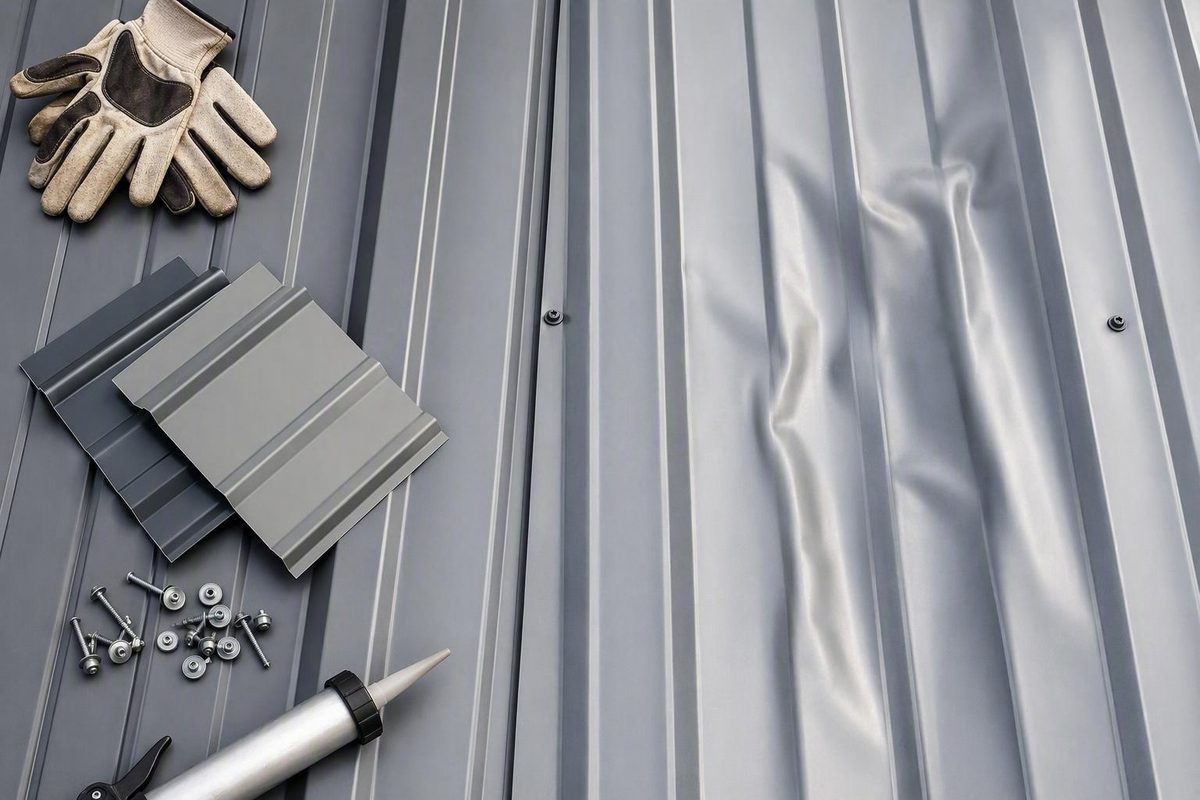
A standing-seam metal roof can look smooth in overcast light and noticeably rippled when low-angle sunlight reflects across it. That effect is commonly called oil canning. It usually describes visible waviness in the broad, flat parts of metal panels—not a diagnosis that the roof is leaking, structurally unsafe, or improperly installed.
That distinction matters. Not every bend, buckle, dent, or uneven panel should be dismissed as ordinary oil canning. Similar-looking distortion can accompany damaged panels, uneven decking, panel misalignment, restricted thermal movement, or fastening problems. A useful assessment considers the complete roof assembly rather than judging it only by how flat the panels appear.
Oil canning is also not simply a thin-metal problem. Panel geometry, material thickness, finish, fabrication, handling, support, clips, fasteners, and thermal movement can all influence the result. Some choices reduce physical susceptibility; others primarily make waviness less visible. None guarantees a perfectly flat roof under every viewing condition.
Much of the detailed prevention and repair guidance available for oil canning is qualitative and produced by manufacturers, suppliers, or roofing contractors. It identifies recurring industry practices and potential contributors, but it does not establish comparative success rates for particular remedies. Product-specific instructions, project documents, approved samples, and an actual inspection remain more authoritative for an individual roof.
What oil canning looks like—and what the term means
Oil canning is visible or perceived waviness, rippling, elastic buckling, or stress wrinkling in the broad, relatively flat areas of metal roof and wall panels. The Metal Construction Association treats those terms as descriptions of the same general phenomenon and notes that it can occur in steel, aluminum, zinc, and copper panels. It may also become especially apparent under particular lighting conditions. The association’s technical bulletin defines oil canning and describes its visual characteristics.
The effect is particularly easy to see in the smooth pans between the raised seams of standing-seam roofing. These uninterrupted areas act like long reflective surfaces. A shallow change in panel contour can bend the reflection enough to create alternating light and dark bands even when the physical deformation is subtle.
Closely spaced ribs, beads, pencil ribs, striations, or corrugations divide the surface into smaller shapes. Some profiles may also add stiffness, but their clearest visual effect is to interrupt long reflections. A heavily profiled panel can therefore look more uniform than a broad architectural pan even when both contain small variations.
Appearance changes with the conditions
The same panel may look:
- Smooth under diffuse or overcast light
- Wavy when sunlight strikes it at a low angle
- Different when viewed from the eave than from the side
- More or less pronounced as its temperature changes
-
Different in summer than in winter
-
Less conspicuous in a matte, textured, lighter, or subdued finish
These changes do not necessarily mean the panel has physically improved or deteriorated. They may reveal or conceal an existing shallow contour. A photograph taken at one time of day is useful documentation, but it is not a complete description of the condition.
The supplied industry guidance provides no widely accepted universal measurement scale that converts a particular amount of reflected-light waviness into “acceptable” or “defective.” The Metal Construction Association notes that the degree of waviness can be difficult to measure. That makes contracts, approved samples, exterior mockups, manufacturer instructions, and documented expectations especially important.
What may not be ordinary oil canning
Gentle, broad waviness visible mainly in reflected light may fit the usual meaning of oil canning. The following conditions should not be classified from appearance alone:
- A sharp crease or kink
- A dent associated with impact or handling damage
- A seam that appears open, displaced, or different from adjacent seams
- A loose or visibly moving panel or trim component
- A localized dip corresponding to apparent deck movement
- A buckle concentrated around an attachment point
- Active leakage or water staining
- Distortion that is becoming progressively worse
Those observations do not prove that the roof is failing, but they justify project-specific investigation. The useful question is not merely, “Is this oil canning?” It is, “Is this reflected-light waviness alone, or is an underlying condition affecting the panel or roof assembly?”
Is oil canning only cosmetic? Start with the underlying condition
Oil canning by itself is commonly classified in metal-roofing guidance as an aesthetic condition rather than proof of structural or waterproofing failure. Sheffield Metals makes that limited distinction while also identifying production, handling, installation, and substrate conditions that can contribute to visible waviness. Its technical overview explains both the cosmetic classification and the possible underlying contributors.
That conclusion should not be extended to every visible deformation. A roof can have ordinary reflected-light waviness and a separate problem. Uneven sheathing can telegraph through a panel. A panel can be damaged during transport. An unsuitable or misaligned clip can restrain movement. A fastener can be installed improperly. Fabrication variation can affect multiple panels. Calling the appearance oil canning does not establish or rule out any of those conditions.
Panel smoothness also does not establish the performance of the complete roof. Uplift capacity and code compliance likewise belong to a tested and properly installed assembly. A smooth panel is not proof that those functions are correct, just as a gently wavy panel is not proof that they have failed.
A practical first assessment
As practical documentation rather than a standardized diagnostic test:
- Observe whether the effect changes with light. Compare morning, midday, late-afternoon, sunny, and overcast conditions.
- Note temperature sensitivity. Record whether the waviness becomes more apparent as the roof heats or cools.
- Distinguish gradual from sharp deformation. Kinks, dents, and concentrated buckles warrant closer examination.
- Compare seams and trim. Note any open, displaced, loose, or irregularly shaped components.
- Check for evidence of water entry. Record active leaks, damp areas, or new staining without assuming that visible waviness caused them.
- Look for progression. Compare dated photographs to determine whether the condition appears stable or changing.
- Record location. Identify the roof plane, panel, approximate distance from an eave or ridge, and nearby penetrations.
These observations can help a contractor, manufacturer, consultant, or other qualified professional decide what requires closer inspection. They do not reveal concealed clip conditions or establish a cause by themselves.
Request project-specific review when distortion is pronounced, new, progressive, or associated with leaks, loose components, seam displacement, impact damage, or apparent substrate movement. If the parties disagree—or if a functional or structural concern exists—an independent roof consultant or building-envelope professional can assess the assembly rather than only its appearance.
This article provides general reference information, not an on-site diagnosis or engineering determination. Mortar Desk describes itself as a building-material reference rather than a contractor or engineering adviser, and project specifications should be checked against the documents and local requirements that govern the work. Mortar Desk explains the scope and limits of its information.
Why metal roof panels oil-can: causes by project stage
Oil canning rarely has one obvious cause. Stress can enter the material during production, fabrication, shipping, storage, installation, or service. Several contributors may interact, and the completed roof’s appearance may not reveal which process was responsible.
A useful investigation follows the panel through the project.
1. Coil and sheet production
Metal roofing begins as sheet or coil. Variation in thickness or tension across the sheet may leave one part of the material behaving differently from another.
Those stresses may not be obvious while the material remains in coil form. Slitting it into narrower widths or forming it into a panel can redistribute them and make waviness more visible. That does not mean every wavy panel has a production defect; it means the material’s manufacturing history is a legitimate part of an investigation.
2. Slitting, roll forming, and fabrication
Metal is stressed further when it is slit, fed through roll-forming equipment, bent, seamed, notched, or cut. Equipment setup, alignment, feed conditions, and material consistency can influence the finished shape.
Long, smooth panels can make small variations more visible. A slight deviation repeated along a broad pan may create a more obvious reflective pattern than the same deviation on a short or heavily ribbed panel.
Fabrication stress can also combine with residual coil stress. Assigning responsibility from a completed-roof photograph alone is therefore unreliable.
3. Transport, storage, and handling
Panels can bend, sag, twist, or become locally dented between fabrication and installation.
A handling-related bend may look different from gentle elastic waviness, but the distinction is not always obvious. Slightly distorted panels may become conspicuous only after installation creates a continuous reflective roof plane.
Storage and lifting should follow the selected manufacturer’s instructions. General supplier recommendations cannot account for every panel length, thickness, profile, bundle size, or jobsite condition.
4. Sheathing, decking, purlins, and framing
A metal panel follows—or spans across—the surface beneath it. Uneven sheathing, warped decking, raised fastener heads, misaligned purlins, or framing that is out of plane can allow flexing or force a panel into an irregular shape.
This is often described as telegraphing: variations in the support plane become visible at the finished surface.
A thicker or more profiled panel may disguise some substrate variation, but a panel upgrade does not make an uneven support plane correct. Substrate preparation remains part of the roof-system specification.
5. Panel layout and alignment
Panels that drift out of alignment may be pushed, pulled, or forced into place. That can introduce stress before the roof experiences normal thermal movement.
Alignment also matters at eaves, ridges, hips, valleys, transitions, and penetrations.
6. Clips and fasteners
Standing-seam systems often use concealed clips or fastening flanges. Their design and installation determine how the panel is attached and, in many systems, how it can move.
Possible contributors include:
- Clips not approved for the panel
- Clips installed out of alignment
- Incorrect clip positioning or spacing
- Fasteners driven at an angle
- Fasteners tightened in a way that distorts a clip or panel
- Attachments that restrain movement the system was designed to permit
- Connections that do not support the panel as intended
The correct clip, fastener, spacing, seating, and tightening procedure are product-specific. Generic rules should not replace the panel manufacturer’s installation instructions or engineered project details.
7. Thermal expansion and contraction
Metal changes dimension as its temperature changes. Properly designed standing-seam assemblies accommodate that movement through their panel, clip, seam, and termination details.
Problems can arise when movement is unintentionally restricted. A panel may be restrained at incompatible points, bound by a misaligned clip, or forced tightly into a transition. Thermal cycling can then make existing stress more visible or add compression that produces wrinkling.
Temperature can also change perception. A panel that looks more wavy when hot is not, by that observation alone, proven to have an attachment defect. Temperature sensitivity is an investigative clue, not a diagnosis.
What the pattern can—and cannot—tell you
A regularly repeating ripple may justify comparing its spacing with clips, fasteners, purlins, supports, or repeated fabrication intervals. Random-looking waviness may justify closer examination of handling, deck irregularity, alignment, shading, and thermal conditions.
Neither pattern proves a cause. Repeated effects can arise from more than one repeated process, while apparently random distortion may have a systematic cause that is not visible from the ground.
A project review may compare observations with:
- Panel shop drawings and layout
- Substrate requirements
- Clip and fastener details
- Installation records
- Manufacturer instructions
- Production or lot information
- Photographs taken before and during installation
- Measurements gathered during a qualified inspection
Prevention begins with the panel specification
Prevention begins before panels arrive. The specification should distinguish between measures that may increase stiffness or reduce stress and measures that mainly conceal reflections.
Physical risk reduction versus visual concealment
These categories overlap, but they are not identical:
| Choice | Principal effect |
|---|---|
| Thicker metal | Generally increases panel stiffness |
| Narrower pan | Reduces the breadth of uninterrupted flat metal |
| Ribs, beads, or pencil ribs | Add formed geometry and break up the flat area |
| Striations | Interrupt reflections and may add some stiffness |
| Flat, aligned substrate | Reduces telegraphing and forced panel distortion |
| Correct clips and movement details | Help the assembly accommodate designed movement |
| Matte, textured, or low-gloss finish | Primarily reduces glare and visual contrast |
| Lighter or subdued color | May make reflected waviness less conspicuous |
A finish can make a roof exhibiting oil canning look more uniform without changing the stresses in its panels. Conversely, a stiffer panel can still show waviness under severe reflected light.
Smooth pans versus profiled pans
A broad, smooth standing-seam pan offers a clean architectural appearance. It is also especially likely to reveal small distortions because little interrupts the reflection.
Striated, ribbed, or beaded pans have a busier appearance. Their formed lines create intentional shadow and texture, so incidental waviness competes less with the overall pattern. Supplier guidance presents these features as ways to reduce the visible appearance of oil canning, not as guaranteed prevention. True Metal Supply’s discussion distinguishes the visual and stiffening effects of striations from complete elimination of oil-canning risk.
The tradeoff is aesthetic. Buyers seeking an uninterrupted minimalist surface are choosing the configuration most likely to show roof-scale reflections. That is not inherently the wrong choice, but expectations should be established before ordering.
Panel width
Narrower panels directionally reduce the width of the flat pan and are commonly associated with lower visible risk. That does not establish a universal “safe” width. The result also depends on panel thickness, profile, length, support conditions, clip arrangement, fabrication, and installation.
Rather than specifying width in isolation, compare the manufacturer’s available configurations. Ask how a narrower pan affects appearance, seam frequency, material quantities, tested assembly options, labor, and detailing.
Color, gloss, and texture
Dark, smooth, high-gloss surfaces can create strong reflections that emphasize shallow waviness. Lower-gloss, matte, textured, lighter, or visually subdued finishes may soften those reflections.
This is primarily an issue of visibility. A matte finish does not necessarily reduce residual coil stress, correct an uneven deck, or improve thermal movement. It may simply make the same contour less apparent.
They cannot reproduce a long roof plane, low-angle sunlight, surrounding reflections, or normal viewing distance.
Use an exterior mockup when appearance is critical
For a visually sensitive project, consider requesting a full-size exterior mockup using the proposed:
- Metal and thickness
- Panel width and profile
- Ribs or striations
- Color and gloss
- Substrate
- Clips and fasteners
- Installation method
View it under several sun angles and from the directions in which the completed roof will normally be seen. Record the viewing conditions and the parties’ approval.
A mockup cannot guarantee that every production panel will look identical.
Ultimately, the specification is an assembly decision. Profile, width, thickness, span, substrate, attachment method, movement accommodation, environmental exposure, applicable testing, and manufacturer requirements must work together.
24-gauge vs. 26-gauge steel: what thickness can and cannot change
For steel roofing, gauge numbers run in the counterintuitive direction: within the applicable steel product system, a lower gauge number generally indicates thicker material. Actual thickness should still be verified in the selected manufacturer’s product data because a gauge designation is not a universal physical dimension across every metal and specification. Mortar Desk’s overview of nominal versus actual material dimensions explains why a material name should not be treated as a complete measurement.
Do not use a steel gauge table to infer the thickness of aluminum, copper, or another metal. Verify the material specification and the manufacturer’s base-metal or coated-sheet data.
As one supplier-reported example, Sheffield Metals lists minimum steel thicknesses of approximately 0.023 inch for 24 gauge and 0.018 inch for 26 gauge. Those figures illustrate the difference within that supplier’s stated product context; they are not universal dimensions for every panel sold under those gauge names. Sheffield Metals provides the attributed thickness figures and associated oil-canning qualifications.
What thicker steel may improve
All else being reasonably comparable, thicker steel is stiffer. Recurring industry guidance therefore describes 24-gauge steel as less susceptible to severe visible waviness than 26-gauge steel, while emphasizing that either can oil-can. A manufacturer-produced technical interview explains the comparison and its assembly-level qualifications.
Thicker material may be worth considering when:
- A smooth architectural appearance is a high priority
- The selected panel has a broad, flat pan
- The roof will be highly visible in low-angle sunlight
- The manufacturer’s tested and approved system uses that thickness
- The price difference is acceptable within the complete project budget
This remains a directional comparison rather than a measured guarantee of appearance.
What 24 gauge cannot fix
Correctly selected 24-gauge panels can still oil-can. Thickness cannot compensate for:
- Residual production or roll-forming stress
- A wide, uninterrupted smooth pan
- Mishandling or bending before installation
- Uneven sheathing or misaligned supports
- Panels forced out of alignment
- Incorrect clips or fastening
- Restricted thermal movement
- Damage after installation
A poorly supported or improperly restrained 24-gauge panel is not automatically preferable to a properly designed and installed 26-gauge system.
Gauge does not establish complete roof performance
Gauge alone does not establish watertightness, uplift resistance, code compliance, lifespan, impact performance, or suitability for a particular building. Those outcomes depend on the tested assembly and project conditions.
When comparing bids, ask for the actual product data rather than accepting “24 gauge” as a complete specification. Compare:
- Base-metal thickness and material specification
- Panel profile and pan width
- Seam and clip design
- Substrate requirements
- Applicable assembly testing
- Finish type and gloss
- Installation requirements
- Price for the complete installed system
- Appearance limitations and warranty language
There is no universal requirement to choose 24 gauge solely because oil canning is a concern. It is one potentially useful measure within a coordinated specification.
Deck, handling, clips, and fasteners: the installation controls that matter
A good panel specification can be undermined by a poor support plane or careless installation. Conversely, careful preparation and movement-compatible detailing can reduce avoidable stress even though they cannot eliminate every source of waviness.
Preinstallation checklist
Before installation begins:
- Inspect the delivery. Look for dents, creases, edge damage, unusual waviness, wet packaging, or distorted bundles. Photograph concerns before panels are moved.
- Confirm panel identity. Check profile, width, length, metal, thickness, finish, color, lot identification, and orientation against approved submittals.
- Follow handling instructions. Use the manufacturer’s requirements for lifting, carrying, stacking, covering, and supporting panels.
- Inspect the support plane. Check sheathing, decking, framing, and purlins for alignment, damage, raised fasteners, moisture-related distortion, and abrupt transitions.
- Verify details. Confirm the approved clips, fasteners, attachment locations, fixed points, sliding points, and transition details.
- Confirm movement accommodation. Make sure panel length and termination details match the manufacturer’s thermal-movement provisions.
- Establish the visual benchmark. Identify any approved sample or mockup and document how appearance will be reviewed.
Substrate tolerances should come from the selected panel manufacturer and project documents. A generalized supplier recommendation should not be converted into a universal rule.
Installation checklist
As work proceeds:
- Maintain the intended panel line and seam alignment.
- Do not force a panel sideways to compensate for accumulated layout error.
- Use the specified clip and fastener at each location.
- Follow product-specific fastener spacing and tightening instructions.
- Avoid angled or over-driven fasteners.
- Install clips in the orientation and position required by the system.
- Keep panel ends and transitions from restraining movement unintentionally.
- Protect installed panels from dropped tools, concentrated loads, and avoidable traffic.
- Review appearance from normal viewing positions as each roof area develops.
- Record relevant concealed conditions before the next panel covers them.
ASC Building Products identifies manufacturing variation, handling, inadequate substrate support, fastening, and thermal movement as possible contributors, while directing installers to product-specific requirements. Its overview summarizes how those factors may interact.
Why the substrate cannot be treated as an afterthought
The roof deck is the reference plane beneath the finished metal. If that plane rises and falls, a broad smooth panel may follow it, bridge it, or flex between high points. The visible outcome depends on panel stiffness and attachment, but replacing a thinner panel with a thicker one does not correct the support itself.
Substrate inspection is therefore not merely appearance control. It helps determine whether the panel can sit and move as designed. Any correction should be selected for the actual deck, framing, panel system, and project requirements.
If pronounced waviness appears during installation
If an unexplained pattern develops while work is underway, a practical documentation sequence is:
- Pause additional installation in the affected area.
- Protect the panels and exposed roof components.
- Photograph installed and uninstalled panels.
- Record panel, bundle, and lot identification where available.
- Note the roof location and environmental conditions.
- Compare the appearance with the approved mockup and project documents.
- Request review by the project owner, installer, and panel manufacturer.
- Document the agreed next step before repeating the condition across the roof.
A pause does not establish that a defect exists. It preserves the opportunity to identify a potentially correctable issue before additional work reproduces or conceals it.
Questions buyers should ask before work starts
Ask the panel supplier, installer, or design professional:
- What substrate flatness and alignment are required?
- How will the substrate be inspected and documented?
- Which clips and fasteners are approved?
- How does the system accommodate panel movement?
- Which panel widths and gauges are permitted for the assembly?
- What are the lifting, storage, and handling instructions?
- Which tests or approvals apply to the exact configuration?
- Is oil canning addressed in the product literature or warranty?
- Will a full-size exterior mockup be provided?
- How will appearance concerns be photographed and evaluated?
- Who has authority to determine acceptance?
- What happens if conspicuous waviness appears before installation is complete?
Clear answers before ordering are more useful than an undefined appearance dispute after completion.
What to do when the roof is already wavy
Begin with documentation rather than an unreviewed repair.
Build a repeatable visual record
Create a panel map and identify each affected location. As a practical documentation method—not a standardized diagnostic protocol—take time-stamped photographs from consistent ground positions using approximately the same distance, direction, and framing.
Photograph the roof:
- In morning, midday, and late-afternoon light
- In sun and overcast conditions
- At different outdoor temperatures
- From normal property or public viewing positions
- Straight on and from an oblique angle
- With enough surrounding roof visible to locate the panel
Record the date, time, weather, approximate temperature, viewing direction, and panel location. Avoid digitally exaggerating contrast or perspective. The purpose is comparison, not producing the most dramatic image.
Collect relevant project documents:
- Signed contract and change orders
- Specifications and drawings
- Approved submittals
- Product data and installation instructions
- Sample or mockup approvals
- Delivery and lot records
- Progress photographs
- Inspection reports
- Manufacturer and installer warranties
- Written communications about appearance
Inspect for an underlying correctable condition
Ask the responsible parties to examine whether the waviness corresponds with:
- Delivery or handling damage
- A distorted panel edge
- Uneven or damaged decking
- Misaligned supports
- Layout drift
- Incorrect or misaligned clips
- Improper fastening
- Restrained panel movement
- Fabrication variation
- A repeated issue associated with one bundle or production lot
Concealed clips, seams, and attachment points should not be adjusted without checking the panel manufacturer’s details and the project requirements. Changing one component can affect panel movement or other aspects of the assembly.
Camouflage is not the same as correction
A different viewing angle, lower-gloss surface, or altered surrounding reflection may make waviness less visible. That does not mean the panel has become flatter.
Coatings and surface patches are not established methods for flattening a deformed panel. A coating may alter color or reflectivity, but it does not reliably remove residual stress, correct an uneven deck, or restore panel geometry.
Where installed waviness is conspicuous, contractor guidance indicates that full visual correction may require panels to be removed and reinstalled. Replacement may also be considered when project-specific inspection establishes panel damage, nonconforming material, or another condition for which replacement is the agreed remedy. Equity Roofing distinguishes surface camouflage from correction involving panel removal and reinstallation.
The available evidence does not establish that adjusting fasteners or adding reinforcement will reliably flatten a panel that has already deformed. An adjustment may correct an underlying restraint without erasing the contour that developed.
Backer rod: a system-specific proposal, not a universal cure
Some suppliers promote adhesive foam backer rod beneath the center of a flat-pan standing-seam panel. The claimed mechanism is a slight intentional crown that changes the panel shape and may reduce visible rippling.
The available demonstration concerns a particular flat-pan, clip-fastened configuration and does not provide independent comparative testing, long-term performance evidence, or universal installation criteria. True Metal Supply demonstrates backer rod as a mitigation option for that specific type of panel.
Before considering backer rod, obtain written manufacturer confirmation addressing:
- Compatibility with the exact panel and substrate
- Approved material and placement
- Effects on movement and attachment
- Effects on applicable testing or approvals
- Effects on concealed drainage conditions
- Warranty implications
- Whether it is intended for initial installation or reinstallation
Do not assume that an installed roof can be retrofitted with backer rod without opening or removing part of the system.
Nor should anyone promise that oil canning will disappear after a particular number of seasons. Temperature and sunlight can change its visibility, and panels may settle differently over time, but the supplied evidence does not support a universal timeline for the physical condition to cure itself.
Acceptance, warranties, and a practical escalation path
Because the supplied guidance provides no universal numerical acceptance threshold, evaluation often turns on the project’s written record. The central documents are the signed contract, specifications, approved submittals, samples or exterior mockup, manufacturer instructions, inspection records, and actual warranty.
The Metal Construction Association states that careful production, material selection, panel design, and installation can minimize oil canning, but total prevention cannot be assured on every project. Its technical guidance expressly rejects a guarantee of complete prevention.
That does not mean every degree or cause of waviness is automatically acceptable. It means the condition must be classified carefully.
Appearance complaint or defect claim?
An appearance-only complaint concerns waviness without an identified material, fabrication, substrate, installation, or performance problem.
A defect claim may allege and document something more specific, such as:
- Damaged or nonconforming material
- Incorrect panel thickness or profile
- Fabrication outside documented requirements
- Substrate work that does not meet project requirements
- Unapproved clips or fasteners
- Installation inconsistent with manufacturer instructions
- Restricted movement caused by improper detailing
- Open seams, leaks, or loose components
A roof can have an appearance concern without an established defect, or a defect that presents as waviness. The classification should follow the evidence rather than precede it.
Warranty coverage cannot be assumed
Sheffield Metals reports that appearance-related oil canning is commonly excluded from roofing warranties, but that general industry statement does not determine coverage for an individual project. A verified manufacturing defect, nonconforming material, or installation error may be treated differently from appearance-only waviness. Its warranty discussion provides the industry attribution but does not replace the project’s actual terms.
Review the actual warranty for:
- Definitions and exclusions
- The issuer of each warranty
- Notice requirements and deadlines
- Required photographs or documents
- Inspection procedures
- Maintenance obligations
- Transfer provisions
- Available remedies
- Limits on labor, removal, or replacement
- Dispute procedures
Warranty documents may distinguish among paint finish, metal substrate, material, workmanship, and weathertightness obligations.
A practical escalation sequence
- Notify the installer in writing. Identify panel locations and state whether the concern is visual, functional, or both.
- Preserve records. Keep photographs, contracts, submittals, product data, delivery information, and communications.
- Request a documented inspection. Ask what was examined and which project requirements were used.
- Compare the work with approved documents. Focus on panel identity, substrate, clips, fasteners, movement details, and mockup expectations.
- Request manufacturer involvement. Ask for a written assessment rather than relying only on an informal verbal opinion.
- Separate findings from proposed remedies. Identify the likely condition before authorizing adjustment, coating, removal, or replacement.
- Consider an independent professional if needed. A roof consultant or building-envelope professional may be appropriate when the parties disagree or functional warning signs exist.
- Check the governing contract and warranty. Any notice, inspection, or dispute procedure should be handled according to the signed documents and applicable project requirements.
Protecting a future purchase
Before signing a contract, define more than “standing-seam metal roof.” Include, as applicable:
- Metal type and specification
- Actual thickness or clearly defined gauge
- Panel profile and pan width
- Smooth, striated, ribbed, or beaded surface
- Color, texture, and gloss
- Responsibility for substrate preparation
- Approved clips and fasteners
- Installation standard and manufacturer instructions
- Applicable tested assembly
- Exterior mockup or full-size sample
- Photography and documentation process
- Appearance limitations
- Warranty documents
- Notice and inspection procedure
- Who determines acceptance and on what basis
Frequently asked questions
Can oil canning cause a metal roof to leak?
Oil canning alone is commonly treated as an appearance condition, not proof that a roof is leaking. But visible waviness does not establish that seams, flashing, penetrations, clips, substrate, or movement details are correct.
If waviness is accompanied by water entry, open or displaced seams, loose components, sharp buckling, or apparent deck movement, the complete assembly should be investigated. Do not assume either that oil canning caused the leak or that calling the distortion oil canning resolves the leak concern.
Does 24-gauge metal roofing eliminate oil canning?
No. Within a specified steel system, 24-gauge material is generally thicker and stiffer than 26-gauge material and is described as less susceptible to severe visible waviness, but it can still oil-can. The Metal Roofing Channel’s technical comparison explains why the distinction is directional rather than a guarantee.
Panel width, profile, fabrication, handling, substrate condition, clip installation, fastening, and thermal movement remain important. Compare the exact product and tested assembly rather than treating gauge as a complete specification.
Do striations prevent oil canning or only hide it?
Striations clearly break up the broad reflective surface that makes waviness noticeable. Depending on the profile, they may also add some stiffness, but that physical effect should be treated as conditional rather than as guaranteed prevention.
They do not remove every source of residual stress or compensate for damaged panels, uneven support, poor alignment, or restricted movement. Their more dependable benefit is reducing how conspicuous the waviness appears.
Will oil canning disappear over time or as the seasons change?
Its appearance may change with temperature, sunlight, viewing angle, and season. A roof that looks smooth in diffuse winter light may show pronounced waves under low summer sun, or the reverse.
That does not establish that the underlying contour has disappeared. Some panels may settle, but there is no reliable universal number of seasons after which oil canning will cure itself. Repeatable photographs can help distinguish changing visibility from apparent progression or improvement.
Is backer rod an approved fix for every standing-seam metal roof?
No. Backer rod is a supplier-promoted, system-specific mitigation option for some flat-pan configurations. It is not an independently established universal cure.
Obtain written manufacturer approval for the exact panel, substrate, attachment, and proposed installation method. Confirm the effects on panel movement, applicable testing, concealed conditions, and warranty coverage before proceeding.
Oil canning should be treated as a system-level appearance issue—not a gauge-only problem and not an automatic diagnosis of roof failure. For a planned roof, align expectations through product-specific data, suitable panel geometry, substrate preparation, movement-compatible installation, and an exterior mockup where visual flatness matters.
For waviness found during or after installation, document it under repeatable conditions, check for functional warning signs, and compare the work with the contract, approved documents, manufacturer instructions, and warranty. Depending on what that review establishes, the appropriate response may be observation, correction of an underlying condition, reinstallation, or panel replacement. No available panel choice or installation measure guarantees perfectly flat metal panels in every light and on every project.