 MortarDesk
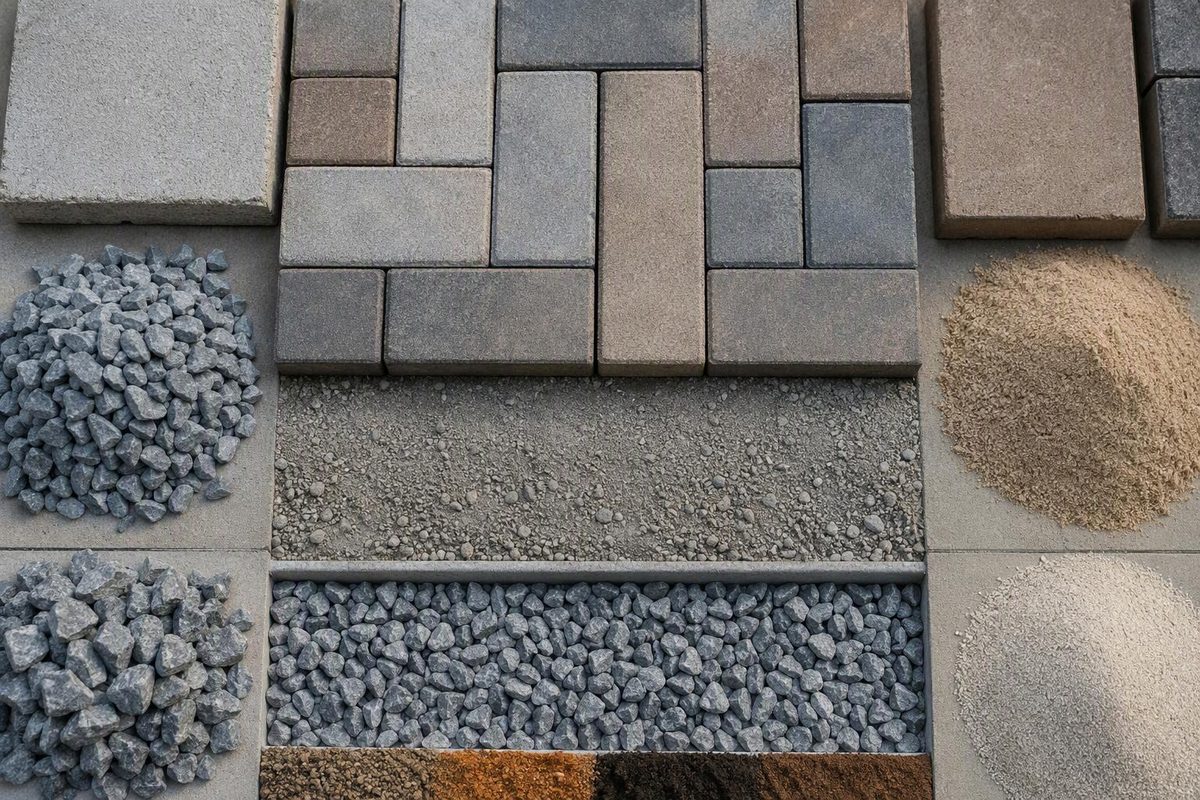
For most conventional sand-set patios, walks and residential driveways, buy a dense-graded crushed aggregate base with a local flexible-pavement or specified ASTM D2940 gradation, then place 1 in. (25 mm) of concrete-sand bedding. Do not choose by a name such as “crusher run” or “paver base” alone because the gradation can differ by supplier.
Dense-graded base contains angular particles in multiple sizes, including fines, so it can be compacted into a dense layer. A nominal maximum size near 3/4 in. (19 mm) is common, but the complete gradation matters more than that single dimension.
The bedding course is a separate material. For a conventional assembly, CMHA specifies clean bedding sand with an ASTM C33 concrete-sand gradation and rejects stone dust and ASTM C144 mason sand for this use (CMHA pavers-on-aggregate-base guide specification).
Enter the paved dimensions and specified compacted depth; adjust the ordering assumptions if your supplier provides them.
Paver Base Volume Calculator
The result is compacted volume first; loose ordering quantity depends on the supplier’s conversion.
Adjust ordering assumptions: 10% and 1.20
Paver Base Materials Serve Different Roles
| Material | How To Identify It | Typical Role | What To Request |
|---|---|---|---|
| Dense-graded crushed aggregate | Angular particles in several sizes, with fines; often sold as a “minus” product | Standard base for most conventional sand-set pavers | Local flexible-pavement base gradation or specified ASTM D2940 material |
| Coarse concrete sand | Clean sand meeting the specified ASTM C33 grading | Nominal 1 in. (25 mm) bedding over dense-graded base | Bedding sand, not mason sand |
| No. 57 crushed stone | Washed, angular, open-graded stone with few fines | Base in permeable or approved open-graded assemblies | ASTM No. 57 or the system’s stated equivalent |
| No. 8 crushed stone | Small, washed angular chips | Bedding in an open-graded assembly | ASTM No. 8 or the system’s stated equivalent |
| Stone dust or screenings | Fine crusher by-product | May be one fraction within a designed dense-graded base | Do not use alone as conventional bedding unless permitted by the system |
| Mason sand | Finer material graded for masonry mortar | Joint material in some systems | Not conventional bedding sand |
| Pea gravel or river gravel | Smooth, rounded particles | Decorative or drainage uses | Do not substitute where angular crushed aggregate is specified |
ASTM D2940 covers quality-controlled graded aggregate spread and compacted on prepared grade to provide base or subbase support. Its scope emphasizes achieving an appropriate density; delivery of the correct aggregate does not by itself create a finished base (ASTM D2940/D2940M-15 abstract and scope).
CMHA similarly recommends aggregate used locally beneath flexible pavement or ASTM D2940 material for its conventional paver assembly (CMHA guide specification). Ask the supplier for the applicable specification or a current sieve analysis rather than relying on the product name.
“Crusher run,” “road base,” “3/4-inch minus” and “paver base” can describe different gradations from one quarry to another. The words on the price sheet do not confirm that the material matches the pavement detail.
Keep the Base and Bedding System Matched
A conventional section, from bottom to top, is:
- Prepared and compacted soil subgrade
- Compacted dense-graded aggregate base
- 1 in. (25 mm) nominal concrete-sand bedding
- Pavers and joint material
The bedding layer is not a substitute for accurate base grading. If the compacted base has a depression, correct that low area before placing the bedding. CMHA specifically says not to fill base depressions with bedding sand (CMHA guide specification).
An open-graded assembly uses different materials—commonly No. 57 base and No. 8 bedding—and must preserve drainage while preventing surrounding soil from migrating into the stone. It is not simply clean 3/4-inch stone substituted into a conventional detail.
At the supplier counter, clean 3/4-inch stone and 3/4-inch-minus road base are not equivalents. Clean stone retains open voids. Minus material includes smaller particles that help form a dense compacted layer.
Permeable and Open-Graded Systems Are Distinct
Two applications can use open-graded aggregate, but their details and limits differ.
Permeable Interlocking Concrete Pavement
CMHA describes a typical 2 in. (50 mm) No. 8 bedding course over a No. 57 base. Where hydraulic or structural design requires it, the assembly can also include a larger No. 2, 3 or 4 subbase. Underdrains may be necessary over soil with low infiltration (CMHA permeable-pavement guidance).
The corresponding guide specification calls for washed crushed aggregate and prohibits rounded river gravel (CMHA permeable-paver specification). These layers are part of a designed drainage system, not interchangeable bulk stone.
Standard Pavers Over an Open-Graded Base
CMHA’s October 2025 guidance allows this alternative only for residential pedestrian projects such as patios, pool decks, sidewalks and walks. It does not extend that guidance to vehicular or commercial work.
The detail calls for geotextile along the excavation bottom and sides, underdrains where the subgrade is not highly permeable, and monitoring for joint-sand loss (CMHA open-graded-base FAQ). Follow the paver manufacturer’s complete detail rather than combining selected components from conventional, permeable and open-graded assemblies.
Base Depth Depends on Use and Site Conditions
CMHA gives these starting ranges for conventional interlocking concrete pavement:
| Use | Compacted Aggregate Base |
|---|---|
| Walk or pedestrian area | 4–6 in. (100–150 mm) |
| Residential driveway | 6–8 in. (150–200 mm) |
| Street | 8–12 in. (200–300 mm) |
These are general minimum ranges, not universal designs. Soil strength, drainage, frost exposure and traffic can require a thicker section. CMHA states that vehicular pavement requires engineered design and recommends aggregate-base compaction targets tied to ASTM laboratory compaction tests (CMHA application guide).
Manufacturer details may also be thicker. Unilock’s basic guide lists 6–8 in. (150–200 mm) for patios and walks and 10–14 in. (250–350 mm) for driveways (Unilock Basic Tech Guide). Use the depth from the selected project detail rather than choosing the smallest published range.
Base depth means the thickness after compaction. If the base is installed in multiple lifts, the finished compacted thicknesses must add up to the specified total.
Calculate Compacted Volume Before Converting the Order
For a rectangular area, compacted cubic yards equal length in feet multiplied by width in feet, multiplied by compacted depth in inches divided by 12, then divided by 27.
For a 12 × 16 ft patio requiring a 6 in. compacted base:
| Calculation | Result |
|---|---|
| Paved area | 192 sq. ft. |
| Compacted depth | 0.5 ft |
| Net compacted volume | 96 cu. ft. |
| Net compacted volume | 3.56 cu. yd. |
| With a stated 10% allowance | 3.91 compacted cu. yd. |
The 3.91 cu. yd. result is a target compacted volume, not necessarily the delivery quantity. Aggregate is commonly quoted loose, and the conversion varies with source, gradation and moisture. Ask the quarry how many loose cubic yards or tons of the exact product are needed to produce 3.91 compacted cubic yards.
If that supplier states that its product requires 1.20 loose yd³ per compacted yd³, multiplying 3.91 by 1.20 gives 4.69 loose yd³. Order rounding then depends on the supplier’s delivery increment. The 1.20 factor is an example supplied for this calculation, not a universal conversion.
Before paying, put these items on the order:
- Material specification or current sieve analysis
- Crushed or angular aggregate requirement
- Required target of 3.91 compacted yd³ for the worked example
- Supplier’s loose-volume or tonnage conversion
- Whether the quote is in loose cubic yards, compacted cubic yards or tons
For a volume-and-weight worksheet, the crushed concrete calculator can show the arithmetic. Replace its density with the quarry’s value for the actual paver-base product.