 MortarDesk
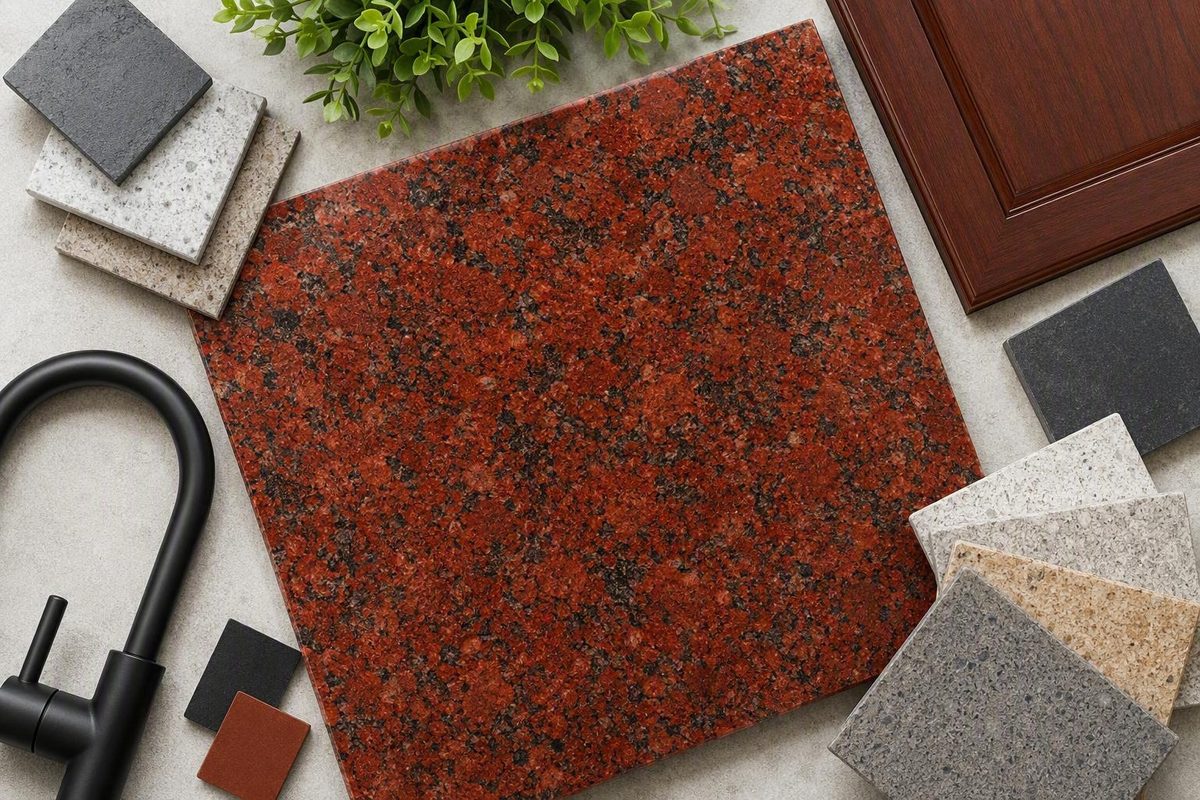
Red granite countertops can make a strong visual statement, but “red granite” is not a precise specification. It is a broad retail label applied to stones with names associated with red, Bordeaux, rose, brown, gold, cream, white, and multicolor palettes.
That makes online catalogs useful for finding possibilities, but not for choosing an exact countertop by name alone.
This guide is therefore focused on slab verification and purchase preparation. Use it to build a shortlist, understand general granite performance and care, and identify what must be confirmed with the supplier or fabricator. It cannot establish the current price, stock, origin, dimensions, finish, or technical characteristics of a particular slab.
What “red granite” means
Granite countertops are made by cutting and polishing slabs of quarried natural stone. Granite occurs in many colors, including red, and each slab can have its own distribution of color and pattern.
In a showroom, “red granite” might describe a slab that appears predominantly red. On a website, however, the phrase may simply identify a seller-controlled browsing category. Inclusion under that category establishes how the seller classified the listing; it does not prove that red is the dominant color of every slab shown.
For a countertop project, verify the actual balance of colors rather than relying on the category name. Depending on the material offered, you may need to assess:
- Whether the slab appears mainly red or has a broader mixture of colors
- How uniform or varied the overall pattern appears
- Whether the full slab suits the intended countertop layout
- How the selected slab differs from the catalog image or other slabs sold under the same name
- Which finish, thickness, dimensions, and quantity are currently available
The same principle applies whether the countertop is intended for a kitchen, bathroom, bar, laundry room, or another surface. “Red” is a discovery term, not a complete material specification.
This guide can establish general characteristics of granite and identify representative names found in seller catalogs. It cannot verify the quarry origin, appearance, availability, price, or project suitability of an individual named product. Those details must come from current documentation for the slab being offered.
Representative red granite names shoppers may encounter
The following names are representative rather than exhaustive. They appear in commercial catalogs associated with red granite, but their inclusion here does not establish a standardized appearance, origin, quality level, or current availability.
Granite Countertop Warehouse displays names including:
- Aegean Bordeaux
-
African Red
-
Barents Red
- Cherry Red
- Desert Ruby
- Empire Red
- Imperial Red
- Multicolor Red
Its supplied catalog material is incomplete, so these examples should not be treated as either the seller’s full range or a complete list of stones available in the wider market. Browse the Granite Countertop Warehouse red-granite catalog.
Marble.com visibly lists Sunset Red, Red Dragon, and Red Bahia under active granite and red filters. The page states that the filtered catalog contains 31 granite countertops, although only part of that selection appears in the available excerpt. That figure describes the seller’s filtered page, not the number of red granite varieties in the market. View Marble.com’s red-filtered granite catalog.
IGS Countertops lists Malibu Red, Multicolor Red, and Iron Red as granite products. Its broader red category also contains Bordeaux-family granite names, including Sucuri Bordeaux, Crema Bordeaux, Bordeaux Premium, and Bordeaux River. The supplied page is truncated and does not establish current inventory. Review the IGS Countertops red category.
The names can be grouped cautiously according to their wording:
- Explicitly red-labeled: African Red, Imperial Red, Sunset Red, Red Dragon, Red Bahia, Iron Red, Malibu Red, Cherry Red, Empire Red, Balmoral Red, and Barents Red
- Multicolor-labeled: Multicolor Red and African Multicolor
- Ruby-labeled: Desert Ruby
- Bordeaux-family: Aegean Bordeaux, Sucuri Bordeaux, Crema Bordeaux, Bordeaux Premium, and Bordeaux River
These are naming groups, not verified visual classifications. Words such as “Cherry,” “Ruby,” and “Bordeaux” may suggest different ideas, but they do not prove the dominant color, undertone, pattern, or appearance of a current slab.
The catalogs also do not support ranking one named variety above another. Labels such as “top rated,” “most popular,” “recommended,” and “top selling” may reflect a seller’s sorting or marketing system. Without an explained methodology, they do not establish durability, quality, value, or suitability for a particular project.
Use trade names as search terms. Do not treat them as substitutes for examining and documenting the current material.
Why trade names and red filters can be misleading
A trade name is a commercial identifier.
The breadth of commercial red categories illustrates the problem. Marble.com’s red-filtered granite listings include names such as Colombo Gold, Crema Montana, Sugar Brown, and Rosewood alongside explicitly red-labeled products. Those names show how broadly the seller’s category is assembled, but they do not establish what any current slab looks like. See the filtered listings and sorting controls.
Other commercial red categories contain granite names such as:
- Madura Gold
- White Spring
- River White
- Ivory Brown
- Rainforest Brown
- Verde Fuoco
- African Multicolor
- Amelia Rose
These examples do not prove that the products lack red or that another color necessarily dominates them. They show only that seller classification may be broader than a buyer expects.
The material filter is just as important as the color filter. The IGS Countertops red category includes granite alongside quartz, porcelain, recycled glass, backsplash products, onyx, and other countertop materials. Individual listings identify their material types, but the category itself is not granite-only. Review the materials included in the red countertop category.
Before adding a product to your shortlist, confirm that:
- The listing identifies the product as granite.
- The trade name applies to the material being quoted.
- The seller can identify the current slab or inventory item.
- The offered slab has an acceptable color balance.
- The seller can distinguish it from similarly named products.
Do not assume two suppliers are offering identical stone because they use the same trade name. The available catalogs show how individual sellers label products, but they do not verify alternate names or equivalence across suppliers.
Catalog identifiers also require caution. Product IDs can be useful when contacting a seller, but they are not performance scores. The same applies to unexplained parenthetical numbers, star ratings, badges, rankings, and sorting positions. Ask the seller what each value means, how it is calculated, and whether it applies to the named product or the current slab.
A red filter narrows a website according to that seller’s classification system. It does not certify that every result is granite or that every listed slab will appear predominantly red.
Natural variation, online images, and slab availability
Natural granite does not reproduce a perfectly fixed pattern from one slab to the next.
A catalog image also may not show enough of the stone to establish:
- The full-slab pattern
- The dominant color across the entire slab
- The finish
- The slab’s dimensions or condition
- Whether the pictured material is currently available
Mountain Empire Stoneworks expressly describes its gallery colors as guides and references rather than guarantees of exact appearance or current stock. The supplier also states that some displayed colors are rare or difficult to obtain and that availability depends on suppliers, importers, quarry output, and production cycles. It reports that its natural-stone inventories can fluctuate daily. These are supplier-specific qualifications, but they provide a clear reason to confirm current availability before relying on a gallery entry. Read the supplier’s gallery and availability qualifications.
A cropped image still has value. It can help you identify candidate names or communicate a broad visual direction. It should not be treated as proof of the full slab’s appearance, finish, dimensions, condition, or present availability.
Use this verification sequence:
-
Identify several candidates. Search under both the granite and red filters where possible. Save the exact trade name, seller, listing address, and product ID.
-
Ask whether current slabs are available. A visible gallery entry is not confirmation that matching material is in stock.
-
Request current full-slab information. Ask whether the supplied image shows the slab currently being offered. If practical, arrange an in-person viewing.
-
Evaluate the complete slab. Confirm whether the overall balance of red and other colors suits the project. Do not base the decision on a small sample area alone.
-
Obtain the specifications in writing. Ask for the material type, dimensions, thickness, finish, quantity, and any other details relevant to the project.
-
Connect the slab to the quote. The written quotation should identify the material or inventory item being discussed clearly enough to avoid confusion.
-
Reconfirm before committing. Check the identity and availability of the selected material before paying or authorizing fabrication.
Ask which services and approval steps are available instead of assuming they are included.
If you can inspect the material in person, consider both the slab’s overall appearance and the portions likely to become separate countertop sections. Ask the fabricator to explain the proposed layout, seams, and cutouts rather than trying to infer the finished arrangement from a catalog image.
Everyday performance: strengths and limitations
The available performance evidence concerns granite generally. It does not establish the technical characteristics of African Red, Imperial Red, Red Dragon, Iron Red, or any other named variety.
General granite guidance lists resistance to scratches, stains, and high temperatures among the material’s advantages. The same guidance describes granite as porous and capable of absorbing staining substances such as oil, food, and wine. It also notes that natural striations or grooves can leave granite susceptible to chips and cracks. Review The Home Depot’s general granite performance guidance.
These statements should not be converted into absolute promises:
- Scratch-resistant is not scratch-proof.
- Stain-resistant is not stain-proof.
- Heat resistance is not a guarantee against every possible incident.
- General durability does not eliminate the possibility of chips or cracks.
Sealing status likely helps explain why granite can be described as generally stain-resistant while also being porous enough to absorb staining substances. The practical conclusion is not that every granite surface will perform identically, but that buyers should confirm the care and sealing requirements for the material being installed.
A trade name alone cannot establish porosity, sealer requirements, or resistance to a particular type of damage. If a performance characteristic is important to the project, ask the supplier or fabricator what documentation applies to the actual stone, finish, sealer, and installation.
The slab is also only one part of the purchase. Ask the responsible project professionals to document the proposed fabrication and installation scope, including measurements, cutouts, edges, seams, delivery, and installation. The supplied catalogs do not establish those terms.
Cleaning and sealing red granite
Routine care for red granite should follow the instructions supplied for the installed stone and sealer. In the absence of different product-specific directions, general granite guidance recommends mild soap and water or a daily cleaner formulated for granite.
Clean up oil, food, and wine promptly. Granite can be porous, and those substances can stain if they are absorbed.
The Home Depot’s general guidance recommends sealing granite and resealing it annually to help resist stains and bacteria. That annual interval is not a universal rule: the appropriate requirements may vary according to the stone, finish, sealant, application, and level of use. See the general granite cleaning and sealing guidance.
At project handover, request written answers to the following:
- Was the countertop sealed before or during installation?
- What sealer was used?
- What routine cleaner is recommended?
- What maintenance schedule applies to this stone and sealing system?
- Who should be contacted if staining or damage occurs?
- Are any care requirements tied to written warranty or installation terms?
Keep those instructions with the project records. A trade name by itself may not tell a future owner or maintenance provider which sealing product or process was used.
Avoid adopting an online test, treatment method, or rigid schedule merely because it refers to granite in general. The evidence supplied here does not support a universal sealing test, stone-specific interval, chemical-avoidance list, or stain-removal procedure.
How to search, compare, and verify options
Online tools can reduce a broad marketplace to a manageable shortlist, provided they are used for discovery rather than final approval.
Marble.com provides separate material and color filters, sorting controls, and comparison for up to four products. Its red-granite page shows both granite and red as active filters, illustrating why buyers should check material and color independently.
Granite Countertop Warehouse links to a color locator and showroom-tour scheduling in addition to its image-based catalog. See the catalog and discovery options.
Mountain Empire Stoneworks provides a color-locator or inventory-search service along with contact, quote, and showroom options. Review its color-search and showroom options.
IGS Countertops allows listed products to be added to a quote request. That feature can organize an inquiry, but it does not establish the current slab, specification, price, or availability.
Turn those tools into a structured workflow:
1. Filter by material first. Select granite instead of assuming everything in a red category is granite.
2. Apply the red filter. Treat the results as candidates, not as proof that every slab is predominantly red.
3. Save several names. Record the seller, exact listing name, product ID, listing address, and the date viewed.
4. Separate stated facts from assumptions. A product name and category are stated catalog information. Dominant color, stock, dimensions, finish, origin, and price remain unverified unless the seller documents them.
5. Use comparison tools cautiously. They can organize listings from one site, but they do not standardize naming across different sellers.
6. Ask about unexplained values. Do not guess what a star rating, badge, parenthetical number, popularity label, or catalog ID measures.
7. Contact the supplier. Provide the exact candidate name and identifier. Ask whether current granite slabs are available and whether the online image represents the material being offered.
8. Replace catalog information with project information. Obtain current slab details, dimensions, thickness, finish, lead time, quote terms, and applicable fabrication or installation information.
A comparison sheet can keep verified facts separate from open questions:
| Field | What to record |
|---|---|
| Seller | Company and contact |
| Listing name | Exact trade name used |
| Product or inventory ID | Seller identifier, if explained |
| Material | Confirmed granite or another material |
| Current slab available | Yes, no, or awaiting confirmation |
| Actual color balance | Description based on the offered slab |
| Full-slab information | Current image, video, or viewing date |
| Dimensions | Written supplier information |
| Thickness | Written supplier information |
| Finish | Written supplier information |
| Origin | Supplier documentation, if provided |
| Lead time | Current written estimate |
| Quote date | Date and validity period |
| Included work | Itemized terms |
| Open questions | Details still requiring confirmation |
Use “unknown” rather than filling a blank with an assumption. The purpose of the sheet is to reveal what remains unresolved before purchase.
A pre-purchase checklist for red granite countertops
Use this final checklist after completing the initial catalog search. It focuses on the facts needed before requesting a final quote or approving a purchase.
Material identity
- [ ] The product is documented as granite.
- [ ] It is not quartz, porcelain, recycled glass, onyx, backsplash material, or another product included in a broad red category.
- [ ] The exact trade name is recorded.
- [ ] The current slab or inventory identifier is documented where available.
- [ ] Any alternate names have been explained by the seller rather than assumed to be equivalent.
- [ ] Ratings, rankings, badges, and unexplained numbers have not been treated as quality evidence.
Appearance
- [ ] The currently offered slab has been evaluated rather than only a generic thumbnail.
- [ ] Its actual balance of red, Bordeaux, rose, brown, gold, cream, white, dark, or multicolor areas is understood.
- [ ] Those descriptions are based on the offered material, not inferred from the trade name.
- [ ] The full-slab pattern is acceptable.
- [ ] The proposed countertop layout has been discussed with the fabricator.
- [ ] The finish has been confirmed in writing.
Availability
- [ ] The supplier has confirmed current availability.
- [ ] It is clear whether the gallery image shows the current slab or serves only as a general reference.
- [ ] Any hold, reservation, deposit, or approval process has been explained.
- [ ] The expected lead time is documented.
Slab information
- [ ] Dimensions are documented.
- [ ] Thickness is documented.
- [ ] Finish is documented.
- [ ] Origin is documented if it matters to the purchase.
- [ ] The available quantity is sufficient for the project.
- [ ] Any relevant condition information or existing repairs have been discussed.
- [ ] The seller has clarified which details apply to the exact slab rather than only to the named product.
The general catalogs cited in this guide do not establish these specifications for a current slab.
Fabrication and installation
- [ ] Responsibility for measurements or templates is clear.
- [ ] Included fabrication is itemized.
- [ ] Sink and appliance cutouts are addressed.
- [ ] Edge work is identified.
- [ ] The proposed seam arrangement has been discussed.
- [ ] Delivery and installation terms are documented.
- [ ] Removal or disposal of existing countertops is clearly included or excluded.
- [ ] Any applicable warranty or remedy terms are in writing.
Not every supplier provides all these services. The checklist is intended to clarify scope, not imply that fabrication, delivery, installation, reservations, or warranties are automatically included.
Care
- [ ] The supplier has stated whether the installed countertop will be sealed.
- [ ] The sealer is identified if one is used.
- [ ] Written routine-cleaning instructions have been provided.
- [ ] Maintenance guidance applies to the installed stone, finish, sealer, and use.
- [ ] A general recommendation has not been mistaken for a universal schedule.
Quote
- [ ] The quotation is written and dated.
- [ ] The quoted material can be connected to the slab or inventory item discussed.
- [ ] Included and excluded work is clearly stated.
- [ ] Material, fabrication, edges, cutouts, delivery, removal, and installation are addressed where relevant.
- [ ] The validity period is stated, or the supplier has explained how long the price and availability can be held.
- [ ] Promotional terms such as “affordable,” “discounted,” or “competitively priced” have not been substituted for an itemized quote.
The available evidence does not support a dependable per-square-foot price range for red granite countertops. It also does not justify assuming that a rare-looking or difficult-to-source slab will always cost more. Obtain comparable written quotes for current materials and equivalent scopes of work.
The decision rule is straightforward: choose from verified current slabs and written project terms—not from a trade name, thumbnail, rating, or promotional label alone.
Frequently asked questions
Is red granite a natural stone?
Yes. Granite countertops are cut and polished from quarried natural-stone slabs, and granite can occur in red as well as other colors. Natural variation means that individual slabs can differ in color distribution and pattern.
A retailer’s red category may also include products made from other materials, so confirm that the specific listing identifies the product as granite.
Does every granite listed under a red filter look predominantly red?
No. Commercial red filters include granite names associated with gold, cream, brown, white, rose, green, and multicolor classifications.
The filter shows how the seller categorized a listing. It does not prove that red dominates the currently available slab. Evaluate current full-slab information or inspect the offered material before deciding.
Do red granite countertops need to be sealed every year?
Not necessarily. A fixed annual interval appears in general retailer guidance, but it should not override the instructions for the installed stone, finish, and sealing system.
Ask the supplier or installer whether the countertop was sealed, which product was used, and what maintenance schedule applies to that installation.
Can I rely on an online gallery to choose the exact slab?
No. A gallery can help identify names and broad visual directions, but natural variation means the current slab may not match a catalog image exactly. A small image also does not establish the full pattern, dimensions, finish, condition, or availability.
Ask whether the pictured material is current, request full-slab information, and connect the selected slab to the written quote before committing.
How much do red granite countertops cost?
The available catalogs do not provide enough consistent information for a dependable material-only or installed price range. Promotional statements about affordability or discounts are not substitutes for comparable quotations.
Request a written, dated quote tied to the current slab. Ask whether it includes material, fabrication, edge work, cutouts, delivery, removal, and installation, then compare providers only after confirming that their quotes cover equivalent work.