 MortarDesk
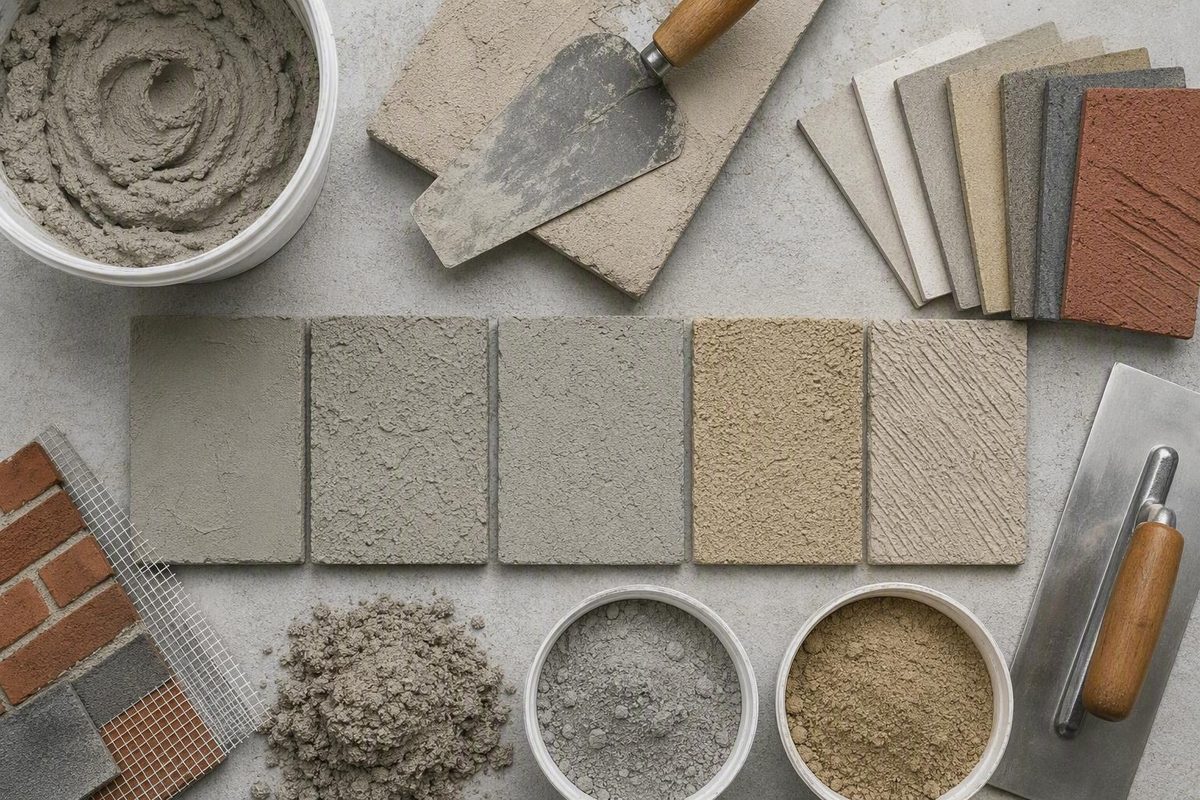
A stucco base coat cannot be selected from a universal mix recipe or thickness chart. The correct material depends first on the substrate and complete wall assembly: sound masonry or concrete, framed construction with lath, approved sheathing within a proprietary system, or a localized repair.
That decision establishes whether the work needs separate scratch and brown coats, a direct-applied masonry schedule, or a proprietary one-coat base. Only then should you compare bag weight, thickness limits, water demand, coverage, working time, curing, application method, and evaluation documents.
The practical rule is simple: identify the wall system before selecting the bag. Products that look similar on a shelf can have materially different permitted substrates and installation requirements.
What a stucco base coat is—and what the term can mean
A cementitious stucco base coat is the plaster beneath the decorative finish. It commonly contains Portland cement, graded sand or another aggregate, water, and product-dependent ingredients such as lime, fibers, or proprietary additives. The base forms the body of the plaster system; the finish supplies the final color, texture, and appearance.
In conventional three-coat stucco, the base ordinarily consists of two applications:
- Scratch coat: The first cement-plaster coat. Its surface is scratched, raked, or grooved while workable to create a mechanical key for the next coat.
- Brown coat: The second base application. It fills, straightens, and levels the wall in preparation for the finish.
- Finish coat: The exposed decorative coat applied after the base has been prepared and cured as required.
The word base therefore does not always mean one application. In conventional work, the scratch and brown coats collectively form the base. The Stucco Manufacturers Association describes conventional stucco as Portland-cement scratch and brown coats installed over the required weather barrier and lath, while proprietary one-coat stucco combines the base functions into one application under its system requirements. (Stucco Manufacturers Association)
A proprietary one-coat product changes the base-coat schedule, not the complete wall. Depending on the evaluated system, the wall can still require approved sheathing, an air- or water-resistive layer, paper backing, metal plaster base or lath, trims, joints, flashing, reinforcement, and a compatible finish.
Retail categories can make the terminology especially confusing. Products displayed near cementitious stucco base coats may include:
- Gypsum basecoat plaster
- EIFS base coat or adhesive
- Masonry cement
- Surface-bonding products
- Bonding agents and primers
- Finish plaster or finish stucco
- Repair compounds
These materials are not interchangeable merely because a retailer places them in the same category or uses the phrase “base coat.” Confirm that the product is a cementitious stucco base intended for the selected substrate and assembly.
Keep three thickness measurements separate:
- Nominal base-system thickness: The specified overall thickness of the base portion of an assembly.
- Maximum thickness per pass: The greatest amount a material may be placed in one application.
- Total finished-wall thickness: The combined thickness of the layers counted by the specified system, potentially including the finish.
A product that permits a thick individual application does not automatically authorize a different total system thickness. Conversely, a system requiring a thicker base may need multiple applications because the material’s one-pass limit is lower.
Conventional three-coat, two-coat masonry, and proprietary one-coat systems
“Three-coat,” “two-coat,” and “one-coat” describe different application schedules. They are not competing names for the same installation.
Conventional three-coat construction uses separate scratch, brown, and finish coats. On framed construction, the cement-plaster base is installed over the specified weather-management components and lath. The Stucco Manufacturers Association describes the conventional scratch-and-brown base as having a nominal thickness of 3/4 inch, but the approved design, applicable code, and project requirements still control. (Stucco Manufacturers Association)
Two-coat masonry construction can mean a base application followed by a finish over suitable concrete or masonry. It does not establish permission to place stucco directly over framed sheathing. For example, a retailer description for an 80-pound QUIKRETE Base Coat says the product can be used for scratch and brown coats in a three-coat system or applied directly to masonry in a two-coat system. That direct-application description is specific to masonry and is not a complete installation specification. (Lowe’s QUIKRETE Base Coat listing)
Proprietary one-coat construction uses a base material as part of a named or evaluated assembly. Its permitted substrates, barriers, lath, reinforcement, trims, thicknesses, and finish requirements come from the assembly documents rather than from the words “one coat” on the bag.
Dryvit’s StucCoat system illustrates the distinction. Its listed components include approved sheathing, an air- and water-resistive barrier, paper backing, metal plaster base, cementitious base, specified reinforcement, optional crack-isolation components, and an acrylic finish. Dryvit states a minimum base thickness of 3/8 inch for the single-coat configuration and a minimum of 7/8 inch for its conventional scratch-and-brown configuration. Those dimensions apply to that named system, not to stucco generally. (Dryvit StucCoat One-Coat)
| System description | Base arrangement | What must be verified |
|---|---|---|
| Conventional three-coat | Separate scratch and brown coats, followed by finish | Weather-management layers, lath, coat thicknesses, curing stages, and finish |
| Two-coat over suitable masonry | Base coat followed by finish | Direct-application approval, masonry condition, preparation or bonding treatment, and thickness |
| Proprietary one-coat | One combined base application followed by finish | Current system documents, approved substrates, barrier, lath, reinforcement, pass limits, and all named components |
“One-coat” is shorthand for the base application. It does not mean the complete wall has one layer or that water management, flashing, lath, trims, joints, reinforcement, or the finish can be omitted.
Start with the substrate and complete wall assembly
Begin by placing the project into one of five categories: sound concrete or masonry, existing brick, framed construction with metal lath, approved sheathing within a proprietary assembly, or localized repair.
Sound concrete or masonry
Direct-applied cementitious plaster may be permitted when both the product and the selected plaster schedule allow it. Before relying on direct bond, verify that the surface is:
- Sound enough to receive plaster
- Clean and free of dust, oil, curing compound, loose material, and other bond inhibitors
- Unpainted where the product requires an unpainted substrate
- Properly rough or absorptive for the selected material
- Repaired where deterioration would undermine the new base
- Conditioned for moisture as the manufacturer directs
Smooth, dense, painted, contaminated, or weak surfaces require more investigation than simply adding a bonding agent.
Existing brick
Treat brick as an existing masonry assembly, not merely as a textured surface. At the planning stage:
- Inspect the brick and mortar joints for deterioration or instability.
- Complete necessary masonry repairs before covering the wall.
- Remove dirt, loose material, incompatible coatings, and bond-inhibiting contamination.
- Determine whether the selected schedule calls for a compatible surface bonder.
- Follow the applicable two- or three-coat plaster schedule.
Do not conceal extensive cracking, movement, hollow areas, or structural distress without determining the cause.
Framed construction with metal lath
A framed wall is an assembly rather than a bare substrate waiting for plaster. Its sequence may include approved sheathing, a specified air- or water-resistive layer, paper backing where required, metal plaster base or lath, trims and accessories, cementitious base, specified reinforcement, and a finish.
The exact order, fastening, laps, openings, transitions, and accessory details depend on the approved design, applicable code, system documents, and local authority requirements. Applying cement stucco directly to wood framing or unspecified sheathing is not a substitute for that assembly.
Approved sheathing in a proprietary system
Some proprietary products list fiberboard, gypsum, wood, or cement-based sheathing among potential substrates. Read that statement together with the complete system instructions. It does not necessarily mean the wet base coat can be bonded directly to any exposed panel.
Verify the exact sheathing, water-management layer, paper backing, lath or plaster base, fasteners, accessories, reinforcement, and evaluation documents required by the system.
Localized repair
A repair product may permit application over existing masonry or cement plaster after unsound material has been removed and the receiving surface properly prepared. Repairs still require compatibility with the existing wall, suitable edge preparation, the specified moisture condition, and compliance with minimum and maximum thicknesses.
A small cosmetic patch is different from diagnosing widespread hollow, delaminated, cracked, or moving stucco.
Most importantly, cement stucco is not itself the wall’s water-resistive barrier. LaHabra’s Fastwall instructions require the applicable water-resistive barrier and flashing for lathed construction and restrict direct masonry or concrete application to suitably sound, clean, unpainted surfaces with sufficient roughness or suction. (LaHabra Fastwall data sheet)
Do not improvise detailed flashing, drainage, joint, or opening design from a bag label. Those details belong to the complete wall design and must be resolved before they are covered.
How to compare bagged base coats before buying
Start with technical compatibility, not price per bag. Create a worksheet with one column for each candidate and record:
- Product type and formulation
- Approved substrates
- Conventional, masonry, repair, or proprietary one-coat use
- Bag weight
- Required or permitted thickness range
- Maximum thickness per pass
- Hand, spray, or pump application approval
- Water requirement per bag
- Mixing time and mixer limitations
- Working or board time
- Coverage at the specified thickness
- Curing directions
- Ambient and surface temperature limits
- Evaluation-report information, when applicable
- Safety-data-sheet availability
- Storage conditions and shelf life
- Compatible finish requirements
Leave a field blank rather than borrowing an answer from another manufacturer.
QUIKRETE Base Coat is an example of a conventional Portland-cement product sold in an 80-pound bag. Its retailer description identifies construction and repair uses, scratch-and-brown applications in three-coat work, and two-coat use over appropriate masonry. Because that listing does not provide complete thickness, coverage, preparation, or curing instructions, it should not be treated as the controlling installation document.
QUIKRETE 1139-78 is a related fiber-reinforced product. The manufacturer identifies it as an 80-pound Portland-cement-based plaster for scratch and brown coats in three-coat systems and brown-coat use over concrete or masonry in two-coat work. QUIKRETE says its synthetic fibers help resist shrinkage cracking; that is a qualified manufacturer claim, not a guarantee that the wall will remain crack-free. (QUIKRETE fiber-reinforced base coat)
LaHabra Fastwall is a factory-prepared mix containing Portland cement, sand, synthetic fibers, and proprietary additives. Rapid Set Stucco Mix is a different preblend based on Rapid Set cement, plaster sand, and additives. Their working, setting, curing, thickness, and coating instructions differ, demonstrating why specifications cannot be transferred from one product to another.
Factory-preblended versus field-mixed plaster
A factory-preblended product supplies proportioned cementitious ingredients, aggregate, and any included fibers or additives. The installer adds only the stated water and any addition expressly authorized by the manufacturer.
A field mix requires suitable plaster sand, approved cementitious ingredients, accurate proportioning, and consistency between batches. A generic field-mix ratio must never be imposed on a proprietary preblend that prohibits added sand, cement, lime, fibers, or admixtures.
Product category matters. EIFS adhesive or base coat belongs to a different assembly, while primers, bonding agents, surface bonders, and finish plasters perform other functions.
Retail price, inventory, ratings, and purchase counts may help arrange a purchase, but they are temporary shopping information. They do not establish substrate approval, yield, durability, code status, or technical quality.
Thickness, coverage, and bag estimating
Required thickness comes from the selected wall system, current product data sheet, applicable evaluation report, and approved project documents. There is no universal stucco base-coat thickness.
A nominal assembly thickness cannot be replaced simply because a material permits a thicker pass. Likewise, a one-pass maximum does not reduce the total thickness required by the approved design.
Published coverage figures show how quickly yield changes with thickness:
| Product and bag | Specified thickness | Approximate published coverage |
|---|---|---|
| LaHabra Fastwall, 80 lb | 3/8 in. | 20–25 sq. ft. |
| LaHabra Fastwall, 80 lb | 1/2 in. | 15–19 sq. ft. |
| SPEC MIX Fiber Base Coat, 80 lb | 3/8 in. | 20–24 sq. ft. |
| SPEC MIX Fiber Base Coat, 80 lb | 1/2 in. | 15–18 sq. ft. |
| SPEC MIX Fiber Base Coat, 80 lb | 3/4 in. | 10–12 sq. ft. |
| Rapid Set Stucco Mix, 50 lb | 3/4 in. | About 7 sq. ft. |
These figures are product-specific estimates, not guaranteed field yields. Coverage generally declines as thickness increases because each square foot consumes more material. Formulation and bag weight also matter, so a 50-pound rapid-setting product and an 80-pound Portland-cement product cannot be compared fairly by square feet per bag alone.
The product documents also demonstrate the range of other specifications that must be kept with the correct material. Rapid Set lists an application range of 3/8 to 2 inches, 2.0–3.5 quarts of water per 50-pound bag, 3–5 minutes of mixing, and approximately 45 minutes of working time at 70°F. It prohibits retempering, over-mixing, and unauthorized additions of Portland cement, lime, or other admixtures.
Fastwall states a one-pass range of 3/8 to 1/2 inch, approximately 1.5 gallons of water per 80-pound bag, low-speed mixing for at least three but no more than five minutes, and a set of 30–45 minutes depending on conditions. Its instructions call for fog curing during the first 24–48 hours after initial hardening, followed by air drying, and state application limits of 40°F–120°F for ambient and surface temperatures during the specified periods. These values belong to Fastwall and must not be generalized.
Use this estimating workflow:
- Calculate wall area. Multiply width by height for each wall section and combine the totals.
- Decide how to treat openings. Apply the estimating convention appropriate to the project rather than automatically deducting every opening.
- Confirm the specified base thickness. Determine whether the required thickness is installed in one application or multiple coats.
- Find the selected product’s coverage at that thickness. Do not substitute a figure from another product.
- Divide wall area by coverage per bag. Use both ends of a published range to create a bounded estimate.
- Round up to whole bags.
- Add a labeled project allowance. Base it on actual wall conditions and application methods rather than a universal percentage.
For a 200-square-foot wall and a product rated for 20–25 square feet per bag at the specified thickness:
- At 25 square feet per bag: 200 ÷ 25 = 8 bags
- At 20 square feet per bag: 200 ÷ 20 = 10 bags
The theoretical requirement is therefore 8–10 bags before any project allowance.
Actual yield can change with:
- Open or heavy lath
- Masonry suction and roughness
- Uneven substrates
- Corners, returns, curves, and small wall sections
- Application method and installer technique
- Water content and thickness variation
- Dropped or discarded material
- Material left in mixers, pumps, or hoses
No single waste percentage is reliable for every project. A flat masonry wall does not necessarily require the same allowance as a complex lathed wall with deep accessories and numerous openings.
A maximum pass thickness is only an application limit. If the assembly requires more material than the product permits in one pass, the next application must be placed at the stage and with the surface treatment required by the manufacturer.
Preparation, mixing, and application workflow
A disciplined workflow prevents a generic recipe from being used on the wrong product.
1. Confirm the assembly and weather window
Identify the substrate, coat schedule, thickness, barrier, lath, accessories, reinforcement, and finish before opening bags. Confirm that forecast and surface conditions fit the product’s temperature, rain, wind, and curing restrictions.
2. Inspect the substrate and water-management work
Verify that masonry or concrete is sound and suitably prepared. On framed walls, inspect the specified sheathing, barrier, flashing, lath, trims, joints, and other concealed components before covering them. A good base coat cannot correct omitted water-management work.
3. Prepare the receiving surface
Remove loose and bond-inhibiting material. Correct defects that the selected system requires to be repaired. Roughen, dampen, or bring the surface to a specified moisture condition only as directed. Determine whether a bonding agent is required rather than adding one automatically.
4. Stage clean equipment and measured water
Use clean containers, paddles, mixers, hoses, and approved mixing water. Measure the water rather than estimating by eye. Organize the work so the batch can be placed within its stated working time.
5. Mix according to the current product instructions
For proprietary preblends, add only the stated water and manufacturer-approved additions. Do not use a general sand-to-cement ratio.
Rapid Set’s published mixing limits and Fastwall’s substantially different values, summarized above, show why one bag’s recipe cannot be transferred to another. Check the current bag and technical sheet even when the product name appears unchanged.
6. Choose equipment appropriate to the batch
- A clean bucket, paddle, and drill may suit small quantities or repairs.
- A wheelbarrow accommodates a larger manually mixed batch but requires more labor.
- A mortar mixer supports larger and more repeatable batches.
- A compatible pump or plaster machine can serve larger wall areas when the product permits machine application.
Equipment choice does not override the material’s mixing limits. Batch size, mixer speed, sequence of addition, hose configuration, and cleanup remain important.
For pumped field mixes, aggregate gradation, water content, hose diameter, hose layout, gradual sand loading, and prompt cleaning affect blockage risk. Oversized aggregate, too much sand, insufficient water, restrictive hose arrangements, or delayed cleanup can contribute to pump pack-outs. Graco’s field-mix guidance should be reconciled with the instructions from both the material and equipment manufacturers. (Graco field-mixed stucco guidance)
7. Place to the specified thickness
Apply by hand trowel, plaster gun, or approved machine only when the product permits that method. Use suitable gauges or accessories to maintain the designed plane. Do not exceed the one-pass limit or stretch the material below the required assembly thickness.
8. Treat the surface for the next stage
A scratch coat is scored or grooved to form a mechanical key for the following coat. A brown coat is floated or leveled to establish the plane for the finish. A proprietary single-coat base may require scoring, floating, reinforcement, or another treatment according to its system instructions.
9. Begin the specified cure
Begin fogging, wet curing, or another specified process at the stage directed by the manufacturer.
Full-wall stucco is advanced work. Stop and obtain qualified help if the approved documents do not clearly resolve lath attachment, water-resistive layers, flashing, drainage, joints, openings, transitions, or proprietary-system requirements. These details are difficult to correct after they are buried beneath plaster.
Curing, weather, and common installation errors
“Cure time” can refer to several different milestones:
- Working time after mixing
- Initial set
- Time until another plaster application can be placed
- Required period of moist curing
- Time allocated for air drying
- Readiness for primer, paint, or another coating
These milestones are not interchangeable. A base can be rigid enough for a following plaster coat while still needing further curing or drying before it receives a coating.
Fastwall’s cited instructions, for example, use a conventional moist-curing schedule followed by air drying. Rapid Set uses a contrasting rapid-product procedure: maintain a wet sheen until the material is hard and cannot easily be scratched with a nail, with a stated minimum water-curing period of 90 minutes. That short procedure applies only to the named rapid-setting product. (Rapid Set Stucco Mix data sheet)
Temperature limits also vary. The Stucco Manufacturers Association describes 40°F–100°F as a general application range for Portland-cement base coats and finishes, subject to rain, freezing conditions, and manufacturer requirements. A product-specific range may differ, as the Fastwall specifications above demonstrate.
Schedule around more than air temperature:
- Rain can damage or wash fresh material and disrupt curing.
- Freezing conditions can affect the substrate and fresh plaster.
- Hot, dry, or windy weather can remove moisture too quickly.
- A wet or frost-covered substrate may violate product requirements.
- Dense or very dry masonry can alter suction and bond behavior.
- Direct sunlight and wall orientation can create different conditions on the same building.
Do not invent a climate-specific cure schedule. Use the manufacturer’s hot-, cold-, wet-, or dry-weather instructions and adjust the work sequence only within those limits.
Common preventable errors include:
- Applying over weak, dirty, painted, oily, or contaminated surfaces
- Treating a bonding agent as a cure for unsound masonry
- Adding unauthorized lime, cement, sand, fibers, accelerators, or admixtures
- Using excessive or inconsistent mixing water
- Over-mixing or retempering
- Mixing more material than can be placed within its working time
- Installing below the required thickness
- Exceeding the maximum thickness per pass
- Failing to key a coat that requires scoring
- Inadequate moist curing
- Applying the next layer before the base has adequate rigidity
- Allowing heat or wind to dry the surface prematurely
- Using unsuitable aggregate or hose arrangements in pumped field mixes
- Leaving cementitious material in equipment until it hardens
Fibers do not eliminate these risks. Crack control depends on the complete wall assembly and installation.
Primer and paint timing requires separate verification. Confirm readiness and compatibility with both the stucco manufacturer and the coating manufacturer rather than relying on an informal cure period or generic coating advice.
Standards, reports, safety documents, and the final verification checklist
ASTM C926 concerns the application of Portland-cement-based plaster. A product statement referring to that standard can be relevant, but it does not independently approve every substrate, thickness, climate, sheathing type, or wall configuration.
Proprietary products and assemblies may cite evaluation reports. The supplied manufacturer materials identify the following references:
- Rapid Set Stucco Mix: manufacturer-listed ICC-ES ESR-2671
- LaHabra Fastwall: manufacturer-listed ICC-ES ESR-2564
- Dryvit StucCoat: manufacturer-listed IAPMO ER-0382 (Dryvit system page)
- SPEC MIX Fiber Base Coat: manufacturer-listed IAPMO ER-950 (SPEC MIX Fiber Base Coat)
These numbers should be treated as manufacturer-listed references, not as independent confirmation of current approval. Before relying on one, obtain the current report from the official evaluation-service database and verify its status, product name, formulation, approved substrates, assemblies, required components, installation conditions, and limitations.
Evaluation-report verification therefore applies when a report is relevant to the selected proprietary product or assembly.
Fire-resistance and code claims commonly belong to a tested wall assembly, not to the bagged base coat in isolation. Framing, sheathing, lath, fasteners, plaster thickness, finish, and other components can all be part of the tested construction.
Applicable law, adopted code, authority requirements, and approved construction documents must be satisfied, while the conditions attached to the selected product and evaluated assembly must also be followed. If the documents conflict, stop and obtain resolution from the responsible design professional, manufacturer, and authority having jurisdiction before proceeding.
Retail listings and generic how-to material are secondary references. They can help identify products and explain concepts, but they should not override approved construction documents, current technical literature, applicable evaluation conditions, or regulatory requirements.
Before ordering, verify:
- [ ] The bag is a cementitious stucco base, not gypsum plaster, EIFS adhesive, primer, masonry cement, or finish
- [ ] The substrate is expressly permitted
- [ ] The wall uses a conventional, masonry, repair, or proprietary one-coat schedule
- [ ] The required number of coats is known
- [ ] The nominal base thickness is identified
- [ ] The maximum thickness per pass is identified
- [ ] Coverage is available at the specified thickness
- [ ] Bag weight is included in the comparison
- [ ] Mixing-water range is known
- [ ] Mixing time and equipment limits are known
- [ ] Working time is suitable for the crew and batch size
- [ ] Hand or machine application is permitted
- [ ] Curing method and duration are known
- [ ] Weather and temperature limits fit the schedule
- [ ] Storage conditions and shelf life have been checked
- [ ] Any applicable evaluation-report number and current status have been verified
- [ ] The finish is compatible with the selected base and assembly
- [ ] Current technical and safety data sheets will be available on site
Safety planning must occur before bags are opened. Follow the current safety data sheet for engineering controls, dust-reducing practices, ventilation, hygiene, and required skin, eye, respiratory, and other protective equipment. Rapid Set’s technical document, for example, identifies cement-dust and silica hazards and directs users to applicable controls and protective measures.
The final decision
Use this sequence:
- Identify the substrate.
- Identify the approved wall assembly.
- Confirm whether the base requires separate scratch and brown coats or a proprietary one-coat application.
- Obtain the current technical data sheet and any applicable evaluation report.
- Verify water management, lath, accessories, thickness, curing, and finish requirements.
- Only then estimate bags and plan mixing and placement.
Thickness, water demand, yield, working time, curing, and application method are product-specific. Stucco is not the water-resistive barrier. If lath, flashing, drainage, joints, openings, or local requirements remain uncertain, consult the authority having jurisdiction, system manufacturer, responsible design professional, or a qualified stucco contractor rather than improvising from a generic recipe.
Mortar Desk publishes independent general-reference information rather than project-specific contracting or engineering advice. Specifications can change, and locally adopted codes can differ, so figures should be checked against the documents and standards edition accepted for the project. (About Mortar Desk)
Frequently asked questions
Is a scratch coat the same as a stucco base coat?
A scratch coat is one portion or type of stucco base coat, but the terms are not always identical. In conventional three-coat work, the scratch coat is the first base application and the brown coat is the second. Together they form the base beneath the finish.
In a proprietary one-coat system, the functional base may be installed in one application, so a separate scratch coat may not exist. Follow the selected system’s terminology and coat schedule.
Can stucco base coat be applied directly to concrete or brick?
Sometimes. A product may permit direct application to suitable concrete or masonry as part of a two-coat or repair schedule. The surface generally must be sound, clean, adequately rough or absorptive, and free of paint or bond-inhibiting residue where the product requires those conditions.
Existing brick should be inspected and repaired before plastering. Determine whether cleaning, roughening, moisture conditioning, or a compatible bonding treatment is specified. Permission for direct masonry application does not authorize direct placement over framed walls or unspecified sheathing.
Does fiber-reinforced stucco base coat prevent cracking?
No. A manufacturer may state that synthetic fibers help resist shrinkage cracking, but fibers do not guarantee a crack-free wall.
Fiber reinforcement is one component of the assembly, not a substitute for correct design and workmanship.
How much area does an 80-pound bag of stucco base coat cover?
It depends on the formulation and installed thickness. The cited product examples range from roughly 20 square feet or more per bag at thinner applications to approximately 10–12 square feet at a 3/4-inch application for one listed 80-pound product.
Use the selected product’s current coverage table at the specified thickness. Then add a separately labeled allowance based on actual wall conditions, application method, and likely waste rather than using a universal bags-per-square-foot figure.
Is stucco base coat waterproof?
No. Cementitious stucco base coat must not be treated as the wall’s water-resistive barrier. A framed stucco assembly generally relies on separately specified barriers, flashing, drainage provisions, lath, accessories, and related components to manage water.
Direct application over suitable concrete or masonry also should not be assumed to waterproof an otherwise deficient wall. Confirm the complete water-management design before covering the substrate.