 MortarDesk
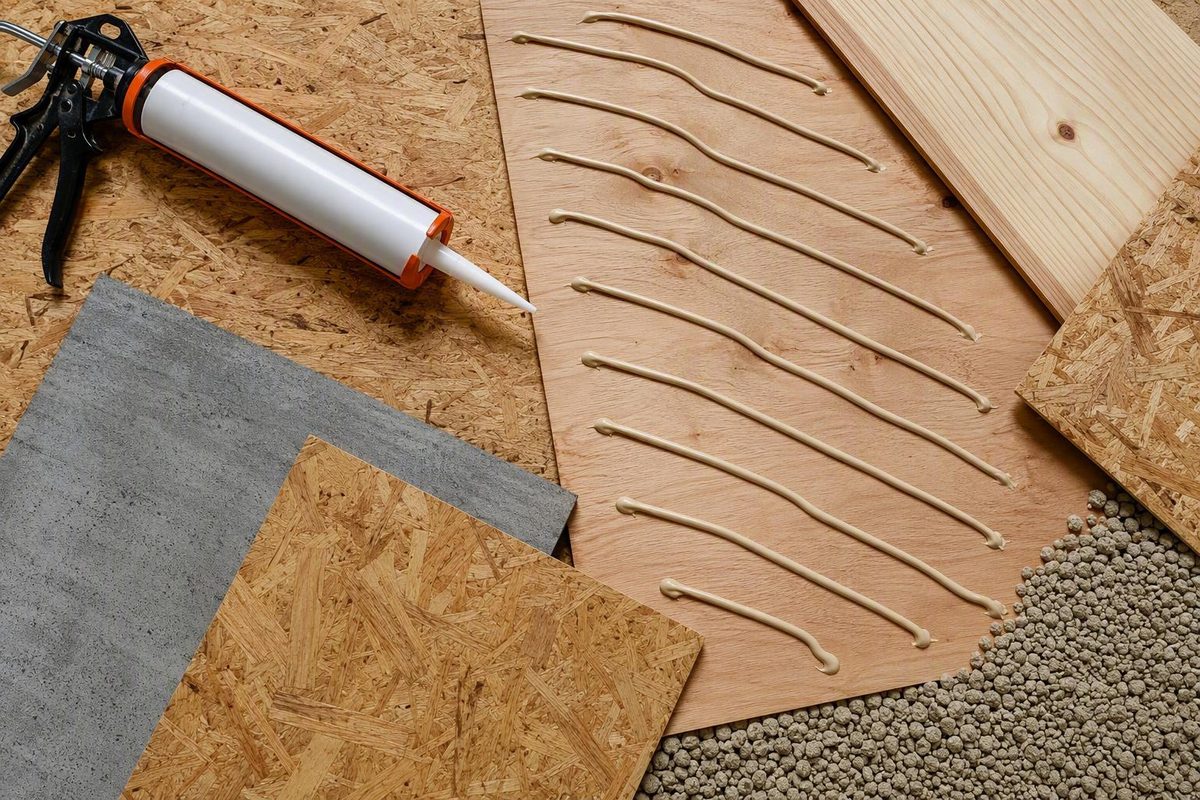
For bonding plywood or OSB subfloor panels to wood joists, start with a product whose current label or technical data sheet states ASTM D3498 or APA AFG-01. Do not choose by the words “heavy duty” alone. APA recommends only adhesives conforming to one of those specifications for its glued-floor system and calls for installation according to the adhesive manufacturer’s directions (APA floor-construction guide).
Adhesive supplements the specified nails or screws; it does not eliminate them. APA’s glue-nailed schedules retain mechanical fasteners, while manufacturers commonly direct installers to fasten each sheet before the adhesive sets (APA; Titebond). Verify the panel manufacturer’s fastening schedule and local requirements separately.
Buying checklist
| Check | What to verify on the exact product |
|---|---|
| Performance specification | ASTM D3498 or APA AFG-01 |
| Substrates | The particular plywood or OSB panel and solid-wood or engineered joist |
| Site condition | Minimum application temperature; whether wet, frozen or treated lumber is permitted |
| Bead | Required diameter on joists and at tongue-and-groove joints |
| Open time | How quickly the panel must be placed and fastened |
| Coverage | Linear feet at the specified bead diameter, not a headline yield at a smaller bead |
| Application | Cartridge and caulk gun, or foam/gel can and its compatible applicator |
| Safety and cleanup | Current label and safety data sheet; ventilation, ignition and skin/eye precautions vary by chemistry |
Chemistry is secondary to those documented conditions. For example, one solvent-based subfloor adhesive is rated from 0°F to 100°F, accepts OSB and wet, frozen or treated lumber, and lists a 10–20 minute working time for a 1/4-inch bead (Titebond). A latex-based product instead says it guns down to 22°F, bonds wet and frozen lumber and meets APA AFG-01 (Liquid Nails). These are product-specific limits, not properties to assume for every solvent- or latex-based adhesive.
Foam-to-gel or polyurethane-can products can provide much greater linear yield, but they require their stated bead and dispensing method. DuPont, for example, directs a continuous zigzag and a single 1/2-inch bead on joists for its canned construction adhesive (DuPont technical sheet). Do not translate cartridge instructions to a foam product by appearance.
Bead size and installation sequence
APA’s general glued-floor procedure uses a continuous bead about 1/4 inch (6.4 mm) in diameter on framing, a serpentine bead on wide members, and two beads where panel ends meet on a joist. It calls for a thinner bead of about 1/8 inch (3.2 mm) in tongue-and-groove joints to limit squeeze-out (APA). The product instructions control if they specify a different bead: Titebond’s cited cartridge product, for example, directs a 3/8- to 1/2-inch bead even though its coverage table also reports smaller beads.
A practical sequence is:
- Confirm panel thickness and span rating first; adhesive cannot correct an underspecified panel. See subfloor thickness and panel rating and OSB versus plywood subfloor sheathing.
- Remove mud, dust and standing water. APA says to wipe water and debris from joists before gluing.
- Apply only enough adhesive for one or two panels so it does not skin over.
- Place and gap panels as the panel manufacturer directs. APA generally recommends 1/8-inch spacing at edges and ends unless the manufacturer says otherwise (APA builder tips).
- Seat the panel and complete its specified fastening before the adhesive sets. Warm weather shortens the available time.
Worked quantity example
Assume a 16 × 20 ft floor (320 sq. ft.), joists at 16 in. o.c., ten 4 × 8 ft panels, and a cartridge product whose instructions permit a 1/4-inch bead. A reasonable ordering estimate is:
- Joist runs:
320 sq. ft. ÷ 1.333 ft spacing ≈ 240 linear ft - Extra bead beside panel-end butt joints: layout-dependent; assume
32 ft - Four panel rows create three glued T&G seams across 20 ft:
3 × 20 = 60 ft - Estimated bead length:
240 + 32 + 60 = 332 ft - Add 10% for starts, stops and waste:
332 × 1.10 ≈ 365 ft
The cited 28 oz Titebond cartridge lists 86 ft at a 1/4-inch bead, so this layout requires 365 ÷ 86 = 4.24, rounded up to five cartridges (Titebond coverage table). At that product’s instructed 3/8-inch bead, its listed yield drops to 39 ft, so the same framing estimate would require substantially more cartridges. Recalculate from the selected product’s required bead rather than treating “28 oz” as a standard coverage unit.
This guidance concerns the structural subfloor-to-joist bond. Bonding a second underlayment layer, finish flooring, foam or panels to concrete is a different application; use the assembly and adhesive specified for that substrate and finish.