 MortarDesk
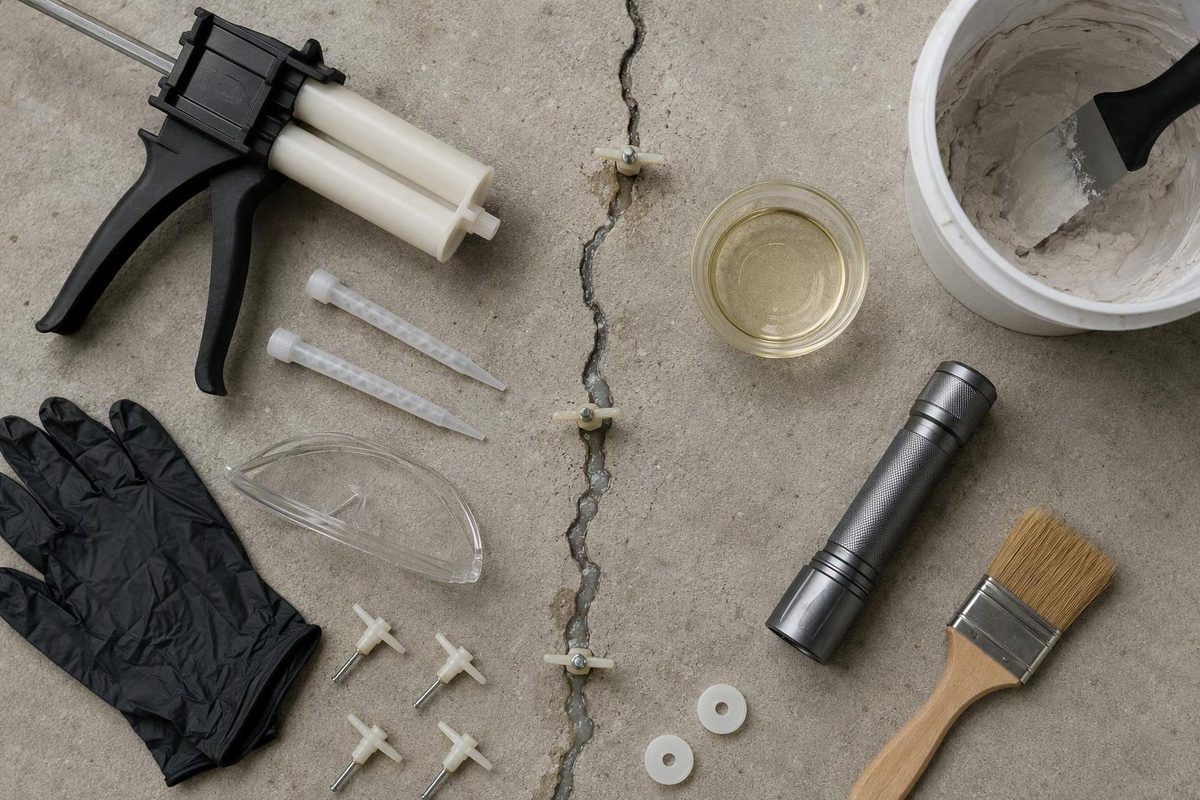
Buy an epoxy foundation crack repair kit only when the injected material is epoxy and the crack meets that product’s stated conditions. The clearest candidate is a dry crack in sound poured concrete with no suspected movement. Active leakage, hollow block construction, wall bowing, displacement or suspected movement calls for another repair method or qualified evaluation—not routine DIY epoxy injection.
“Apparently stable” is not a structural finding. If stability is uncertain, obtain an assessment from a qualified foundation professional or structural engineer before ordering material.
Quick decision: Is an epoxy injection kit suitable for this crack?
Check wall construction, moisture, movement and crack pattern before comparing prices or nominal package lengths.
| Condition | What it means for product selection | Buying decision |
|---|---|---|
| Sound poured-concrete wall; dry crack with no suspected movement | May fit a surface-port epoxy system | Compare the exact product’s substrate, crack range and application limits |
| Active seepage or a wet, glistening crack | A dry-substrate epoxy may not bond or fill as intended | Stop the flow and consider a product-approved water-reactive system |
| Suspected widening, movement or displacement | Rigid epoxy does not accommodate continued movement | Obtain qualified evaluation before selecting a repair |
| Hollow concrete-block wall or stair-step mortar-joint crack | Poured-wall injection instructions do not transfer directly | Use a masonry-appropriate method after determining the cause |
| Horizontal cracking, wall bowing or several related crack patterns | The condition may extend beyond a simple crack fill | Treat this as a precautionary stop-DIY point and seek qualified assessment |
Simpson Strong-Tie states that continual seepage must be stopped before epoxy injection and that polyurethane resin may be required for an actively leaking crack. Its guidance also says dry cracks give the best results and warns that an unsealed backside can let epoxy escape rather than fill the crack effectively (Simpson Strong-Tie crack-injection guide).
Do not use crack width alone as a structural-safety test. Even a hairline crack can leak if it passes through the wall. Direction, location, displacement, wall shape and evidence of change are also relevant. A contractor-authored assessment guide identifies horizontal cracking, wall bowing, wider diagonal cracking, ongoing movement and multiple crack patterns as conditions requiring closer evaluation; these observations are reasons for precautionary referral, not diagnoses from appearance alone (AquaGuard foundation-crack guide).
Wall construction is a separate disqualifier. RadonSeal expressly limits its surface-port epoxy kit to poured-concrete foundation walls and says it is unsuitable for hollow concrete-block walls. Stair-step cracks following block mortar joints have different geometry from cracks in a monolithic poured wall.
Establishing the cause remains separate from filling the visible opening.
Confirm what the kit actually injects
A low-pressure surface-port system commonly has three parts:
- Injection resin: the liquid driven into the crack.
- Paste-over surface sealer: material placed over the exposed crack to contain injection pressure.
- Injection ports: fittings that provide controlled entry points through the surface seal.
The injection resin determines the system type. Epoxy paste applied to the wall does not turn polyurethane foam inside the crack into an epoxy repair.
RadonSeal describes its product as a two-component epoxy injection kit for poured-concrete foundation walls. The Sikadur Crack Repair Kit likewise injects low-viscosity epoxy, but pairs it with a separate two-part polyester surface sealer.
The reverse arrangement appears in retail listings: some foundation kits inject polyurethane foam while using epoxy paste as the surface sealer. Those are polyurethane injection systems, not all-epoxy kits (retailer examples of polyurethane kits with epoxy paste-over).
Do not assume all injection epoxies behave alike. Simpson Strong-Tie lists low-viscosity, super-low-viscosity, gel-viscosity, long-pot-life and fast-setting low-viscosity formulations in its structural injection range. Viscosity affects flow into narrow or irregular spaces, while setting speed and pot life affect the available working time (Simpson Strong-Tie structural injection line).
For buying purposes, rank the checks in this order:
- wall and substrate compatibility;
- active-water and movement restrictions;
- installer restrictions;
- crack-width and temperature limits;
- viscosity, open time and cure time;
- documented coverage basis;
- ports, surface sealer and required tools.
Compare the documented kit specifications
These are representative documented systems, not a comprehensive market comparison. The figures apply only to the named products and stated conditions.
| System | Documented application | Coverage and timing | Purchase conditions |
|---|---|---|---|
| RadonSeal DIY Epoxy Kit | Poured-concrete foundation walls; seller-stated hairline to 1/2 in. crack range | Nominal 10 ft or 20 ft; one-year stated shelf life | Conventional caulking gun required; flat, corner or mixed ports (product page) |
| Sikadur Crack Repair Kit | Concrete and solid masonry; specified 0.1–6 mm range | Approximately 2–4 m; 30-minute open time and 24-hour cure at 20°C | Dry substrate; installation restricted to Sika Approved Contractors (April 2020 data sheet) |
| Simpson Strong-Tie contractor line | Structural concrete crack injection; formulation-dependent | No single coverage or timing figure applies across the line | Resin must be selected by viscosity, setting speed, pot life and temperature |
RadonSeal’s nominal 10-foot and 20-foot package labels assume a 1/16-inch-wide crack through a 10-inch-thick poured-concrete wall. Those lengths are conditional estimates, not guaranteed field coverage. The page states a one-year shelf life from purchase.
As checked on September 14, 2026, the RadonSeal page listed the kit at $289–$519 and an optional caulking gun at $15. These are page-listed prices, not quotations, and may change.
The cited Sikadur data sheet specifies approximately 500 cps viscosity at 23°C, product temperature of 5–30°C, and ambient and substrate temperatures of 5–45°C. It requires sound, clean and dry material and prohibits application to wet or glistening cracks or under osmotic or hydrostatic pressure. It states an 18-month shelf life for unopened, undamaged packaging stored under the specified conditions.
Most importantly, that Ireland-market data sheet restricts installation to Sika Approved Contractors. Standard-cartridge packaging must not be interpreted as unrestricted homeowner approval. The sheet also states CE marking to EN 1504-5 and conformity to ASTM C881 Grade 1, Class C, Types I and II. Those declarations apply to that named product under its stated conditions—not to epoxy kits generally. Requirements can differ by country, so check the current local data sheet before purchase.
Record the following specifications for the exact product under consideration:
- injection-resin chemistry;
- permitted substrate and wall construction;
- minimum and maximum crack width;
- viscosity;
- coverage basis, including assumed width and depth;
- product, substrate and ambient temperature limits;
- working or open time;
- cure time;
- shelf life and storage conditions;
- homeowner, licensed-installer or approved-contractor restriction;
- port type and count;
- surface-sealer chemistry and quantity;
- required applicator or dispenser;
- current local product and safety data sheets.
Estimate coverage without trusting the nominal length alone
Nominal feet or metres are conditional estimates. Crack geometry helps explain why consumption changes, but simple geometric volume does not reliably predict cartridge requirements or a successful fill.
For example, RadonSeal’s 10-foot and 20-foot labels assume a 1/16-inch-wide crack through a 10-inch poured-concrete wall. A wider crack or thicker wall creates more internal space for the same visible crack length and can therefore require more resin.
Consumption may also increase because of:
- branching below the surface;
- internal voids or widening;
- porous concrete absorbing resin;
- an irregular crack path;
- material escaping through an unsealed backside.
A through-crack with no accessible or sealed backside can allow epoxy to escape. High consumption therefore does not prove that the crack is being filled effectively.
Do not apply a universal waste percentage or generic crack-volume calculator to every kit. Resin flow, permitted pressure, package yield, porosity and crack geometry vary. Use the selected manufacturer’s estimator or documented coverage basis, then resolve unexplained geometry and inaccessible backside conditions before ordering.
Know what is included—and what still has to be supplied
“Complete kit” does not necessarily mean every item needed from preparation through cleanup.
For RadonSeal, buyers can select flat ports, corner ports or a mixed set of nine flat and six corner ports. A conventional caulking gun is still required and may need to be purchased separately.
The documented Sikadur package contains:
- two 300 ml surface-sealer cartridges;
- two 250 ml epoxy injection-resin cartridges;
- 16 injection ports;
- mixer nozzles and applicators;
- two flow restrictors and one push-fit connector;
- two pairs of gloves;
- two wooden applicators.
Its cartridges fit standard caulking dispensers, but that convenience does not remove the cited data sheet’s approved-contractor restriction.
Before purchase, inventory the complete system:
- compatible dispenser for each cartridge format;
- correct port style and sufficient port count;
- enough paste-over sealer and injection resin;
- cleaning tools appropriate to the substrate;
- equipment needed to remove paint, coatings or old sealant;
- the current local product data sheet;
- the current safety data sheet.
Use the selected product’s safety data sheet for protective equipment, ventilation, handling, spill response and disposal. These requirements depend on the exact resin, hardener and surface sealer—not the generic word “epoxy.”
Low-pressure injection: the sequence and the failure points
This is an overview of surface-port injection, not a replacement for the selected kit’s current instructions.
First, expose sound concrete around the crack. Remove oil, grease, paint, coatings, sealants, dust, debris and standing water as applicable so the paste-over can bond. Although RadonSeal says routine drilling, grinding or crack chasing is unnecessary for its kit, Simpson Strong-Tie notes that coatings or contamination may still require removal or routing.
Install the ports at the spacing specified for the selected system. Simpson Strong-Tie’s procedure uses approximately 8-inch spacing and calls for paste-over at least 3/16 inch thick and 1 inch wide along the crack. Another kit may specify different dimensions. Keep paste from blocking the port or crack opening, and let the surface seal harden before injection.
For a vertical crack, begin at the lowest port. Inject within the product’s pressure and timing limits until material reaches the next port, close the previous port as directed and continue upward. For a horizontal crack, begin at one end. Continue at each position until the crack refuses additional material; do not assume that higher pressure is the correct response to restricted flow.
| Symptom | Possible causes | Response |
|---|---|---|
| Paste-over leaks | Inadequate thickness, poor adhesion or contamination | Stop and restore the surface seal |
| Strong back pressure | Filled or discontinuous segment, misaligned port, debris, excessive viscosity or cured nozzle material | Check the port, nozzle and instructions |
| Resin does not reach the next port | Branching, widening, blockage or backside loss | Investigate rather than assuming a complete fill |
| Material use is unexpectedly high | Voids, porosity, branching or an unsealed backside | Pause and determine where the resin is going |
Increasing pressure can worsen a failed surface seal. It cannot correct a blocked nozzle, unsuitable resin viscosity or loss through the backside.
Epoxy versus polyurethane or professional injection
Choose by repair objective and actual crack condition, not by the largest word on the package.
| Repair objective or condition | Potential system | Main limitation |
|---|---|---|
| Bond a dry crack in sound concrete where movement is not suspected | Rigid epoxy injection | Poor match for continued movement or active water |
| Seal certain wet, irregular or moving cracks | Flexible or water-reactive resin, often polyurethane | May not provide rigid structural bonding |
| Treat pressurized leakage or difficult geometry | Professional drilled-packer injection | Requires specialized equipment and experienced installation |
| Address settlement, wall deformation or external water conditions | Structural or water-management work | Injection alone does not correct the cause |
Product requirements control. General contractor guidance may describe some epoxies as usable in slight dampness, but that cannot override a selected data sheet prohibiting wet or glistening cracks.
Professional drilled-packer injection is also a different method—not merely a larger surface-port kit. It can involve drilled holes, mechanical packers with non-return valves and injection pumps. Material, drilling pattern, equipment and pressure are selected for the structure and leak conditions.
Polyurethane is not automatically a permanent answer to every wet crack. Sika describes some polyurethane foam resins as temporary water stops that may require secondary acrylate injection for durable waterproofing (Sika injection-system overview). Check the exact product’s intended role rather than assuming all expanding resins provide the same repair.
Finally, inspect the water source as well as the crack. Note whether leakage follows heavy rain, snowmelt, irrigation or groundwater changes, and check grading and downspout discharge around the foundation. Filling a crack does not remove the exterior condition that made it leak.
The buying rule is to choose the system by the material actually injected and the product’s documented conditions. A dry crack in sound poured concrete with no suspected movement may fit a product-approved epoxy system. If the wall is block, water is actively flowing, stability is uncertain, or the wall shows bowing or displacement, stop before purchase and obtain qualified evaluation or select a method designed for those conditions.