 MortarDesk
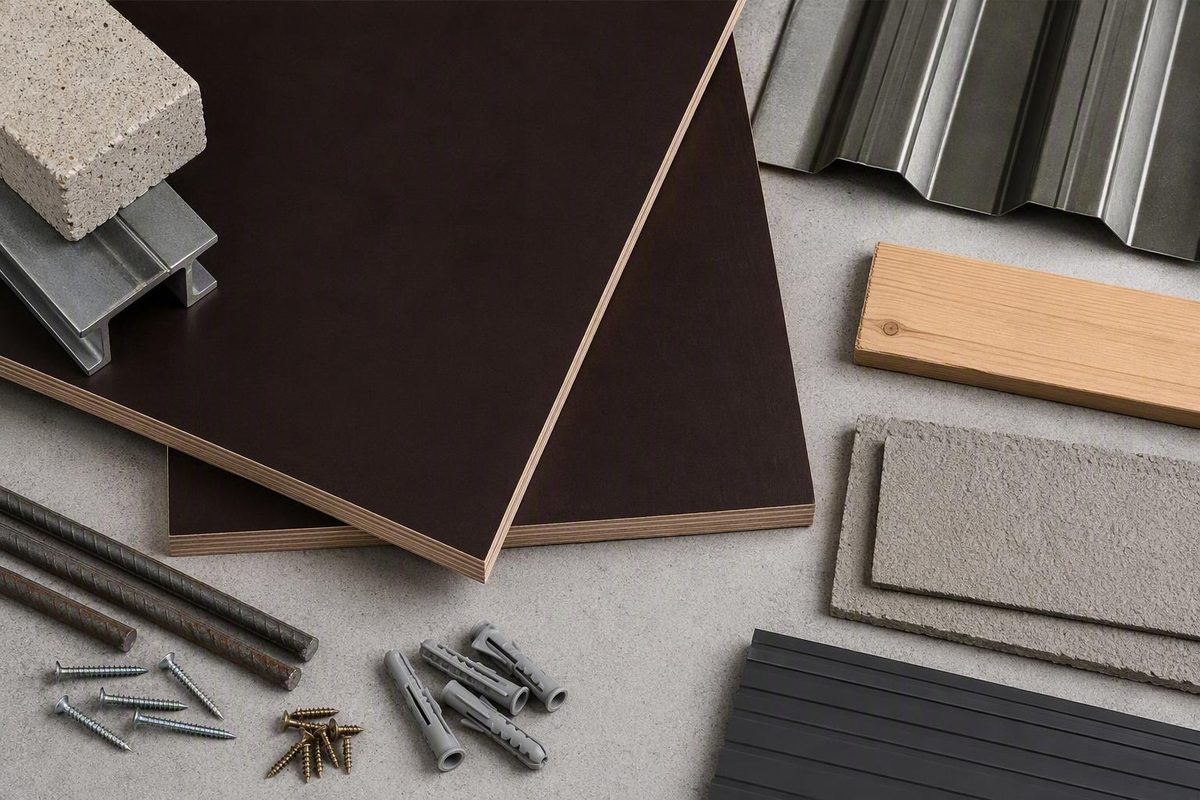
Film faced plywood is easy to recognize and surprisingly difficult to specify. A dark, smooth coating may suggest a durable concrete-forming panel, but it reveals little about the veneers underneath, the adhesive holding them together, the condition of the edges, or the panel’s structural properties.
That distinction matters because film faced plywood is not one uniform grade. Performance depends on the complete construction: overlay, veneer core, internal glue lines, edge protection, manufacturing consistency, exposure, and handling. A specification-led buyer evaluates those elements separately instead of relying on color, nominal thickness, price, or an advertised number of reuses.
This guide is a procurement overview based primarily on supplier and retailer literature. Those sources are useful for documenting market terminology, dimensions, finishes, and purchasing practices, but they are not substitutes for current standards, accredited test reports, product-specific design values, or project engineering.
What film faced plywood is—and what the name does not guarantee
Film faced plywood generally consists of a plywood core covered on one or, more commonly, both faces with resin-impregnated paper or a polymer overlay bonded during manufacture. Heat and pressure consolidate the overlay into a relatively smooth, moisture-resistant surface.
It helps to read the panel as four interacting components:
-
Face film: The overlay exposed to concrete, traffic, abrasion, cleaning, and weather.
-
Core glue lines: The adhesive bonds between the veneers, separate from the surface coating.
- Protected edges: Factory-applied paint or sealant intended to reduce moisture entry where veneer layers are exposed.
Phenolic-resin film is common, which is why sellers frequently use film faced plywood and phenolic plywood as synonyms. The terminology is inconsistent, however. Some suppliers include phenolic, melamine-coated, and plastic-film panels within the broader film-faced category, while others reserve the name for phenolic-overlaid products. One commercial overview, for example, presents phenolic resin, melamine, and polyfilm as different possible coatings (Alvibel’s overview of film-faced plywood construction).
“Phenolic plywood” should therefore be treated as a starting description, not a complete specification. Ask what the face film is, whether both faces carry the same coating, and what adhesive bonds the core veneers.
The last question is particularly important: a phenolic face does not prove that phenol-formaldehyde adhesive bonds the core veneers. The overlay and internal glue lines are independent specifications. A panel can have a phenolic surface while using a different adhesive system in its core.
Application names add another layer of ambiguity:
- Formwork plywood is an application category covering plywood designed or marketed for forming concrete.
- Film faced plywood is one panel type commonly sold for that application.
-
HDO and MDO are overlay categories, although sellers do not always apply those terms consistently.
-
Plyform or forming plywood may be overlaid or unoverlaid, depending on the product.
Face descriptions provide useful but limited information:
- F/F: Smooth film faces on both sides.
- F/W: One smooth film face and one wire-textured face.
- Hexa, haircell, mesh, and similar patterns: Textured finishes intended mainly to improve grip or wear behavior.
A supplier listing F/F and F/W panels identifies the wire face as the textured side and describes factory-sealed edges. The same supplier lists smooth and patterned films in several grammages (Thomes North America’s film-faced plywood specifications). A textured face is not inherently better than a smooth one. It serves another purpose and can transfer its pattern if placed against fresh concrete.
The practical rule is simple: do not let the label replace the technical data sheet. “Phenolic,” “formwork,” “marine,” “HDO,” “exterior grade,” and “premium” remain incomplete descriptions unless tied to a defined construction, intended service condition, and supporting documentation.
Why concrete formwork is the main application
Plywood formwork is a temporary mold that supports and shapes fresh concrete until the concrete develops enough strength for the form to be removed. The sheathing face affects both containment and the appearance of the stripped surface.
An intact smooth overlay is intended to:
- Limit moisture uptake through the panel faces
- Reduce adhesion between cement paste and wood
- Facilitate stripping and cleaning
- Protect the veneer face from some abrasion and contamination
- Help produce a cleaner, more uniform concrete surface
These functions explain why concrete formwork is the principal market for film faced plywood. Common supplier-listed applications include walls, slabs, columns, beams, bridge decks, tunnels, and other infrastructure work.
The face configuration should match the required result. Smooth F/F panels prioritize cleanability and a relatively smooth concrete finish. A scratched, contaminated, bubbled, or uneven face can still mark concrete, so a “smooth film” description does not guarantee architectural results.
They may suit transport flooring, platforms, loading surfaces, flight cases, or workshop applications.
Other marketed uses include:
- Vehicle and transport flooring
- Platforms and walkways
- Flight cases and equipment cases
- Workshop fixtures
- Cabinetry and furniture
- Covered decking
- Interior partitions or linings
These are product-dependent examples, not general approvals. Retail catalogs sell film-faced birch panels with Hexa, haircell, smooth phenolic, and textured phenolic surfaces specifically for flight-case applications (Penn Elcom’s film-faced panel catalog). A similar coating does not establish equivalent structural values, dimensions, bond durability, or suitability for repeated contact with wet concrete.
The caution works in both directions. A full-size formwork panel is not automatically suitable for structural flooring, fine furniture, permanent exterior construction, vehicles, CNC machining, or laser processing. Each use introduces separate questions:
- Structural flooring: Are strength, stiffness, span, fastening, and support data available for the exact product?
- Marine or wet service: What construction, bond, exposure, and detailing requirements apply?
- Permanent exterior work: What service classification, weathering data, edge detailing, and finish compatibility are documented?
- Furniture and cabinetry: Are appearance, emissions, machining behavior, and dimensional stability suitable?
- Machining: Does the manufacturer provide coating, dust, fume, tool, ventilation, and fire-control information for the proposed process?
The coating identifies a surface treatment. It does not establish all the properties needed for a particular application.
Moisture-resistant faces do not make every panel waterproof
Film faced plywood is better described as moisture-resistant unless product-specific evidence establishes a more demanding service classification. Commercial sources alternate between “water-resistant” and “waterproof,” sometimes within the same description. The more limited wording better reflects how a complete panel is exposed in practice.
The film primarily protects an intact face. Water can reach the wood through:
- Factory or site-cut edges
- Drilled holes and tie points
- Fastener penetrations
- Scratches and gouges
- Worn or abraded film
- Open joints and core gaps
- Poorly sealed repairs
- Delaminated or poorly bonded areas
Once moisture reaches the veneers, performance also depends on the internal adhesive, veneer quality, film adhesion, exposure duration, manufacturing moisture control, storage, and opportunity to dry. A glossy black or brown surface cannot reveal those characteristics.
Factory edge paint or sealant is used because exposed plywood edges provide a direct route to the veneers. The coating can reduce moisture entry, but it does not make the panel impervious. Cutting, drilling, or damaging the sheet interrupts that protection.
Supplier handling guidance commonly treats the core, glue line, and overlay as separate parts of the panel and recommends resealing cuts and holes while storing sheets flat and dry (Kosmex’s formwork plywood selection and handling guide). These practices manage exposure; they do not transform the plywood into a permanently waterproof material.
Buyers should distinguish among four conditions:
- Intermittent jobsite wetting: Contact with fresh concrete, rain, cleaning water, and drying between pours.
- Repeated wet-service cycles: Recurring pours with limited drying and repeated edge or fastener exposure.
- Permanent exterior exposure: Long-term weathering, ultraviolet exposure, temperature cycling, and persistent moisture risk.
- Continuous immersion or marine service: Sustained water exposure requiring product- and jurisdiction-specific evidence.
A panel that performs acceptably under intermittent jobsite wetting may not be suitable for the other conditions. Verify the declared exposure or service classification, bond evidence, intended-use limitations, and edge-maintenance instructions. Do not infer them from film color, a phenolic description, or the trade term “WBP.”
The specifications that actually distinguish one panel from another
A useful data sheet should describe more than film color and nominal thickness.
| Specification | What to request | Why it matters |
|---|---|---|
| Core construction | Species, veneer count, layup, jointing method, and face/back construction | Influences stiffness, consistency, machining, weight, and localized weakness |
| Veneer quality | Limits on knots, splits, gaps, overlaps, and repairs | Defects can affect finish, fastener behavior, and consistency |
| Core voids | Acceptance limits or production-control method | Large gaps can create localized weakness and visible edge defects |
| Core adhesive | Chemistry, declared bond classification, and product-specific test evidence | Indicates how glue lines are intended to tolerate exposure |
| Face film | Resin or polymer type, film weight, color, smoothness, and pattern | Affects surface interaction, cleanability, and wear behavior |
| Thickness | Nominal and stated actual thickness | Needed for fit, detailing, calculations, and procurement consistency |
| Tolerance | Permitted thickness and dimensional variation | Wide variation can affect joints and alignment |
| Dimensions | Finished length and width | Determines coverage, joints, waste, and delivered value |
| Flatness | Permitted bow, cup, or twist | Affects support contact, joints, and surface uniformity |
| Edge treatment | Factory coating, coverage, and repair instructions | Helps manage moisture entry at exposed veneer edges |
| Structural data | Strength, stiffness, directionality, and applicable grade | Required when the panel forms part of a load-resisting system |
| Test records | Bond, exposure, emissions, and quality-control reports | Provides evidence beyond sales terminology |
Core species and construction
Supplier literature identifies birch, other hardwoods, eucalyptus, poplar, and combination cores. Species can influence density, weight, workability, and cost, but the species name alone does not rank finished panels reliably.
Veneer thickness, layup, gaps, overlaps, jointing, moisture control, pressing, adhesive spread, and bond quality also matter.
Density is a supporting value, not a complete quality measure. It cannot reveal localized voids, weak glue lines, uneven veneers, or poor film adhesion.
Film chemistry and weight
Film weight is usually stated in grams per square metre, or g/m². Supplier literature commonly describes a 120–220 g/m² market range, while individual listings include a 117 g/m² light-brown film and other options at 125, 165, and 220 g/m² (OnePly’s listed film-weight options).
These are market examples, not universal requirements. A heavier overlay provides more material before the coating is worn through, but grammage alone cannot predict:
- Film adhesion
- Core strength or stiffness
- Internal bond durability
- Resistance to edge damage
- Concrete finish
- Successful reuse count
Thickness, dimensions, and tolerance
Common supplier-listed formwork thicknesses include 12, 15, 18, and 21 mm. A widely listed full-sheet format is 1220 × 2440 mm, approximately 4 × 8 ft; suppliers also offer other formats, while retailers sell much smaller craft panels (Vinawood’s film-faced plywood specification guide).
Nominal inch and metric descriptions are not necessarily exact equivalents. A product name such as “3/4 inch” should not be assumed to state the measured thickness precisely. Request:
- Nominal thickness
- Stated actual thickness
- Plus-and-minus tolerance
- Measurement method
- Whether the overlay is included in the stated dimension
Measure representative delivered sheets. For a broader explanation of why labels and measured dimensions can differ, see Mortar Desk’s guide to nominal and actual material sizes.
Bond and service classifications
“WBP” is an ambiguous trade description, not a sufficiently precise purchasing specification. Sellers may expand or interpret it differently, and the term alone does not identify an adhesive chemistry, test method, bond class, exposure duration, or service limit.
Some supplier guides direct buyers to EN 314 bond classes and EN 636 service classes. Those references may be more specific than “WBP,” but the available evidence here consists of supplier interpretations rather than the official standards. Buyers should verify the applicable classification, edition, declared product performance, jurisdictional acceptance, and test documentation independently.
Where panels will be installed indoors or machined in an enclosed space, request product-specific emissions and safety information for the complete panel. A claim concerning only the film or only the adhesive does not necessarily characterize the finished product.
Selecting a panel for formwork without turning a thickness chart into engineering advice
Start with the pour rather than the catalog. Define:
- Pour geometry
- Expected concrete pressure
- Span and support spacing
- Required finish
- Weather and moisture exposure
- Fastening pattern
- Stripping method
- Handling equipment
- Intended reuse
- Acceptance criteria for deflection, joints, and surface marks
Supplier charts often associate thinner panels with lighter or vertical work, mid-range panels with common slabs, beams, or columns, and thicker panels with heavier work. These are market-positioning examples, not safe design rules.
Thickness alone cannot establish allowable pressure, span, support spacing, fastening, or deflection. Two sheets with the same nominal thickness can differ in veneer layup, strength, stiffness, bond, defects, and tolerance. Where structural loads or worker safety are involved, selection requires current product-specific values, applicable local requirements, and a formwork design prepared or checked by a suitably qualified person.
Match the face to the required finish
For fair-faced or architectural concrete, specify a clean, smooth film and define what “acceptable” means. Criteria may cover:
- Scratches and gouges
- Bubbles or local film loss
- Panel flatness
- Joint layout and leakage
- Tie-hole treatment
- Color or texture variation
- Previous-use marks
- Permitted concrete patching
A nominally smooth face can still produce poor results if it is contaminated, worn, uneven, or installed with misaligned or leaking joints.
Increase scrutiny as exposure and reuse rise
A short, protected pour may tolerate a different construction from a repeated-pour project exposed to rain and standing water. As exposure and the desired reuse count increase, place more weight on:
- Documented bond performance
- Consistent veneer layup
- Tight, protected edges
- Film adhesion
- Compatible repair materials
- Flat, covered storage
- Controlled stripping and cleaning
Treat desired reuse as a procurement input, not a guaranteed output. It tells the supplier what service is intended. Actual service life still depends on the core, glue lines, weather, concrete, release agent, handling, repair, storage, and the project’s rejection criteria.
A concise decision path is:
- Define the required finish and exposure.
- Establish loads, pressures, supports, and allowable deflection through the formwork design.
- Set a realistic target for successful reuse.
- Specify the overlay, core, glue line, dimensions, tolerances, and edge protection separately.
- Verify product documents and inspect representative samples.
Mortar Desk publishes general building-material reference information, not individualized engineering, contracting, or formwork-design advice. Structural decisions should rely on current product data, applicable standards and local requirements, and an appropriately qualified designer.
Film faced plywood compared with HDO, MDO, marine plywood, and unoverlaid plyform
These names describe overlapping market categories rather than a universal quality ladder. Because product constructions and terminology vary, the following table is best read as a procurement-question matrix, not a standards-based classification.
| Panel category | Typical market description | Principal selection concern | Possible surface result | Moisture limitation | Documentation to request |
|---|---|---|---|---|---|
| Film faced plywood | Resin film, commonly phenolic; smooth or textured | Film adhesion, core consistency, bond evidence, and edge protection | Smooth film is selected for a cleaner finish; patterns may imprint | Cuts, penetrations, wear, and weak glue lines remain vulnerable | Film chemistry and weight, core layup, bond evidence, structural data, edge treatment |
| HDO | Forming panel with a high-density resin-treated overlay | Exact overlay construction, panel grade, and structural values | Marketed where a dense, smooth forming face is wanted | Edges and damaged areas still require attention | Overlay designation, grade, structural data, exposure evidence, release-agent guidance |
| MDO | Panel with a medium-density resin-treated overlay | Exact construction and suitability for the intended finish | Product-dependent, generally less glossy than smooth film | Not automatically suitable for every repeated wet-service condition | Overlay specification, bond evidence, structural data, intended use |
| Marine plywood | Plywood sold to defined wet-service construction or bond requirements | Verification of the governing specification and permitted exposure | Wood or supplied face treatment may transfer texture | “Marine” does not mean immune to deterioration or automatically suitable for immersion | Governing standard, veneer and bond grade, structural data, exposure limits |
| Unoverlaid or B-B plyform | Forming plywood without a continuous resin-film face | Face grade, forming grade, strength, and finish expectations | Wood grain and face variation may transfer | Bare or treated wood faces absorb and wear differently from resin film | Plyform grade, face/back veneers, bond evidence, structural values, treatment |
Supplier literature describes HDO, MDO, film-faced plywood, and unoverlaid plyform as having different overlays and likely finish characteristics, but it also publishes inconsistent reuse estimates. Those comparisons do not use common products, climates, concrete mixes, handling practices, or failure criteria (SUMEC’s commercial comparison of forming-panel overlays).
Marine plywood addresses a different selection problem. Its verified construction and bond may suit specified wet conditions, but an untreated wood face is not necessarily the preferred concrete-release surface. Conversely, a smooth phenolic face does not establish marine-grade construction underneath.
Choose among these categories by asking:
- What concrete finish is required?
- What exposure must the complete panel withstand?
- Are structural values available for the exact product and thickness?
- Is traction required on the exposed face?
- Is the overlay compatible with the proposed release agent?
- Which standards, grades, or classifications are documented?
- What defects and finish variations will the project accept?
Category name, color, density, or overlay pattern alone cannot establish structural capacity, bond durability, finish quality, or marine suitability.
How to inspect, specify, and price a purchase
A detailed request for quotation reduces the chance of receiving a visually similar but technically different panel.
RFQ checklist
Ask the supplier to state:
- Exact finished length and width
- Nominal and actual thickness
- Thickness and dimensional tolerances
- Core species and veneer layup
- Veneer count, where relevant
- Controls for gaps, overlaps, and voids
- Core adhesive chemistry
- Declared bond or service classification
- Film chemistry, color, texture, and grammage
- Whether one or both faces carry the specified film
- Factory edge-seal material and application
- Recommended repair coating
- Structural strength and stiffness data
- Emissions information
- Product-specific test reports
- Certification identifiers and scope
- Manufacturer and factory location
- Batch-control and traceability process
- Quantity and packaging
- Currency, taxes, and payment terms
- Freight terms and destination
- Lead time and availability
Request the technical data sheet, a representative cross-section or core photograph, and evidence supporting the exact bond claim. Broad labels such as “premium,” “exterior grade,” “boil proof,” or “WBP” are not substitutes.
Delivery inspection workflow
Sample sheets from different positions in the shipment, not only the top of the stack.
- Confirm markings, batch details, and paperwork.
- Measure length, width, and thickness on multiple sheets.
- Check thickness at several points, including near edges.
- Sight or lay sheets to identify bow, cup, or twist.
- Inspect faces under angled light for scratches, bubbles, ripples, contamination, and inconsistent film.
- Examine edges for open gaps, cracks, swelling, or early delamination.
- Compare the edge seal with the approved sample.
- Review an agreed cross-section or test piece for obvious core gaps and overlaps.
- Quarantine visibly damaged or nonconforming sheets before use.
A manufacturer buying guide recommends checking surface uniformity, bubbles, scratches, bonded edges, cross-sections, and supporting bond documentation (Green Timber’s film-faced plywood inspection guidance). These are supplier-recommended checks. They can reveal visible defects but cannot establish bending strength, stiffness, emissions compliance, bond durability, or safe formwork spacing.
Certificates also need scrutiny. Match each document to the exact manufacturer, factory, product name, thickness, production scope, standard, issuing body, and current certificate number. A logo on a website or quotation does not prove that the delivered batch is covered.
Normalize price before comparing offers
A sheet price is meaningful only after normalizing:
- Sheet area
- Thickness
- Currency
- Tax
- Freight and unloading
- Order quantity
- Packaging
- Quotation date
- Availability
- Waste and rejection rate
A small retail panel and a full formwork sheet cannot be compared by sticker price. Two nominally similar full sheets are not equivalent if actual thickness, overlay, bond evidence, freight terms, or documentation differ.
For repeated formwork, calculate cost per successful pour:
Cost per successful pour = total purchase, freight, maintenance, rejection, concrete-repair, and premature-failure costs ÷ acceptable pours actually achieved
Include cleaning labor, edge repair, disposal, and surface remediation when they materially differ. Model at least three cases:
- Conservative: Early damage or fewer successful pours
- Expected: Realistic performance under planned handling
- Best case: Favorable conditions and careful maintenance
Retail collection filters sometimes advertise maximum-repetition values of 10, 20, 35, or 50, but the listing does not provide common test conditions (OnePly’s film-faced plywood collection). Those numbers show that reuse is a market concern; they do not promise that a buyer will achieve the selected value.
Care, edge repair, and troubleshooting
Care cannot correct a weak core or unsuitable bond system, but poor handling can quickly damage an otherwise serviceable panel.
Use a consistent workflow:
- Inspect each sheet before use.
- Confirm release-agent compatibility with the panel and required concrete finish.
- Apply the agent in a thin, even film.
- Install and fasten without unnecessary face damage.
- Strip without gouging or prying through the overlay.
- Remove concrete residue promptly using methods approved for the panel.
- Allow sheets to dry.
- Repair cuts, holes, and damaged areas promptly.
- Stack sheets flat, supported, and under cover.
Commercial forming guidance warns that excess release oil may stain concrete and collect abrasive grit. Because compatibility is product-dependent, follow the panel manufacturer’s instructions and the project’s finish requirements rather than assuming that any release agent is suitable.
Reseal newly cut edges, drilled holes, tie penetrations, and damaged areas with a coating confirmed as compatible with the factory finish. Do not assume that any exterior paint, resin, or sealant will adhere properly or withstand the intended exposure.
| Symptom | Possible contributors | What to check |
|---|---|---|
| Edge swelling | Exposed wood, delayed resealing, standing water, poor storage, or inadequate bond durability | Edge coating, cutting history, drainage, storage, and bond evidence |
| Delamination | Weak glue line, prolonged wetting, manufacturing defect, impact, or recurring edge damage | Where separation began, exposure history, adhesive information, and batch pattern |
| Film peeling | Impact, abrasion, poor adhesion, incompatible chemicals, or unrepaired damage | Peel location, cleaning method, release agent, and recurrence across the batch |
| Surface scratches | Rough stripping, dragging, exposed fasteners, abrasive grit, or poor stacking | Handling tools, separators, cleaning, and fastener placement |
| Concrete sticking | Worn film, contamination, unsuitable release agent, uneven application, or stripping conditions | Face condition, release procedure, contact area, and timing |
| Staining | Excess or incompatible release agent, contamination, rust, dirty storage, or repair products | Agent application, hardware, storage surfaces, and repair material |
| Poor concrete finish | Scratches, bubbles, worn film, leaking joints, contamination, or poor flatness | Face under angled light, joints, alignment, and acceptance criteria |
| Warping | Uneven wetting or drying, unsupported storage, manufacturing variation, or exposure | Stack support, moisture history, flatness records, and batch distribution |
| Visible core gaps | Veneer layup or production-control problems | Edge cross-section, repeated defect locations, and supplier acceptance limits |
Do not diagnose edge swelling from film weight alone. Likewise, peeling film has no single universal cause. Record where failure began and whether it is isolated, repeated across a batch, or associated with a release agent, weather event, cutting operation, or storage condition.
A service-history log is more useful than memory. Identify each sheet or batch and record:
- Pour count
- Face used
- Weather and wetting
- Concrete or release-agent changes
- Damage
- Cleaning method
- Edge and face repairs
- Reason for rejection
Over time, those records reveal achieved cost per pour and provide project-specific evidence for future purchasing.
Do not infer that coated plywood is safe to heat, burn, or laser process from a generic product name. One retailer markets a phenolic-faced birch panel as laser compatible, but its listing does not provide enough coating, emissions, ventilation, or fire-control information to establish safe use for every machine or setting (MakerStock’s phenolic-faced birch listing). Obtain the manufacturer’s current safety documentation and machine-specific guidance before processing or disposal.
Frequently asked questions
Is film faced plywood the same as phenolic plywood?
Often, but not always. Many sellers use the terms interchangeably because phenolic-resin film is common on formwork panels. Other suppliers include melamine and plastic overlays within the film-faced category.
Even when the face is phenolic, that does not establish which adhesive bonds the core veneers. Specify the overlay and internal bond system separately.
Is film faced plywood completely waterproof?
No universal waterproof claim is justified. An intact overlay can reduce moisture uptake through the faces, but edges, cuts, holes, fasteners, scratches, worn film, repairs, and weak glue lines can admit moisture.
Treat the panel as moisture-resistant within its documented service conditions. Verify the core bond evidence, edge treatment, intended exposure, and repair instructions before repeated wetting, permanent exterior exposure, immersion, or marine service.
How many times can film faced plywood be reused for concrete formwork?
There is no fixed number. Seller claims vary, and the available comparisons do not use consistent panels or test conditions.
Reuse depends on the core, glue lines, film adhesion, edge sealing, concrete, release agent, weather, stripping, cleaning, storage, and the project’s rejection criteria. Budget with conservative, expected, and best-case scenarios, then track acceptable pours actually achieved.
What thickness of film faced plywood should I use for formwork?
Supplier catalogs commonly list 12, 15, 18, and 21 mm, but none is a universal answer (APAC’s formwork plywood thickness examples). Selection depends on concrete pressure, panel span, support spacing, geometry, product-specific strength and stiffness, fastening, and allowable deflection.
Do not convert a supplier’s application chart into a structural design. Use current product data and a qualified formwork design wherever structural loads and safety are involved. Mortar Desk’s editorial scope is limited to general reference information rather than project engineering.
Can film faced plywood be used outdoors, in marine settings, or for laser cutting?
Only when the exact product has documentation supporting the proposed use.
For outdoor or marine exposure, verify the complete panel’s construction, bond evidence, service classification, edge detailing, and permitted exposure—not merely the presence of a phenolic face. Intermittent jobsite wetting, permanent weather exposure, and continuous immersion are different service conditions.
For laser processing, obtain product-specific coating, emissions, ventilation, machine-compatibility, and fire-control information. A retailer’s compatibility icon or general machining statement is not enough.
The safest buying sequence is specification-first: identify the application and exposure; establish engineered formwork requirements where loads are involved; specify the overlay, core, bond, dimensions, tolerances, and edge treatment separately; verify current documents; inspect the delivered batch; and track actual service history. The film is only one part of the panel. Achieved performance depends on the complete construction and how it is handled.