 MortarDesk
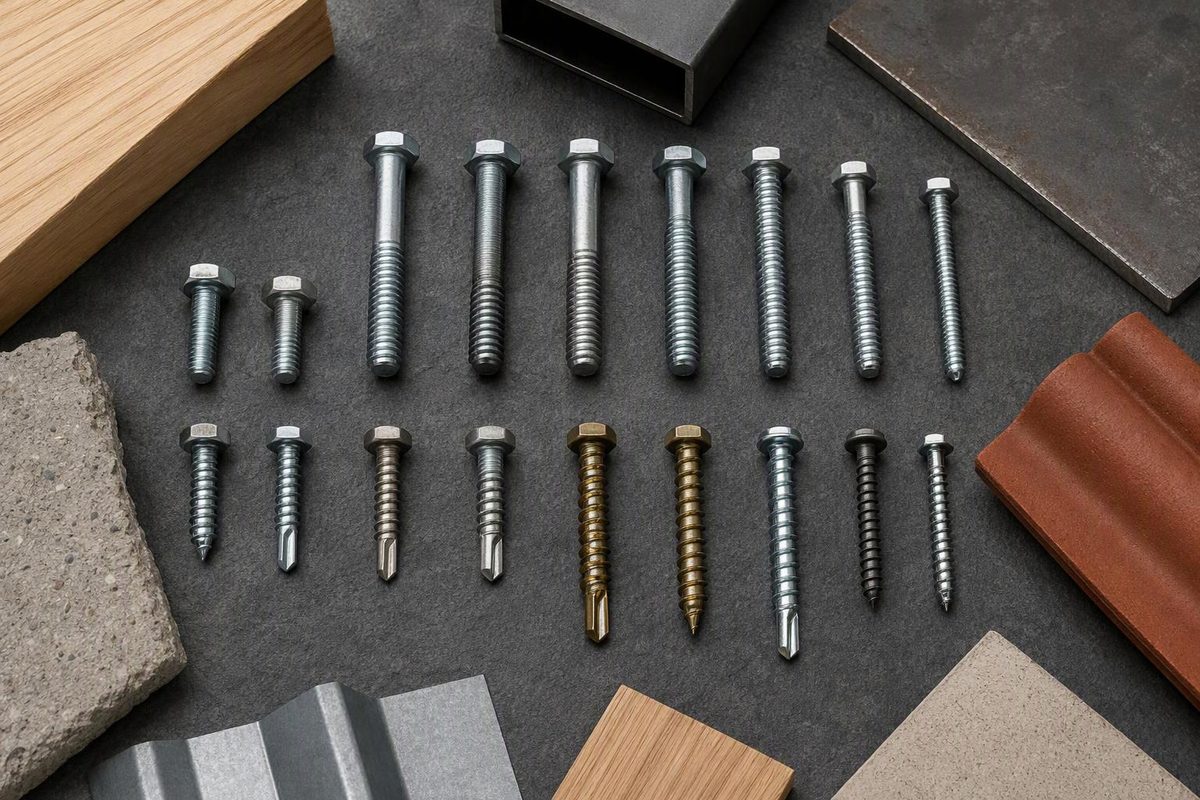
A hex head screw has six external flats driven with a wrench, socket or nut driver. “Hex head” identifies only the head shape and drive interface—not the screw’s diameter, thread, point, strength, material or intended substrate. A 1/4-20 hex cap screw, a structural wood screw and a self-drilling sheet-metal screw can all have hex heads, but they are not interchangeable.
Choose the connection, visible size notation and exposure; the selector returns the specifications you still need.
Hex Head Screw Specification Selector
A matching socket identifies the drive only. Use the connection details to build the rest of the specification.
Result: The Full Specification Is Still Needed
Do not order by socket size
- Identify the connection and substrate.
- Record nominal diameter, thread pitch or TPI, and length.
- Record the point, head form, material, coating and washer.
- For structural work, find the named product and current report or schedule.
Source basis: ISO 4017:2022, ICC-ES ESR-2236 (January 2026) and the ITW Buildex 2026 catalog figures discussed in the article. Product-specific limits do not transfer to look-alike screws.
Read Thread Size Separately From Wrench Size
For an inch machine-threaded screw, 1/4-20 × 3/4 in. identifies three dimensions:
- 1/4 in. is the nominal thread diameter.
- 20 is the number of threads per inch, abbreviated TPI.
- 3/4 in. is the nominal screw length.
None of those values necessarily states the required socket or wrench. One documented 1/4-20 × 3/4 in. hex cap screw, for example, uses a 7/16 in. wrench. Its specifications separately identify Grade 8 steel, full threading and compliance with ASME B18.2.1 (Fastenal).
Calling that fastener a “7/16 screw” would confuse the head dimension with the thread diameter. Fastener diameter is almost always the major diameter across the threads, not the width across the head flats (Bolt Depot). A replacement selected only because the same socket fits can therefore have the wrong diameter, thread or application.
| Marking | Diameter | Thread | Length |
|---|---|---|---|
| 1/4-20 × 3/4 in. | 1/4 in. | 20 TPI | 3/4 in. |
| M6 × 1.0 × 30 | 6 mm | 1.0 mm pitch | 30 mm |
Metric notation keeps thread size and head size separate as well. M6 × 1.0 × 30 means a 6 mm nominal diameter, 1.0 mm thread pitch and 30 mm length. It does not state that the head measures 6 mm across its flats.
ISO 4017:2022 covers steel and stainless-steel hexagon-head screws with metric coarse-pitch threads from M1.6 through M64 and product grades A and B. Property class or stainless grade remains a separate part of the selection (ISO). Matching an M designation and length is not enough if the required material or property class differs.
For a projecting hex head, length is normally measured from the bearing surface beneath the head to the tip. Confirm the product drawing when the screw has a shoulder, sealing assembly or unusual point. Standard fastener notation normally gives diameter, thread count or pitch, and then length (Bolt Depot).
The Head May Include a Flange or Sealing Washer
A plain hex head and a hex washer head are related but not identical descriptions. A hex washer head, commonly abbreviated HWH, has an integral flange beneath the driving flats. That flange increases the bearing area, but the abbreviation does not by itself promise a weather seal.
A roofing or cladding screw may be supplied with a separate bonded sealing washer beneath the head. The washer, coating and substrate compatibility then become controlling parts of the specification. A screw labeled only “HWH” should not be assumed to include the washer required for an exposed panel connection.
This distinction also prevents confusion when replacing a screw from a roof or wall panel. Match the head and drive, but also record whether a bonded washer is present, what material the screw enters and what coating the manufacturer requires. Guidance specific to exposed panel connections is covered in Metal-to-Metal Roof Screws Match the Connection.
Match the Screw Type to the Connected Materials
The substrate and connection determine what kind of thread and point the screw needs. The external hex drive does not answer that question.
| Hex-head type | Thread and point | Typical connection | Controlling checks |
|---|---|---|---|
| Hex cap or machine screw | Machine thread | Nut or tapped hole | System, diameter, pitch, length, grade |
| Lag screw | Coarse wood thread | Hardware or wood to wood | Pilot hole, penetration, washer, exposure |
| Structural wood screw | Proprietary wood thread and point | Evaluated wood connection | Exact product, report, spacing, edge distance |
| Self-drilling screw | Drill point and tapping threads | Sheet steel to steel | Steel thickness, point capacity, TPI, speed |
| Roofing or cladding screw | Wood or metal thread | Exposed metal panel | Substrate, washer, coating, tightening |
A hex cap screw or machine screw is specified to mate with a nut or tapped hole. Determine whether the connection uses inch or metric threads before comparing diameter and pitch. Then match length and the required grade, property class or stainless grade. Socket fit alone does not establish any of those details.
A lag screw uses a coarse wood thread and usually a gimlet-style point. Its selection depends on the required diameter and penetration, the manufacturer’s pilot-hole instructions, the washer and the corrosion protection needed for the exposure.
A structural wood screw is a particular evaluated product rather than a generic screw with a structural-looking head. The design may depend on the exact product, length, spacing, edge distance and exposure rating stated in its evaluation report or approved schedule.
A self-drilling screw has a drill point ahead of its tapping threads. Its point must drill the combined steel thickness for which that specific product is listed. Nominal diameter, TPI and length remain separate specifications.
A roofing or cladding screw must match the material beneath the panel as well as the panel itself. Wood-substrate and metal-substrate screws can share a similar head and sealing washer while using different threads and points.
Structural Capacity Comes From the Specified Product
A hex head does not establish load capacity. Head shape cannot substitute for an evaluation report, tested product specification or approved fastener schedule.
The January 2026 ICC-ES report for Simpson Strong-Drive SDS screws, for example, defines a specific 0.256 in. major diameter, 10 TPI thread, Type 17 point and hex washer head. It then provides application-specific design and spacing requirements (ICC-ES ESR-2236). Those provisions apply to the identified SDS products; they do not make another same-looking hex-head screw equivalent.
For a structural connection, retain the manufacturer and product identification when the design names them. Verify the current evaluation report or approved schedule rather than replacing the screw according to head style, nominal length or driver size alone.
The same limitation applies when comparing a general lag screw with an evaluated structural wood screw. Both may accept a socket and have coarse threads, but that visual similarity does not transfer the structural screw’s documented capacities or installation conditions to the lag screw. Product labels also use “lag bolt” and “lag screw” inconsistently, so compare the specification rather than relying on the name; see Lag Screw vs Lag Bolt.
Self-Drilling Point Capacity Must Cover the Steel
A self-drilling screw must drill and tap the actual combined steel thickness in the connection. The point number is part of that selection, not an optional description of the tip.
The 2026 Buildex catalog decodes 10-16 × 3/4 in. HWH Teks/3 as:
- #10 nominal screw size
- 16 TPI
- 3/4 in. length
- HWH, meaning hex washer head
- No. 3 drill point
The catalog lists a drill-and-tap capacity of 0.036–0.175 in. for its listed #10 Teks/3 products. Its installation guidance also warns that overdriving can break the screw in torsion or strip the substrate (ITW Buildex).
That thickness range belongs to the listed Buildex products. It should not be assigned to every #10 screw, every No. 3 point or every screw with a similar hex washer head. Another manufacturer or product series requires its own documented drill-point capacity and installation instructions.
Steel thickness is only one part of the match. The replacement must also retain the required nominal diameter, TPI, length, head, material and coating. A drill point that can penetrate the steel does not by itself establish the screw’s suitability for the connection or exposure.
Decode a Complete Replacement Specification
Suppose a label or manufacturer’s schedule calls for 10-16 × 1 in., 5/16 in. HWH, No. 3 point. Each part controls a different feature:
- #10 nominal diameter: This is the screw size. It is not 5/16 in.
- 16 TPI: This identifies the thread count and must remain part of the replacement specification.
- 1 in. length: This is normally measured from beneath the projecting head to the tip.
- 5/16 in. drive: This is the nut-driver or socket size, not the thread diameter.
- HWH: This specifies a hex washer head with an integral bearing flange. It does not necessarily specify a bonded sealing washer.
- No. 3 point: This identifies the self-drilling point, whose capacity must suit the connected steel.
- Material and coating: These must match the substrate, exposure and manufacturer’s requirements.
The Buildex catalog lists this exact size and head/point combination as part 1129000, with a 0.036–0.175 in. drill-and-tap capacity. Changing the point or thread can change what thickness the screw can drill and hold, even if a 5/16 in. nut driver still fits.
If the screw passes through an exposed roof panel, retain any specified bonded washer and compatible coating as well. The HWH designation alone confirms the head form, not the complete weather-sealing assembly.
Record Every Controlling Detail Before Ordering
Start with the complete marking or the manufacturer’s schedule rather than the socket in your hand. Record the thread system, nominal diameter, TPI or metric pitch, length, head form, wrench size, point, material, coating and washer arrangement as separate fields.
For numbered inch screws, use the screw gauge reference to interpret the nominal diameter. The gauge number still does not supply the thread count, length, point or application.
If the connection is structural, add the exact product name and the applicable evaluation report or approved schedule. If it joins steel, add the combined steel thickness and documented drill-point range. If it is exposed to weather, add the required sealing washer and corrosion-compatible finish.
An unidentified removed screw may provide physical dimensions, but its hex head cannot reveal every performance requirement. Where grade, coating, approval or drill capacity cannot be confirmed from the screw or project documentation, treat that field as unknown rather than assuming that a visually similar replacement is equivalent.