 MortarDesk
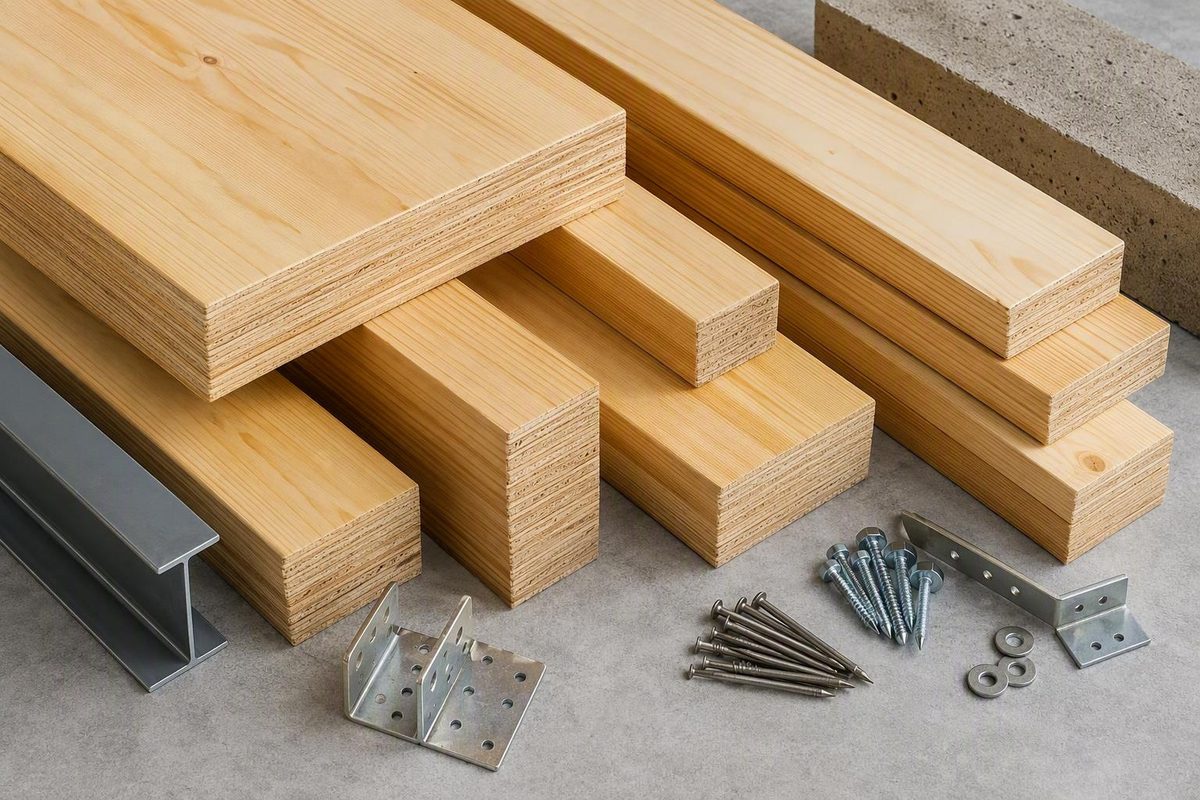
Pine laminated veneer lumber, usually shortened to pine LVL, is not one universal beam, grade, or specification. The phrase describes a category of engineered wood made with pine veneer, but it does not identify the manufacturer, pine species, structural grade, dimensions, treatment, exposure limits, allowable loads, or installation rules.
That distinction matters when buying structural material. Retail listings can help locate stock and compare preliminary prices, but structural selection requires documentation for the exact product being supplied.
A reliable buying process therefore starts with complete product identity and ends with the applicable technical tables—not with a generic “pine LVL span chart.”
What pine LVL is and how it is manufactured
Laminated veneer lumber is an engineered wood product made from multiple thin wood veneers bonded together, generally with the veneer grain aligned along the finished member’s length. That parallel orientation distinguishes conventional LVL from engineered products that intentionally arrange their wood material in other patterns.
The basic manufacturing sequence is:
- Logs are rotary peeled into long sheets of veneer.
- The veneer is dried and assessed or graded.
- Localized defects may be removed, dispersed, or positioned during layup.
- Structural adhesive is applied.
- The veneers are assembled with their grain generally running in the member’s long direction.
- Heat and pressure consolidate the assembly into a large billet.
- The billet is cut into members of the required thickness, depth, and length.
LVL veneer is much thinner than a board or glulam lamination. Typical veneer thickness is about 3.2 mm, within a reported production range of 2.5 to 4.8 mm. Douglas-fir is identified as a common U.S. raw material, while Southern pine, yellow poplar, and other softwoods may also be used. Oklahoma State University explains LVL materials and manufacturing.
Distributing or removing localized veneer defects helps avoid concentrating all the knots, grain deviations, or similar natural features in one solid-sawn section. The process can therefore produce more uniform and predictable material properties than relying on one piece cut from a log. This general manufacturing principle does not establish the capacity of an unnamed product. Actual design properties still depend on the manufacturer, product family, grade, dimensions, and governing documentation.
“Pine LVL” should be used narrowly. It means LVL whose manufacturer or sufficiently complete product documentation explicitly identifies pine as the fiber source. It should not be used as a synonym for all LVL.
The principal material distinctions are:
- Pine LVL: Multiple pine veneers bonded with structural adhesive.
- Solid-sawn pine: A continuous piece cut from a log, then dried, surfaced, and graded.
- Glulam: An engineered member made from bonded sawn-lumber laminations rather than thin rotary-peeled veneers.
Southern pine is one possible U.S. LVL raw material. That does not mean an LVL sold in a Southern pine market—or stocked beside Southern pine lumber—is pine-based. The species must be established from the named product’s documentation.
Not every LVL is pine: how to verify the species
Retail catalogs commonly display dimensions, brands, grade designations, prices, and availability without stating which wood species was used for the veneer. An item appearing in an “LVL beam” category proves only that the retailer categorizes it as LVL. It does not prove a pine fiber source.
The following matrix distinguishes documented pine products from listings whose supplied pages do not establish species:
| Product or listing | What the available documentation establishes | Classification |
|---|---|---|
| West Fraser LVL | Manufacturer identifies northern lodgepole pine | Verified pine LVL |
| NelsonPine LVL | Manufacturer identifies New Zealand radiata pine | Verified pine LVL |
| Roseburg RigidLam LVL | Product family may use Southern yellow pine or western Douglas-fir | Potentially pine; verify the supplied member |
| East Coast Lumber “LVL 2.1e PINE 14 in. x 28 ft.” | Retail title explicitly says pine | Retailer-identified pine, but incomplete product identity |
| Home Depot LVL listings | Retail category displays brands and dimensions but does not identify veneer species | Species unverified |
| Menards LVL listings | Category displays dimensions and grades but does not identify veneer species | Species unverified |
| PWT LVL distributor page | Describes LVL without naming its veneer species | Species unverified from that page |
West Fraser states that its LVL is manufactured from northern lodgepole pine. Its product page also identifies grades, applications, and dimensions, providing stronger identification than an unnamed retail category. West Fraser identifies its LVL fiber source and product range.
Nelson Pine Industries says NelsonPine LVL uses New Zealand radiata pine. It also provides application-specific resources covering lintels, joists, rafters, bearers, stud frames, holes and notches, built-up sections, care, protection, and substitutions. NelsonPine identifies radiata pine and links its technical resources.
Roseburg requires more careful labeling. The company says RigidLam LVL may be manufactured from either Southern yellow pine or western Douglas-fir. Southern pine is therefore a documented option within the family, not proof that every RigidLam member is pine. Buyers still need the markings and technical documents for the material offered. Roseburg describes RigidLam species options and separate Southern Pine resources.
Retail evidence is normally less complete. Home Depot’s category page, for example, shows multiple brands, dimensions, prices, and intended product roles without identifying the veneer species of the displayed LVL. Some products are studs or columns rather than beams.
An East Coast Lumber title is unusually explicit: “LVL 2.1e PINE 14 in. x 28 ft.” That supports describing the listed item as pine LVL at the retailer level. However, the page leaves the manufacturer and brand blank, omits the thickness, and provides no capacities, treatment status, intended application, or technical specifications. The East Coast Lumber listing identifies pine but omits important product details.
Use this verification hierarchy before treating an item as pine LVL:
- Manufacturer technical sheet or current user guide. Match the exact product family and grade.
- Evaluation or code report. Confirm that it covers the product, manufacturing source, and relevant jurisdiction.
- Explicit manufacturer fiber-source statement. Determine whether it applies to the entire family or only a mill, grade, or regional version.
- Complete product identification. Match the stamp, label, SKU, grade, dimensions, treatment, and plant information where provided.
- Explicit retailer title. Useful for finding a candidate product, but insufficient by itself for structural selection.
- Generic retailer category. Not evidence of species.
Before comparing products or accepting a substitution, record the manufacturer, product family, stated species, complete grade designation, manufacturing or plant information where shown, and the edition date of each technical document. Reconcile the seller’s description with the markings on the delivered member.
Common pine LVL applications—and the limits of a use list
Documented general LVL applications include:
- Beams
- Door and window headers or lintels
- Floor joists
- Rafters
- Studs
- Columns
- Trusses
- Planks
- Stair stringers
- Bearers
- Selected formwork and scaffolding components
A use appearing on a manufacturer’s general product page does not mean every grade, size, treatment, or configuration in that family is approved for it. Each application has its own design inputs, tables, details, and limitations.
Beams and headers
Beams and headers collect loads over openings or transfer loads to concentrated supports. Selection must address clear span, loading, tributary width, bearing, support conditions, deflection, lateral restraint, and connections. If several plies are assembled, the design must also establish how loads transfer between them.
A depth appearing in a retailer’s “beam” category is not a design recommendation. The same depth may be sold in multiple grades or brands, and equal outside dimensions do not establish equal capacity.
Repetitive joists and rafters
Joists and rafters commonly work as repeated members at specified spacing. Their tables may depend on spacing, continuity, dead and live loads, roof or floor construction, deflection limits, wind or snow, bearing, blocking, and restraint.
A beam table cannot automatically be used as a joist table, and a repetitive-member table cannot automatically be applied to an isolated beam carrying concentrated loads.
Studs and wall framing
Stud applications introduce different questions: wall height, axial and lateral loading, spacing, bracing, eccentricity, openings, finishes, and connections.
A SENSO supplier guide aimed at the Australian market proposes solid-pine framing for more routine walls and LVL for tall, heavily finished, or alignment-sensitive walls. This is promotional guidance for the supplier’s products and market, not a universal rule for choosing between pine studs and LVL. The SENSO wall-framing guide describes its proposed hybrid approach.
Columns
A column is not simply a beam turned vertically. Column selection can be governed by axial loading, slenderness, unsupported height, end restraint, eccentricity, bearing, and connections. Use a column-capacity resource for the exact product rather than inferring capacity from a beam chart.
Temporary works
Formwork, scaffolding, and planks may involve concentrated loads, impact, repeated handling, moisture, inspection, and temporary-works requirements. A product family that lists these applications still requires competent system design and the relevant technical documentation.
Retail categories can obscure these distinctions. LVL, laminated strand lumber, glulam, engineered studs, columns, and rim products may appear together because they are all engineered lumber. They are not interchangeable merely because their dimensions look similar.
For any application, find the manufacturer resource specifically named for that use, such as a lintel, beam, joist, rafter, bearer, stud, stair-stringer, column, bearing, or allowable-load table. Obtain the corresponding connection and installation details as well.
Grades, dimensions, and product labels to record
It is not a standalone span recommendation.
West Fraser lists these grades:
- 3100Fb–2.0E
- 3000Fb–1.9E
- 3000Fb–1.8E
The East Coast Lumber pine listing uses “2.1e” in its title. These examples show that grade-related labels appear in both manufacturer documentation and retail catalogs, but a number by itself does not identify a complete structural specification.
The supplied evidence does not provide an adequate authoritative basis for defining E or Fb, including their units and technical limitations. Those symbols should therefore be interpreted through the exact manufacturer guide, evaluation report, governing standard, or other authority recognized for the project. In practical buying terms, they are parts of the product’s property or grade identification—not self-contained answers to “How far can this beam span?”
Similar E labels do not prove that two products have equal:
- Bending performance
- Shear performance
- Bearing capacity
- Connection values
- Fastener requirements
- Treatment status
- Exposure approval
- Adjustment factors
- Code-recognition or quality-control basis
A 1.9E member from one manufacturer is not automatically interchangeable with another 1.9E product, and a 2.1e retail listing is not automatically suitable for a particular opening.
Record all three dimensions
A meaningful LVL description requires:
- Thickness: The narrow face dimension, such as 1-3/4 inches.
- Depth: The vertical section dimension when used as a conventional beam, such as 11-7/8 or 14 inches.
- Length: The supplied end-to-end dimension, such as 18 or 28 feet.
A title containing “14 in. x 28 ft.” is incomplete if it does not state thickness. Without all three dimensions, neither structural checks nor price-per-volume comparisons are complete.
West Fraser lists thicknesses of 1-1/2, 1-3/4, and 3-1/2 inches, depending on grade, and depths from 5-1/2 through 24 inches. It also says as many as four members may be ganged for its product. These are West Fraser-specific dimensions and assembly limits, not universal pine-LVL rules. The selected product’s documents must establish ply limits, fasteners, spacing, edge distances, bearing, and load-transfer details.
The broader retail market includes other combinations, but species often remains undisclosed. Menards displays LVL that is predominantly 1-3/4 inches thick, with listed depths including 7-1/4, 9-1/4, 9-1/2, 11-1/4, 11-7/8, 14, and 16 inches. Its broader category shows lengths from 8 to 48 feet while also including laminated strand lumber, glulam, and related products; the page does not establish that its displayed LVL is pine. Menards illustrates the dimensional variety and mixed nature of retail categories.
A practical identification record should include:
| Field | What to capture |
|---|---|
| Manufacturer | Full company name |
| Product family | Exact branded family |
| Species | Explicitly documented pine species, if required |
| Grade | Complete printed designation |
| Thickness | Actual listed or measured thickness |
| Depth | Full member depth |
| Length | Ordered and delivered length |
| Treatment | Untreated or exact treatment designation |
| Service condition | Manufacturer-defined dry, treated, temporary-exposure, or other category |
| Technical edition | Date or version of the guide, report, or table |
| Product markings | Stamp, label, plant, batch, or SKU information |
Photographing the markings before installation can preserve product identity if labels will later be concealed.
Why there is no universal pine LVL span chart
A safe member cannot be selected from pine species, depth, or an E/Fb label alone. “How far will a 14-inch pine LVL span?” remains incomplete even after thickness is supplied.
For planning purposes, span generally means the unsupported or clear distance between supports. The selected table’s definition must still be checked because documents may distinguish clear span from center-to-center dimensions, design span, overall member length, and overhang.
Inputs needed for sizing
Before opening a table or calculator, assemble:
- Exact manufacturer and product family
- Complete grade designation
- Confirmed species where relevant
- Member thickness and depth
- Number of plies
- Clear span
- Total member length
- Dead loads
- Live loads
- Concentrated or point loads
- Tributary width or repetitive-member spacing
- Support arrangement and continuity
- Required deflection criteria
- Bearing length and support material
- Hanger and connection conditions
- Lateral-restraint requirements
- Intended service or exposure condition
- Wind and snow conditions
- Intended application
- Project jurisdiction and locally adopted code
- Applicable document edition
Roseburg notes that beam selection varies with span, depth, building width, member spacing, loads, and snow conditions. It provides separate Southern Pine resources for U.S. and Canadian use, together with allowable-load, bearing, column, and application information. This structure illustrates why a brand name or nominal dimension is insufficient.
Use the identified manufacturer’s:
- Span tables
- Allowable-load charts
- Evaluation or code reports
- Bearing tables
- Column-capacity tables
- Connection schedules
- Calculators or design software
- Application-specific user guides
Values from one manufacturer cannot simply be transferred to another brand, species, or grade. Equal dimensions do not establish a valid substitution because design properties, recognized adjustments, fastening rules, and service limitations may differ.
An Australian hySPAN guide demonstrates how narrowly legitimate span tables can be bounded. Its tables vary by application, dimensions, loading, spacing, support configuration, continuity, bearing, wind classification, and other assumptions. Conditions outside the stated limits are directed to separate design software. Those values are specific to that product and Australian standards framework and must not be reused as North American pine-LVL recommendations. The hySPAN guide documents the assumptions controlling its tables.
Qualified structural review is appropriate for:
- Removing or altering a load-bearing wall
- Concentrated, impact, or unusual loads
- Custom roof framing
- Complex, offset, or discontinuous supports
- Uncertain load paths
- Unverified hangers or connections
- Weather-exposed or damp conditions
- High-wind or cyclonic regions
- Significant snow loading
- Conditions outside published tables
- A substitution not explicitly covered by the documentation
- Damage or field modifications that may affect the member
A generic calculator can help organize preliminary inputs, but its output is only as reliable as its product data and assumptions. Mortar Desk publishes general building-material reference information rather than project-specific engineering advice. Structural work must be checked for the project and locally adopted code.
Moisture, storage, cutting, holes, and multi-ply installation
Moisture terminology must be read precisely. Temporary wetting during construction is not the same as approval for long-term damp service or permanent exterior exposure.
West Fraser specifies its cited LVL for covered, dry-service conditions, requires weather protection before and after installation, and says damaged LVL must not be installed. It also broadly prohibits cutting, drilling, and notching other than trimming to length, with product guidance required for possible heel cuts. These restrictions apply to the West Fraser product and should be confirmed in the current user guide for the supplied market.
PWT LVL is described as having a water-resistant coating intended to protect the product during construction. That statement does not make it waterproof or establish approval for permanent exterior exposure. The distributor also says product mix and availability vary by location. The PWT distributor describes the coating as construction-stage protection.
Keep these concepts separate:
- Exterior structural adhesive describes an adhesive characteristic.
- Preservative treatment applies to specified biological exposure risks under documented treatment conditions.
- Surface coating may provide temporary construction-stage protection.
- Exposure approval establishes where the completed product may be used.
One characteristic does not automatically prove another. A member manufactured with exterior structural adhesive is not necessarily approved for permanent weather exposure, and a water-resistant coating is not a substitute for documented treatment or exposure approval.
Storage and inspection
Follow the selected manufacturer’s handling and storage guide. In particular:
- Keep the product identified and matched to its documents.
- Support and protect it as the manufacturer directs.
- Protect dry-service products from weather before and after installation.
- Inspect members before installation.
- Do not install material the manufacturer identifies as damaged.
- Refer questionable or unidentified material to the supplier, manufacturer, or qualified professional.
These steps preserve product identity and avoid concealing unresolved damage or exposure issues in the structure.
Cutting, drilling, and notching
Modification rules differ materially by product. West Fraser broadly restricts cutting, drilling, and notching except for trimming to length and specifically directed work. NelsonPine, by contrast, links separate technical guidance for holes and notches. That difference is why a generic “LVL hole chart” should not be applied to an unidentified member.
Obtain product-specific confirmation before:
- Drilling service holes
- Notching an edge or end
- Ripping a member to reduce its depth or thickness
- Making heel cuts
- Tapering an end
- Cutting large penetrations
- Removing damaged material
- Applying field treatment or sealing to a cut surface
Permission to trim a member to length does not imply permission to notch it. Guidance for repetitive joists may also be inapplicable to a beam carrying concentrated loads.
Multi-ply members
A built-up beam requires more than placing several LVL pieces side by side. The applicable documentation must establish:
- Maximum number of plies
- Permitted fasteners or bolts
- Fastener dimensions
- Row and spacing requirements
- Edge and end distances
- Whether loading may be applied to one face
- How side-applied loads transfer through the assembly
- Bearing requirements for the complete width
- Hanger model and installation
- Connection to posts, walls, or supporting members
There is no responsible generic fastening pattern for every pine LVL. A schedule for one manufacturer’s two-ply beam should not be assumed valid for a three- or four-ply assembly from another product family.
For termite-prone, damp, deck, balcony, or weather-exposed locations, confirm the exact treatment and exposure documentation before purchasing. Ordinary dry-service pine LVL should not be presumed suitable merely because other pine products can be preservative-treated.
Pine LVL prices, availability, and meaningful comparisons
Retail prices are snapshots tied to a seller, location, observation date, inventory system, and delivery arrangement. They are not current quotations.
The page did not state the thickness, manufacturer, brand, treatment, capacity, or intended application. The example confirms that a pine-labeled LVL was offered at retail, but it does not establish suitability or enable a complete like-for-like comparison.
Species-unspecified products can illustrate the broader LVL market but should not be presented as pine prices. Several displayed products showed pickup or delivery as unavailable for that location, and the page did not identify the veneer species. The Home Depot category provides the localized price and availability examples.
Some displayed prices did not have a clearly matched length in the supplied page excerpt, and its result counts were inconsistent. Those figures cannot support reliable pine-specific price-per-foot conclusions.
How to compare quotes fairly
Match all of the following:
- Manufacturer
- Product family
- Confirmed species
- Complete grade designation
- Thickness
- Depth
- Length
- Quantity or number of plies
- Treatment status
- Service or exposure category
- Seller and location
- Tax
- Delivery charge and radius
- Special-order or restocking terms
- Lead time
- Minimum order
- Hangers and connectors
- Multi-ply fasteners
- Required coatings or treatments
- Unloading or lifting requirements
- Rebate conditions
- Availability of technical documentation
Material price per linear foot can be useful only after the structural specification has been matched. Comparing a 1-3/4-inch member with an item whose thickness is missing is not like-for-like.
Also distinguish unit price from installed cost. Installed cost may include delivery, lifting, temporary support, connectors, fastening, labor, engineering, waste, and lead-time effects. The available evidence does not establish that LVL is always cheaper or more economical than solid pine, glulam, laminated strand lumber, or steel.
Before ordering, ask the seller to reconfirm price, inventory, exact product identity, treatment, delivery restrictions, and technical-document availability. Compare the quotation with the markings expected on the delivered material.
A documentation-first pine LVL buying checklist
Begin with the intended application and jurisdiction, not a preferred beam depth.
1. Define the application
Record whether the member will serve as a beam, header, joist, rafter, stud, column, stair stringer, bearer, or temporary-work component. Identify whether it supports a floor, roof, wall, opening, point load, or another structural element.
2. Establish the jurisdiction
Identify the project location, locally adopted code, relevant amendments, and document edition accepted by the building official. Tables prepared for another country or standards framework are not default substitutes.
3. Obtain the complete product identity
Require:
- Manufacturer
- Product family
- Explicit pine species, if pine is required
- Complete grade designation
- Thickness
- Depth
- Length
- Treatment designation
- Manufacturing or plant markings where applicable
Do not accept “14-inch pine LVL” as a complete specification.
4. Collect the current documents
Obtain the current:
- User guide
- Application-specific span table or allowable-load chart
- Evaluation or code report, where applicable
- Bearing table
- Connection details
- Installation and handling instructions
- Treatment and exposure documentation
- Hole, notch, and cutting guidance
- Multi-ply schedule
Confirm that each document covers the precise product and grade being purchased.
5. Confirm the service condition
Classify the intended condition using the manufacturer’s terminology:
- Covered dry use
- Temporary construction exposure
- Preservative-treated use
- Damp or protected exterior use, if explicitly documented
- Another manufacturer-defined exposure category
Do not infer service approval from adhesive terminology or a surface coating.
6. Record the design inputs
Provide the table user or structural professional with:
- Clear span
- Dead and live loads
- Concentrated loads
- Tributary width or member spacing
- Support configuration
- Continuity
- Deflection criteria
- Bearing conditions
- Connection conditions
- Wind and snow conditions
- Exposure
- Intended finishes where weight or deflection sensitivity matters
7. Resolve fabrication and connection details
Before cutting or installation, confirm:
- Hanger selection
- Bearing requirements
- Fastener type and schedule
- Multi-ply assembly
- Post or wall connection
- Lateral restraint
- Permitted holes and notches
- End cuts and heel cuts
- Any documented cut-surface requirements
- Handling and temporary bracing
8. Treat every product change as a substitution
A change in manufacturer, product family, species, grade, thickness, depth, treatment, or manufacturing source may affect the design. Equal dimensions and similar E labels do not make a replacement like-for-like.
Send the proposed substitute through the same verification process as the original selection. Obtain revised tables, calculations, or documented approval where required.
9. Inspect the delivery
Compare the delivered members with the order and technical documents. Verify markings, grade, dimensions, treatment, quantity, and visible condition. Keep the product identified, supported, and protected as directed by its manufacturer.
Material that is damaged, unidentified, unexpectedly modified, or inconsistent with the approved documentation should not be concealed in the structure. Follow the manufacturer’s instructions and obtain professional assessment where necessary.
The governing decision rule is simple: “pine LVL” identifies a material category, not a complete structural specification. Before purchase, confirm the manufacturer, product family, pine species, grade, full dimensions, treatment and exposure limits, technical tables, bearing and connection requirements, and local approval. Use retailer listings to investigate availability and price—not to select a structural member.
Mortar Desk’s editorial scope and engineering-advice limitations apply to this guide.
Frequently asked questions
Is all LVL made from pine?
No. Manufacturers use different wood sources, and many retail listings do not identify veneer species. Documented pine examples include northern lodgepole pine and New Zealand radiata pine, while RigidLam may be manufactured from Southern yellow pine or western Douglas-fir.
Treat a product as pine LVL only when its manufacturer documentation, evaluation report, fiber-source statement, or sufficiently complete product identity supports that description. Do not infer pine from a generic LVL category, local lumber species, color, or appearance.
What does 1.9E, 2.0E, or 2.1E mean on an LVL listing?
These labels form part of a product’s grade or property identification, but the supplied evidence does not adequately establish authoritative definitions, units, or limitations for E and Fb. The label alone is not a span, load, or substitution rule.
Use the exact manufacturer guide or recognized evaluation documentation to interpret the designation and find the applicable design values, adjustments, and tables. Products with similar E labels may still differ in bending, shear, bearing, connections, treatment, exposure limits, and code recognition.
Can pine LVL be used outdoors or left exposed to rain?
Only when the exact product documentation approves the intended condition. A dry-service product that must be protected from weather should not be presumed suitable for permanent outdoor use.
Temporary construction protection, exterior structural adhesive, preservative treatment, and a water-resistant surface coating are different characteristics. For decks, balconies, damp areas, termite exposure, or other exterior conditions, verify the treatment, exposure approval, connection requirements, and any documented instructions for field cuts.
Can pine LVL be drilled, notched, cut, or assembled into a multi-ply beam?
Sometimes, but the rules are product-specific. One manufacturer may broadly prohibit drilling and notching, while another publishes defined hole-and-notch details.
Obtain the applicable guide before modification. Multi-ply beams also require documented ply limits, fastening or bolting schedules, bearing checks, hanger selection, and connection details. Do not use a generic hole chart or fastening pattern.
Can one LVL brand or grade be substituted for another of the same size?
Not automatically. Matching thickness, depth, length, or a similar E designation does not prove equal bending, shear, bearing, connection, treatment, or exposure performance.
Treat a change of brand, family, grade, species, dimensions, treatment, or manufacturing source as a proposed substitution. Compare the applicable technical documents and obtain recalculation or documented approval where required before ordering or installation.