 MortarDesk
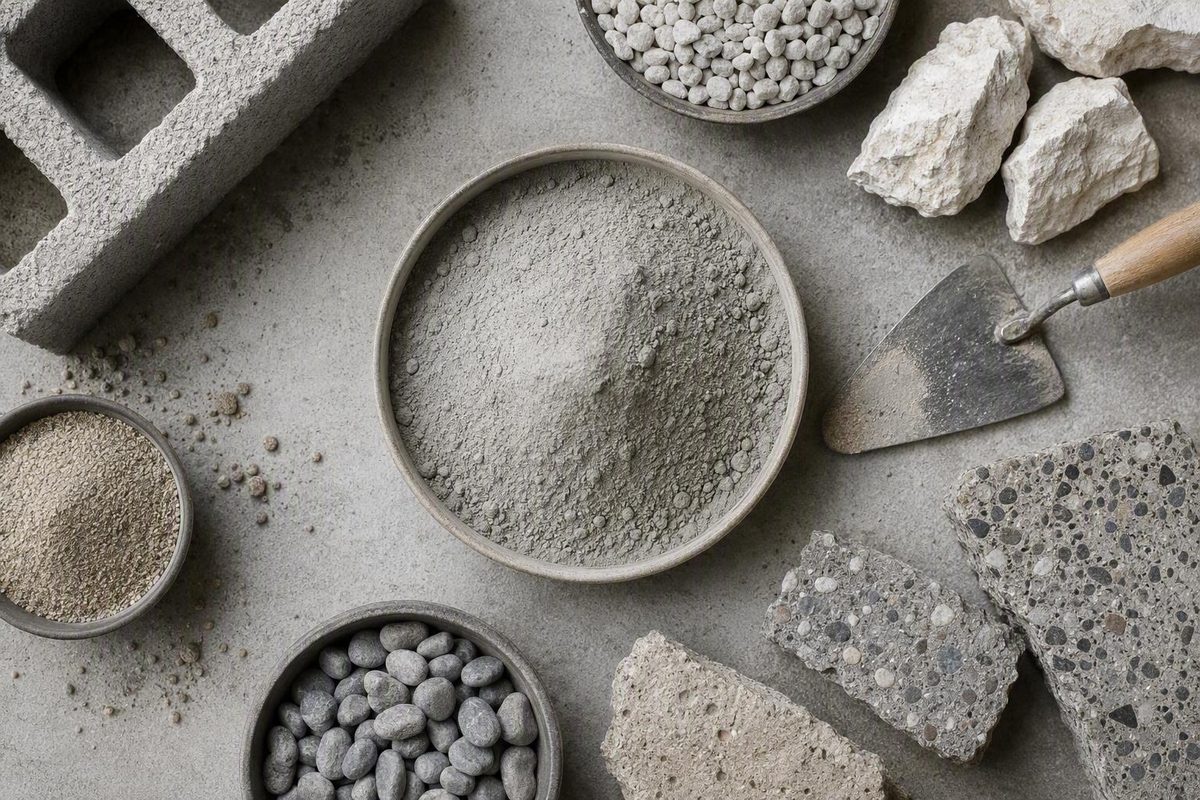
Portland limestone cement has moved from an alternative binder to an ordinary part of the U.S. cement supply. Usually abbreviated PLC, it lowers clinker content by incorporating finely ground limestone. In U.S. specifications, it is designated Type IL.
The change is meaningful but easy to overstate. Type IL can reduce cement-production emissions and, in a properly designed concrete mixture, often delivers performance broadly comparable to ordinary portland cement. It is not a complete concrete mix, a guarantee of a particular carbon reduction, or proof that concrete made with any two Type IL products will behave identically.
For buyers, specifiers, producers, and crews, the practical rule is straightforward: treat PLC as a mainstream, standards-based cement, but qualify the actual product and concrete mixture for the work.
What Portland Limestone Cement and Type IL Mean
Portland limestone cement is a blended hydraulic cement made with portland cement clinker and additional limestone. In U.S. practice, PLC is designated Type IL and generally contains 5% to 15% limestone by mass, introduced as blended fines or interground with clinker, according to this technical overview of Type IL cement.
The first character in IL is a capital letter I, not the numeral 1. Labels and retailer pages sometimes render the name as “Type 1L,” “Type 1 L,” or a similar variation. In this context, those labels generally mean Type IL. For purchasing or specification purposes, verify the formal designation on the bag, technical data sheet, and mill certificate rather than relying on typography in a product title.
PLC should not be confused with concrete:
- Cement is the hydraulic binder.
- Concrete normally combines cement, water, fine aggregate such as sand, and coarse aggregate such as gravel or crushed stone.
- Mortar normally combines cementitious materials, water, and fine aggregate, without concrete’s coarse aggregate.
- Preblended concrete mix already contains cement and graded aggregates and generally requires only the water and procedures specified by its manufacturer.
A bag of Type IL cement is therefore not equivalent to a bag of ready-to-use concrete mix. Unless the package explicitly identifies the product as preblended concrete or mortar, the buyer must supply the appropriate aggregates and water.
The common comparison is with ordinary portland cement, or OPC. OPC and PLC are cement categories, not complete descriptions of finished concrete. Strength, slump, air content, setting, shrinkage, finishing response, permeability, and durability also depend on aggregate grading, water content, supplementary cementitious materials, chemical admixtures, temperature, curing, and workmanship.
Type IL is intended to serve many of the same applications as OPC, and a producer may initially target the same cement dosage. Cement type alone, however, cannot establish that two complete concrete mixtures will perform identically.
How PLC Is Made and Why Limestone Changes the Cement
The central manufacturing difference between PLC and conventional portland cement is the amount of clinker in the finished product.
Clinker is produced by heating prepared raw materials in a kiln. It is the principal reactive ingredient later ground to make cement, but its production also accounts for much of cement manufacturing’s production-related carbon emissions. Carbon dioxide is released through calcination of carbonate raw materials and through fuel combustion and other kiln-energy demands.
PLC reduces the clinker required per unit of finished cement by replacing part of it with limestone. Two principal production routes are used:
- Intergrinding: Limestone is ground with clinker and gypsum during finish milling.
- Blending: Separately prepared limestone fines are blended with the other cement constituents.
These routes can produce different particle-size distributions even when two products have similar nominal limestone contents. Mill configuration, grinding strategy, separator operation, clinker hardness, and limestone characteristics all affect the finished cement.
Limestone is more than simple dilution
Replacing clinker with a less reactive material could reduce performance if the cement were not formulated appropriately. PLC production therefore uses fineness, particle-size distribution, sulfate balance, and other controls to obtain the intended behavior.
Finely ground limestone can contribute in three principal ways:
- Particle packing: Small limestone particles can fill spaces between larger cement grains, producing a denser initial particle arrangement.
- Nucleation: Fine surfaces provide sites on which cement hydration products can form.
- Limited chemical reaction: Limestone can react with aluminate-bearing phases to form carboaluminate phases.
Limestone is generally easier to grind than clinker. PLC is consequently often finer than a companion portland cement made from the same clinker. Additional grinding energy may be required, but the Portland Cement Association’s technical assessment concludes that reduced-clinker energy savings outweigh that added requirement. The report also describes the packing, nucleation, and carboaluminate mechanisms in its state-of-the-art review of limestone use in cement.
Greater fineness can support early hydration and strength development. It can also alter water demand, admixture response, setting, bleeding, and shrinkage. Limestone percentage by itself does not predict those effects.
How large is the carbon reduction?
The defensible answer is product- and boundary-specific.
A comparison based on 2021 U.S. industry-average environmental product declarations reported an average 8.2% lower cement-level carbon footprint for PLC averaging 10.8% limestone, compared with portland cement averaging 2.7% limestone. Those are category averages for the products and boundaries compared, not guaranteed values for an individual plant, shipment, or project.
The American Cement Association separately describes potential reductions of up to approximately 10%. “Up to” identifies a possible maximum rather than a universal result, as its overview of blended cements makes clear.
Neither figure should automatically be applied to:
- A specific bag or bulk shipment
- A concrete mixture containing other cementitious materials
- Transportation to a particular project
- Placement and construction activities
- A complete building or pavement
- A lifecycle assessment using a different unit or boundary
A cement-level reduction also does not mean the concrete-level reduction will have the same percentage. Cement dosage, supplementary cementitious materials, aggregate sourcing, transportation, mixture yield, strength requirements, waste, and service life can all change the comparison.
For a defensible environmental comparison, request product-specific environmental product declarations and confirm that they use compatible:
- Declared or functional units
- Geographic bases
- Reference periods
- Product category rules
- Lifecycle modules or boundaries
- Treatment of supplementary materials
- Strength or performance bases, where relevant
Comparing one product’s cradle-to-gate figure with another product’s broader lifecycle total will produce a misleading result even if both documents are called EPDs.
The Standards Behind Type IL—and How Common It Is
The principal U.S. specifications for Type IL blended hydraulic cement are:
- ASTM C595/C595M
- AASHTO M 240
AASHTO M 85 is associated with portland cement requirements; it is not the governing Type IL specification. Contract documents may incorporate particular editions, additional tests, agency provisions, approved-source requirements, or exposure criteria, so the standard listed on a data sheet is only the starting point.
ASTM and AASHTO added Type IL provisions in 2012. Under the cited Type IL requirements, limestone content cannot exceed 15% by mass. A producer may include a target percentage in the designation—for example, Type IL(12) identifies a 12% limestone target. The designation may also include suffixes associated with other requirements, including sulfate-resistance classifications. The same industry report states that all 50 state departments of transportation had accepted PLC by February 2024, although that does not mean every source or mixture is automatically approved for every project.
Standards compliance establishes requirements for the cement. It does not guarantee that:
- Products from different plants have identical fineness or chemistry.
- Every lot produces the same slump or setting response.
- One admixture dosage works with every cement.
- A concrete mixture satisfies every exposure requirement.
- A crew can use identical timing and visual finishing cues.
- A cement source can change during a project without review.
This is the distinction between a cement specification and a concrete qualification. The first establishes what the cement must meet. The second determines whether the complete concrete system satisfies the project requirements.
PLC is now a mainstream U.S. cement
PLC is no longer a niche product. The Federal Highway Administration reports that it accounts for more than half of the cement consumed in the United States, making it the country’s most common cement type in its technical note on PLC variability.
Adoption developed over time. A Colorado paving project in 2007 is identified as the first reported U.S. paving application, followed by formal Type IL recognition in ASTM C595 and AASHTO M 240 in 2012.
General acceptance still does not mean automatic approval for a particular job. An agency may permit Type IL while requiring a listed cement source, mixture submittal, exposure classification, trial batch, performance test, or approved-product entry. Project documents remain controlling.
PLC Versus OPC: A Property-by-Property Comparison
The most accurate comparison is not “PLC performs exactly like OPC.” It is that properly produced PLC, used in an appropriately designed and cured concrete mixture, often provides broadly comparable performance, while some fresh and hardened properties remain source- and mixture-dependent.
| Property | Typical comparison with OPC | What controls the result |
|---|---|---|
| Water demand | May increase, decrease, or remain similar | Cement fineness, particle packing, aggregate moisture and grading, admixtures, paste volume, temperature |
| Workability | Often comparable after mixture adjustment; some finer PLCs may reduce slump | Particle-size distribution, water reducer, SCMs, mixing sequence, elapsed time |
| Bleeding | Commonly lower | Fineness, paste volume, water content, aggregate grading, admixtures |
| Setting | Can be earlier, similar, or otherwise different | Temperature, sulfate balance, clinker chemistry, limestone composition, admixtures |
| Early strength | Can be comparable or higher when greater fineness accelerates hydration | Fineness, curing temperature, cement chemistry, water-cementitious ratio |
| 28-day strength | Often broadly comparable in qualified mixtures | Cement optimization, proportions, curing, SCMs, testing age |
| Elastic modulus | Usually similar when strength and aggregate systems are comparable | Aggregate type and volume, concrete strength, paste characteristics |
| Shrinkage | Mixed; some systems show little change, while very fine PLC may increase early restrained shrinkage | Paste volume, water content, fineness, curing, restraint, strength class |
| Chloride transport | Mixed research findings | Pore structure, curing, SCMs, fineness, test method, age |
| Freeze-thaw resistance | Generally comparable when a suitable air-void system is established | Entrained air, spacing, saturation, curing, aggregate durability |
| Sulfate resistance | Not guaranteed by the basic Type IL designation | Cement designation, aluminate chemistry, SCMs, permeability, performance testing |
Water demand and workability
It is tempting to make a universal rule that finer PLC always needs more water. The evidence does not support that conclusion. Greater surface area can raise water demand, but improved particle packing can work in the other direction. Aggregate grading and moisture, paste volume, chemical admixtures, and supplementary cementitious materials can dominate the field result.
A mixture that loses slump after a cement change does not necessarily need more mixing water. The appropriate response may be a different water-reducer dosage, an altered mixing sequence, a moisture correction, or another qualified proportioning change. Adding water without controlling the revised mixture can compromise strength and durability.
Bleeding, setting, and finishing
PLC commonly produces less bleeding than an otherwise comparable OPC system. Reduced bleeding can be useful, but it also creates a field-control issue: crews accustomed to a particular amount or appearance of bleed water may misjudge when the surface is ready to finish.
Setting behavior is not uniform. Some PLC systems set earlier; others are similar or respond differently depending on sulfate balance, clinker aluminate content, limestone chemistry, temperature, and admixtures. A product name is not a finishing timetable.
Crews should observe the concrete actually delivered, protect it against rapid moisture loss, and follow the project’s finishing procedures rather than assuming that an OPC schedule transfers unchanged.
Strength and elastic modulus
PLC is commonly formulated to target similar 28-day performance to portland cement produced from the same clinker. Greater fineness may accelerate hydration and support early- and midterm strength. At later ages, the effect may become smaller and more dependent on cement source, mixture design, supplementary materials, and curing.
Elastic modulus is strongly affected by aggregate type, aggregate volume, and concrete strength—not cement name alone. Where PLC and OPC concretes have comparable strengths and aggregate systems, modulus is generally similar. Project-specific structural values still require the prescribed tests and design procedures.
Shrinkage and early-age cracking
Shrinkage results are mixed. Water content, paste volume, aggregate restraint, curing, temperature, member geometry, strength class, and jointing may influence volume stability more than the Type IL designation itself.
Some testing has found greater early restrained shrinkage in PLC mortar when the PLC was ground substantially finer than its companion OPC. That is a reason to investigate fineness and cracking risk where early restraint matters, not proof that every PLC concrete shrinks more.
Early-age cracking should be managed as a system problem. Relevant controls include mixture proportions, temperature, evaporation, placement sequence, finishing, curing, joint timing, reinforcement, geometry, and restraint.
Chloride transport
Evidence on chloride transport is not one-directional. Some research found no change in rapid-chloride-permeability classification between PLC and companion OPC concretes made with the same clinker composition. Other work found higher permeable-void content and higher chloride diffusion in the tested PLC mixtures.
The quantified findings illustrate the importance of context. The FHWA review reports that PLC mortar ground more than 30% finer than companion OPC showed increased early restrained shrinkage. It also cites a study in which PLC concrete had up to 10% more permeable voids and chloride diffusion coefficients 2% to 30% higher than companion OPC concrete, with smaller increases for finer PLC. Separately, FHWA’s investigation characterized 18 commercial PLC samples from 13 plants in nine states, collected from 2022 through 2025. These findings are summarized in the agency’s PLC variability report cited below.
Those results involve particular products, mixtures, ages, and test methods. They should not be converted into a claim that PLC is inherently chloride resistant—or inherently unsuitable for chloride exposure. Bridge decks, marine work, parking structures, and deicing-salt exposure require qualification of the complete binder and concrete system.
Freeze-thaw resistance
Properly air-entrained PLC concrete has generally shown freeze-thaw behavior comparable to OPC concrete. The Type IL designation does not, by itself, create an adequate air-void system.
Cement source and admixture compatibility can change total air content, air retention, and dosage requirements. Producers should verify the air system with the project materials, while field personnel should test and control air rather than assume that a previously used dosage remains valid.
Sulfate resistance
The basic Type IL designation does not automatically mean sulfate resistance. Where moderate or high sulfate resistance is required, the cement must carry the relevant designation and satisfy the applicable performance requirements. Concrete permeability, water-cementitious ratio, supplementary cementitious materials, curing, and exposure severity also affect the result.
The broader evidence remains favorable but qualified. A 2025 academic review reported generally comparable or favorable PLC strength and durability findings while identifying setting, early-age cracking, cold-climate performance, admixture compatibility, extreme environments, and long-term field performance as areas requiring further study. The review of PLC in pavements and bridge decks supports general feasibility, not universal equivalence.
Why Two Type IL Cements May Behave Differently
The recent FHWA investigation cited above documented meaningful differences among the commercial PLC products it characterized. It explicitly declined, however, to conclude that PLC is more or less variable overall than OPC.
That limitation matters. Cement has always varied by raw materials, production plant, mill, and production period. The federal work shows that PLC variability can affect concrete; it does not establish that OPC is uniform or that Type IL is uniquely difficult.
Important variables include:
- Fineness
- Complete particle-size distribution
- Limestone or calcite content
- Limestone mineralogy, purity, and grindability
- Clinker chemistry
- Sulfate form and dosage
- Cement plant and production source
- Supplementary cementitious materials
- Air entrainers, water reducers, accelerators, and retarders
- Water-cementitious ratio and paste volume
- Aggregate characteristics and mixture proportions
These variables can influence slump retention, water demand, entrained air, hydration rate, setting, bleeding, finishing, early strength, later strength, shrinkage, cracking tendency, permeability, and exposure-specific durability.
Why fineness is not one simple number
Blaine fineness is often used to describe cement surface area, but it may be an imperfect predictor of PLC behavior. Fine limestone particles affect the measurement, and two products with similar Blaine values can still have different particle-size distributions.
Concrete behavior may depend not only on total measured surface area but also on how particles are distributed among very fine, intermediate, and coarse fractions. Limestone and clinker may occupy those fractions differently. A single fineness number should therefore not be treated as a complete compatibility or performance forecast.
Specification is not qualification
An ASTM C595-compliant cement has met the applicable cement requirements. It has not yet proved compatibility with a project’s:
- Sand and coarse aggregate
- Aggregate moisture and grading
- Fly ash, slag, silica fume, or other SCMs
- Air-entraining admixture
- Water reducer or plasticizer
- Accelerator or retarder
- Mixer and batching sequence
- Placement and pumping method
- Ambient and concrete temperatures
- Finishing process
- Curing method
- Freeze-thaw, sulfate, or chloride exposure
A supplier change can therefore affect an established concrete mixture even when the old and new products are both labeled Type IL.
Project quality plans should define when requalification is needed. Sensible triggers include a change of cement manufacturer, production plant, clinker source, limestone target, significant mill-certificate property, fineness trend, sulfate balance, or an unexplained shift in slump, air, setting, or strength. The response may range from closer monitoring to new laboratory and production-scale trials.
A Practical Checklist for Switching to PLC
A transition from OPC to PLC—or from one PLC source to another—should be treated as a quality-control exercise, not a blind name-for-name substitution.
A nominal one-for-one replacement at the same cement dosage is a reasonable design intention for many applications. It is not permission to skip verification.
1. Review the controlling requirements
Before batching, identify:
- Required cement specification and designation
- Concrete strength ages
- Maximum or specified water-cementitious ratio, if any
- Air-content requirements
- Slump or workability limits
- Supplementary cementitious-material limits
- Exposure classes
- Chloride, sulfate, or freeze-thaw provisions
- Temperature and curing requirements
- Agency or owner approval requirements
- Submittal, testing, and source-change provisions
Do not assume that general acceptance of PLC overrides a contract requiring a listed source, special designation, or exposure test.
2. Obtain current product documents
Request the technical data sheet and a current mill certificate for the proposed PLC. Review the complete designation, production plant, fineness information, chemical data, strength results, and any disclosed limestone target.
Compare the documents with those for the previous cement. A difference does not automatically disqualify the new product, but it can identify properties that deserve attention during trial batching.
3. Trial the complete mixture
Use project-representative materials:
- Proposed PLC
- Actual aggregate sources and gradings
- Expected aggregate moisture conditions
- Specified SCMs
- Intended admixture brands and products
- Representative water
- Planned mixing order and duration
Laboratory trials are useful, but a production-scale or field trial may also be needed. Mixer energy, transport time, temperature, pumping, and placement can reveal effects that a small batch does not reproduce.
4. Check fresh properties
At minimum, consider:
- Slump or another workability measure
- Slump retention
- Water demand
- Air content and air retention
- Concrete temperature
- Unit weight and yield
- Setting behavior
- Bleeding
- Pumpability or placement response
- Surface appearance
- Finishing timing and effort
Record elapsed times and temperatures. “It felt sticky” or “it finished fast” is difficult to investigate unless it is connected to batch data, admixture dosage, weather, and timing.
5. Check hardened properties
Testing should match the work and exposure. It may include:
- Early strength where stripping, opening, or loading depends on it
- Specified-age compressive or flexural strength
- Later-age strength where relevant
- Drying- or restrained-shrinkage indicators
- Air-void analysis
- Freeze-thaw or scaling performance
- Sulfate resistance
- Chloride transport or electrical-resistivity tests
- Other agency- or project-specific durability measures
Not every small project needs every test. Select tests from the governing specification and actual risk rather than assuming the cement label answers every performance question.
6. Control water and admixtures
Do not respond to unfamiliar slump or finishing behavior by adding uncontrolled water. Added water changes the mixture and can reduce strength and durability.
Where greater workability is required, evaluate a qualified water reducer or plasticizer through controlled trials. Cement chemistry, fineness, SCMs, temperature, and mixing sequence can all affect admixture demand, so a previously successful dosage should be verified rather than copied automatically.
7. Adjust slab finishing to observed bleeding
For slabs, the supported general sequence is:
- Strike off the concrete.
- Bull float as required.
- Wait for bleed water to evaporate.
- Continue finishing only after the surface is ready.
The Tennessee Concrete Association emphasizes that sequence and warns against finishing while bleed water is present or applying surface water as an improvised finishing aid in its guidance on producing durable Type IL concrete.
Lower bleeding does not mean finishing can begin immediately. It means the crew may receive different visual cues than it did from a familiar OPC mixture. Wind, low humidity, hot substrates, and high concrete temperature can further complicate the surface condition. Follow the project’s evaporation-control and finishing procedures.
8. Cure promptly and protect the concrete
PLC does not eliminate the need for curing. Preventing premature moisture loss supports hydration, strength development, surface quality, and durability.
Use the curing method, duration, and temperature protection required by the project specification and applicable product instructions. Bagged-product literature may direct users to keep the work damp for several days and protect it from freezing, but such directions are product-specific and do not replace engineered hot- or cold-weather procedures. One manufacturer provides this type of guidance in its Type IL product data sheet.
9. Verify exposure performance as a system
For freeze-thaw exposure, confirm the required air content and, where specified, air-void or freeze-thaw performance. For sulfate exposure, require the appropriate cement designation and applicable mixture performance. For chloride exposure, examine permeability, SCMs, curing, cracking risk, cover, and other relevant design controls.
Do not rely on “Type IL” alone as proof of resistance to any of these exposures.
10. Monitor production and establish change triggers
After approval, track:
- Water and admixture dosage
- Slump and slump loss
- Air content
- Concrete temperature
- Setting and finishing observations
- Early and specified-age strength
- Mill-certificate trends
- Cement source and plant
- Customer or crew reports
Define who has authority to adjust the mixture and when a change requires renewed testing. This converts field observations into usable quality-control information instead of informal reactions.
What Field Experience Shows—and What It Cannot Prove
PLC has substantial U.S. field precedent, particularly in concrete pavements.
A 2018 practice brief reviewed approximately ten years of early PLC use in Colorado, Utah, and Oklahoma and reported more than 900 lane-miles of highway paving across those states. It identified a 2007 Colorado project as the first reported U.S. paving application and described later Colorado and Utah mixtures that met project strength requirements and received placement or pavement ratings broadly comparable to companion OPC work. The history is documented in the government-sponsored field-practice brief on PLC after ten years.
This record supports the feasibility of using PLC in demanding work. It does not isolate PLC as the sole cause of successful performance.
Several field mixtures also incorporated fly ash. The 2007 Colorado mixture included fly ash and recycled concrete aggregate, while other comparative pavement mixtures used fly ash with both PLC and OPC. Their performance reflects the whole system:
- Cement
- Fly ash or other SCMs
- Aggregates
- Water and admixtures
- Air-void system
- Mixture proportions
- Placement
- Jointing
- Curing
- Climate and traffic
It would therefore be inaccurate to attribute every strength or pavement result solely to Type IL.
Field case studies also have limits. Selected highways in three states cannot prove performance for every climate, cement source, bridge deck, structural element, marine exposure, residential slab, or cold-weather placement. Successful precedents reduce uncertainty and provide implementation experience, but they do not replace project qualification.
The newer academic literature reaches a similar balanced conclusion. Overall strength and durability findings are generally favorable, while the evidence base remains less complete for extreme climates, early-age cracking, cold-weather behavior, admixture compatibility, and long-term field exposure.
Transportation-agency acceptance has the same limitation. It shows that PLC can be specified and controlled within established infrastructure programs. It does not release a contractor, supplier, or designer from project documents, approved-material requirements, mixture tests, or exposure provisions.
How to Buy and Verify Bagged Type IL Cement
Bagged Type IL cement is sold in different package sizes, but package size, stock, and distribution are seller-specific. One retailer offers a 15-pound bag of PLC, while another listing shows a seller-specific 94-pound Type IL product. Neither example establishes universal availability.
Package weight does not tell you whether a product is cement or preblended concrete. Read the identity statement and instructions. If the bag says portland limestone cement and directs the user to mix it with aggregates, it is a binder—not a complete concrete mix.
Bag and document checklist
Before buying or approving a product, verify:
- Exact designation: Look for Type IL, not merely “portland cement” or “limestone product.”
- Claimed standard: Confirm ASTM C595/C595M where the project requires it.
- Manufacturer and plant: This is especially important when matching an approved source.
- Technical data sheet: Use a current manufacturer document, not only an undated retailer summary.
- Mill certificate: For controlled work, obtain a current certificate tied to the source or shipment as required.
- Limestone target: Look for a designation such as IL(12) or another disclosed target, where available.
- Strength information: Confirm test ages and methods rather than relying on “high strength” marketing.
- Aggregate instructions: Determine which sand, gravel, lime, or other materials must be added.
- Water instructions: Follow the applicable manufacturer procedure, subject to the project design.
- Admixture guidance: Check compatibility information or consult the cement and admixture suppliers.
- Safety data sheet: Use the SDS for the exact product.
- Environmental product declaration: Request a product-specific EPD if carbon comparison affects purchasing.
- Production date and storage condition: Reject hardened, water-damaged, or improperly stored material.
Manufacturer volumetric recipes can be useful for the applications expressly covered by that product. They are not universal structural mix designs. A recipe for craft work, mortar, stucco, or general concrete does not establish the necessary strength, durability, yield, air system, or code compliance for a footing, slab, wall, or other regulated element.
Likewise, a retailer’s generic “dry time” should not be interpreted as full cure, design-strength attainment, safe loading time, coating readiness, freeze resistance, or permission to place a structure in service. The relevant milestone depends on the mixture, temperature, moisture, member geometry, exposure, and governing requirement.
Handling and safety
Dry hydraulic cement and freshly mixed cementitious material require careful handling. Manufacturer literature warns that fresh portland-cement mixtures can cause severe alkaline burns and that dry products may present respirable-silica hazards. Consult the exact product SDS and applicable workplace rules for skin, eye, dust, and respiratory controls rather than treating one manufacturer’s PPE list as universal; these hazards are stated in the manufacturer literature linked above.
Keep bags dry and off the ground, control dust when opening and mixing them, avoid direct contact with fresh material, and provide washing facilities appropriate to the work. For occupational tasks, the employer’s exposure assessment, training, SDS program, and applicable safety requirements control.
The practical conclusion is that Type IL should be treated as a mainstream, lower-clinker cement—not as a promise of fixed carbon savings or identical field behavior. Verify ASTM C595 or AASHTO M 240 documentation, qualify the complete mixture, observe its actual setting and finishing response, cure it appropriately, and compare environmental performance using compatible product-specific EPDs.
Mortar Desk publishes general building-material reference information rather than project-specific engineering or contracting advice. As its scope statement explains, specifications change and codes vary locally. Check the applicable standard edition, project documents, local code, product instructions, and requirements of the authority having jurisdiction. Structural and otherwise regulated work may require a qualified professional or licensed trade.
Frequently Asked Questions About Portland Limestone Cement
Is Type 1L cement the same as Type IL cement?
Generally, yes. In the formal U.S. designation, the first character is a capital I, followed by L: Type IL. “Type 1L” usually results from the capital I being read or rendered as the numeral 1.
For specifications and purchasing, use the formal Type IL designation and verify ASTM C595/C595M or AASHTO M 240 documentation. Do not rely solely on how a retailer formats the product name.
Can portland limestone cement replace ordinary portland cement one for one?
PLC is generally designed to replace OPC at the same cement dosage, but “one for one” describes the initial substitution intention—not guaranteed concrete equivalence.
Trial the proposed PLC with the actual aggregates, SCMs, admixtures, water, and mixing procedure. Check slump, air, setting, bleeding, finishing response, strength, and any required durability properties. Make adjustments through controlled mixture qualification rather than improvised water addition.
Does PLC always reduce the carbon footprint by 10%?
No. “Up to 10%” is a broad cement-level claim, not a guaranteed reduction for every product. One U.S. industry-average comparison reported an 8.2% lower footprint for the PLC and portland-cement categories compared, but an individual result depends on limestone content, clinker production, fuels, electricity, transportation, declared unit, geography, and lifecycle boundary.
A percentage reported for cement also does not transfer automatically to concrete or an entire project. Compare compatible, preferably product-specific EPDs.
Is Type IL concrete as strong and durable as OPC concrete?
Properly produced, proportioned, controlled, and cured PLC concrete often provides strength and durability broadly comparable to OPC concrete. Field projects and the broader research record support its use in demanding applications.
The Type IL label alone is not a performance guarantee. Fineness, chemistry, SCMs, admixtures, water content, air entrainment, aggregates, curing, and exposure all matter. Chloride transport, shrinkage, setting, and early-age cracking are particularly dependent on the tested product and mixture.
Can bagged PLC be used by itself like ready-mix concrete?
No. Bagged PLC is cement binder, not ready-mix concrete or a complete dry concrete mix. To make concrete, it normally must be combined with suitable fine aggregate, coarse aggregate, and water in controlled proportions.
Follow the exact manufacturer instructions for the intended application. Do not treat a general bag recipe as a universal structural mix design, and do not infer service readiness from a generic retail “dry time.”