 MortarDesk
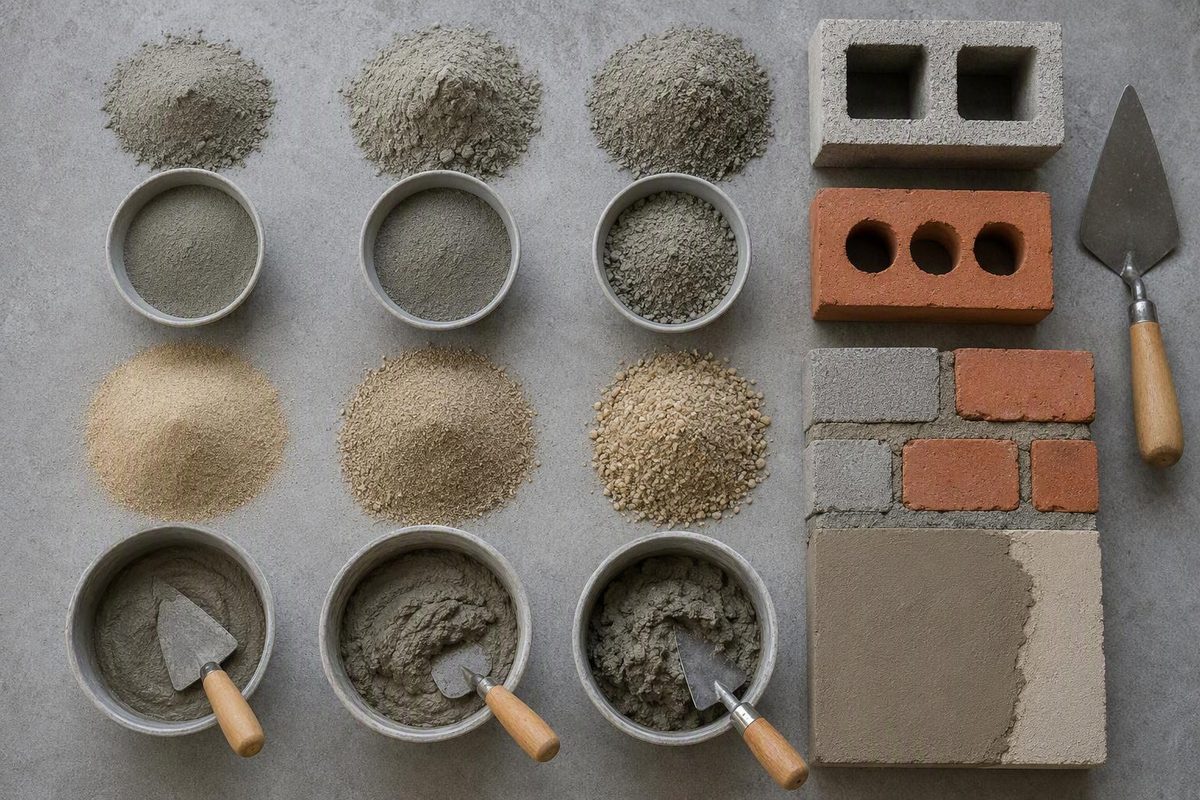
Masonry cement is a factory-blended binder used to make mortar. It is not ready-to-use mortar. For a typical proportion-specified batch, combine 1 volume of masonry cement with 2¼ to 3 volumes of damp, loose masonry sand, then add clean water for workable mortar. Buy the cement type—N, S or M—required by the plans, masonry units, exposure and locally adopted code.
Look for ASTM C91/C91M on the cement bag and ASTM C144 compliance for field-added sand. The current cement specification on the research date is ASTM C91/C91M-25, which covers three types of masonry cement. The resulting mortar is governed by ASTM C270-26, which provides separate proportion and property specifications for unit-masonry mortar.
The Brick Industry Association’s mortar guidance defines masonry cement as a hydraulic cement containing portland or blended hydraulic cement, plasticizing material such as limestone or lime, and other ingredients that modify properties such as workability, water retention, setting or durability.
Type N vs. S vs. M
| Masonry cement type | ASTM C270 laboratory mortar strength* | Typical starting point | Do not select it merely because… |
|---|---|---|---|
| N | 750 psi (5.2 MPa) minimum average at 28 days | Most above-grade veneer and other normal brickwork; many interior walls | It is the type most commonly stocked |
| S | 1,800 psi (12.4 MPa) minimum average at 28 days | Reinforced or loadbearing exterior masonry; work requiring greater flexural bond or compressive strength | It sounds like a universal “strong” upgrade |
| M | 2,500 psi (17.2 MPa) minimum average at 28 days | Some below-grade foundation, retaining-wall, sewer and manhole work when specified | The highest compressive-strength number must be safest |
*These are minimum average results for laboratory-prepared masonry-cement mortar under ASTM C270’s property specification. They are not guaranteed strengths for mortar sampled from a jobsite mixer or for the completed wall. ASTM C270 expressly says that field-test strengths do not represent laboratory mortar or mortar in the wall. The Concrete Masonry & Hardscapes Association likewise explains that ASTM C780 field testing checks consistency of materials and procedures rather than compliance with ASTM C270 laboratory-strength values.
Stronger is not automatically better. Mortar also has to bond to the unit, retain water, remain workable and accommodate movement. BIA recommends the lowest-compressive-strength mortar that satisfies the project and identifies Type N as the normal choice for most veneer. Its application table starts with Type S for reinforced or loadbearing exterior brickwork and Type M for exterior foundation or retaining walls (BIA Technical Note 8B). Structural drawings and locally adopted masonry requirements override a general-use table.
Check whether the bag already contains sand
A bag labeled masonry cement contains the cementitious binder and workability-enhancing ingredients. It still needs:
- properly graded masonry sand;
- clean water;
- measured batching and adequate mixing.
A bag labeled mortar mix or masonry cement and sand already contains sand and normally needs only water. For example, SPEC MIX sells an 80 lb (36.3 kg) preblended masonry-cement-and-sand mortar; its approximate yield is 40–45 modular bricks or 11–13 nominal 8 in. blocks per bag (SPEC MIX product data). Do not add another 2¼ to 3 parts sand to a preblended product.
Masonry cement also differs from:
- Portland cement, which is one binder used in field-proportioned cement-lime mortar; see Portland cement for mortar.
- Mortar cement, a separate product specification that includes minimum flexural-bond-strength requirements; BIA notes that ASTM C91 masonry cement does not include those requirements.
- Concrete mix, which contains coarse aggregate and is intended for pours rather than masonry joints; see concrete mix ratio vs. mortar type.
- Thinset mortar, which is formulated to bond tile rather than lay brick or block; see thinset vs. mortar.
The 1:2¼–3 mix ratio is by volume
Under the ASTM C270 proportion route, masonry sand for these mixes is measured at not less than 2¼ and not more than 3 times the volume of cementitious material. A Heidelberg product sheet translates that into one 1 ft³ bag of masonry cement plus 2¼–3 ft³ of ASTM C144 sand. It specifies 3–5 minutes of mixing after the last water is added (Heidelberg Materials product sheet).
Do not convert the ratio into “one bag to three bags” unless the containers hold equal volumes. Bag weights vary by manufacturer and cement type. Measure damp, loose sand with a known-volume box or bucket and follow the proportions on the selected bag and project specification.
There is no universal fixed water ratio. Sand moisture, masonry-unit absorption and weather affect water demand. Add water gradually to obtain the workable consistency required by the product instructions. Keep water, sand volume and mixing procedure consistent from batch to batch; excess sand or inconsistent batching can reduce performance and produce visible color variation.
Worked buying example: 120 standard bricks
Suppose the project documents call for Type S mortar for a 120-brick section.
- Select Type S masonry cement meeting ASTM C91/C91M.
- Select masonry sand meeting ASTM C144.
- Use the selected bag’s yield rather than a universal coverage figure. One manufacturer’s 70 lb (31.8 kg) Type S masonry-cement example, mixed with 240 lb (109 kg) of mason’s sand, yields approximately 2.75 ft³ (78 L) of mortar and lays about 144 standard bricks under its stated conditions (QUIKRETE product sheet).
- The arithmetic is 120 ÷ 144 = 0.83 bag. One full bag and 240 lb of the specified sand cover the example on paper, with about 17% of the published yield remaining. Increase the order if joint dimensions, unit geometry, site waste or the actual product sheet indicate that this margin is insufficient.
Do not transfer that yield to another bag size, product or brick format. It is also not a basis for selecting Type S where Type N, M or another mortar has been specified.
Historic repointing requires a separate compatibility decision. BIA says stronger repair mortar can concentrate stress and spall older masonry; Type O is often used for older brickwork, and ASTM C1713 may apply to structures not built with modern mortars (BIA Technical Note 8B).
Mixing and handling checks
- Keep bags dry and off damp floors; masonry cement is moisture-sensitive.
- Follow the exact bag instructions and keep batch volumes and mixing time consistent.
- Tool joints at a consistent thumbprint-hard stage.
- Retemper only to replace water lost through evaporation, and never use mortar that has begun to set. General industry guidance gives a 2½-hour maximum from initial mixing, or 2 hours in hot-weather construction, but the product or project requirement may be shorter. The cited Heidelberg sheet, for example, says to use or discard its mortar after 90 minutes.
- Wear eye protection, alkali-resistant gloves and suitable dust protection. Fresh cement mortar is highly alkaline and can burn skin or injure eyes; consult the product safety data sheet.
For a structural or permitted wall, take the mortar designation from the drawings and current local requirements rather than substituting by strength alone. An order should identify the product form (masonry cement or sand-containing mortar mix), type, standard, color and quantity.