 MortarDesk
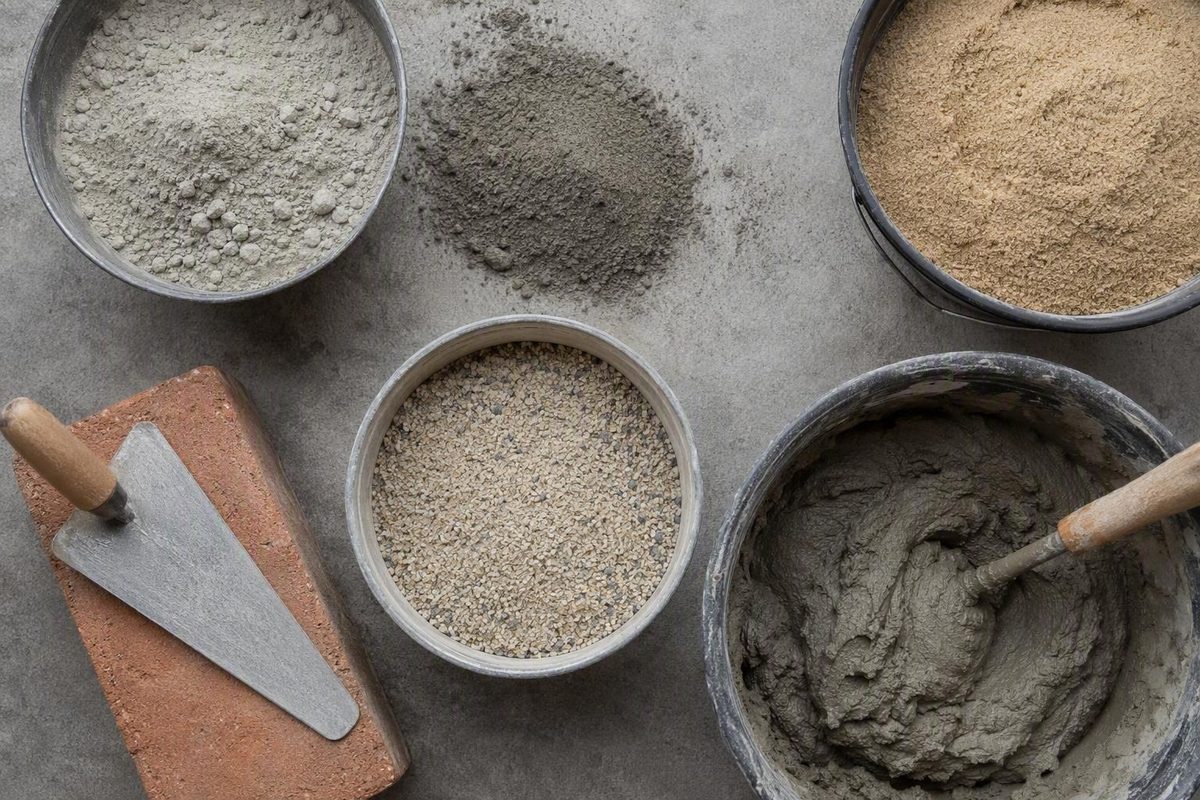
The short answer: Portland cement is an ingredient, not ready-to-use mortar
Yes, Portland cement can be used to make masonry mortar—but it is the hydraulic binder, not the finished mortar. Do not use dry Portland cement alone, or Portland cement mixed only with water, as a substitute for masonry mortar.
A conventional site-batched Portland-lime mortar contains:
- Portland cement
- Hydrated lime
- Fine, compatible masonry sand
- Clean water
Mortar differs from neat cement paste and concrete. Portland cement supplies hydraulic binding action, while hydrated lime and properly graded fine sand help produce a mortar that can be spread, retain water, develop bond, and be tooled into a joint. Mortar is formulated for workability, water retention, air content, bond, and suitable strength—not maximum compressive strength alone (Sakrete’s mortar-and-cement guide).
A functional masonry mortar needs an appropriate balance of:
- Workability and cohesion
- Water retention
- Bond
- Air content
- Elastic response
- Compressive strength
- Compatibility with the brick, block, or stone
That is why neither neat Portland-cement paste nor bagged concrete mix should be substituted for masonry mortar. Cement paste lacks mortar’s aggregate and complete formulation. Concrete includes coarse aggregate and is intended for a different role, not for ordinary bedding or pointing joints.
For a quick buying decision:
- Buy Portland cement only when you have a verified Portland-lime formulation and will also obtain the specified hydrated lime and masonry sand.
- Buy masonry cement when the specification permits that binder system; suitable sand and controlled water are still required.
- Buy factory-preblended mortar when you want the binders and dried sand already proportioned and have confirmed the correct mortar designation.
Do not buy Portland cement expecting a complete bag of mortar.
This article provides general reference information, not a project-specific mix design. Specifications and codes vary by edition and locality. The project documents, current applicable standard, product instructions, and locally adopted code govern. Mortar Desk is a building-material reference site, not a contractor or provider of engineering advice, as explained on its About Mortar Desk page. Structural, unusual, historic, or consequential masonry work should be reviewed by an appropriate professional.
Portland cement, masonry cement, mortar mix, and concrete are different products
Bag labels can be confusing because cement, mortar, and concrete are often used casually as though they were interchangeable. They are not.
Portland cement is a powdered hydraulic binder. It is used as an ingredient in mortar, concrete, stucco, and non-specialty grout, but it is not a complete version of any of those products. A Portland-cement bag may therefore be suitable as one component of a mortar formulation without being a “mortar mix.”
Portland-lime mortar is a complete masonry mortar made from Portland cement, hydrated lime, fine masonry sand, and water. If it is field-batched, every dry ingredient must be selected, measured, and combined according to the governing formulation.
Masonry cement is a formulated cementitious product intended for masonry work. It is normally combined with suitable sand and water. Use the binder system named in the specification.
Factory-preblended mortar may contain the complete binder system and dried masonry sand in factory-controlled proportions. For example, SPEC MIX says its Portland-lime-and-sand product contains Portland cement, hydrated lime, and dried masonry sand and is available as Types M, S, and N (SPEC MIX Portland-lime-and-sand mortar). Such a product generally needs only the water specified by its manufacturer, but the buyer must still select the correct mortar designation.
Concrete contains cementitious binder, water, fine aggregate, and coarse aggregate. Masonry mortar normally contains fine aggregate without the coarse stone found in concrete. That difference affects placement, joint thickness, workability, and intended use.
| Product | Typical contents | What must be added | Principal advantage | Principal batching risk |
|---|---|---|---|---|
| Portland cement | Hydraulic cement binder | Specified hydrated lime, compatible masonry sand, and water | Direct control over ingredients and binder system | Wrong proportions, variable sand, inconsistent water, or omitted lime |
| Masonry cement | Formulated masonry binder | Suitable sand and specified water | Fewer separate binder ingredients to measure | Wrong sand proportion or assuming every product meets the same requirements |
| Factory-preblended mortar | Factory-proportioned binder system and dried masonry sand | Usually only manufacturer-specified water | Reduces field-proportioning and bulk-sand variability | Wrong mortar type, damaged material, or departure from water and mixing instructions |
| Concrete mix | Cementitious binder, fine aggregate, and coarse aggregate | Usually specified water | Convenient for concrete placement | Using coarse-aggregate concrete where masonry mortar is required |
| Neat Portland-cement paste | Portland cement and water | Nothing else | No valid advantage for ordinary masonry joints | Mistaking binder paste for complete mortar |
Cement type is not mortar type
A label such as Portland cement Type I or Type II classifies the cement. A label such as mortar Type M, S, N, or O classifies the finished mortar system. The letters and Roman numerals are not a conversion table.
Portland Type II cement may be one component of Portland-lime mortar, but it does not automatically produce Type S mortar. A retailer’s Type II Portland-cement listing, for example, tells buyers to add lime and mason sand to make mortar, while sand and coarse aggregate are used to make concrete (Paramount Stone’s Portland Type II listing).
When reading a bag:
- Identify whether it is Portland cement, masonry cement, or complete mortar.
- Look for the finished mortar designation required by the project.
- Confirm what must be added.
- Check the current data sheet rather than relying only on the product name.
- Do not infer a finished mortar classification from the Portland-cement type.
Choose the mortar for the masonry—not merely the highest strength
Types M, S, and N are commonly available finished mortar classifications. Type O may also arise in discussions of softer masonry and historic work. These designations should not be selected simply by choosing the product described as strongest.
At a broad comparative level:
- Type M has the highest Portland-cement content among Types M, S, and N.
- Type S is an intermediate category.
- Type N is commonly presented as a general-purpose category.
- Type O is a softer category that may be considered in some compatible, non-demanding, or preservation applications.
These descriptions are only orientation. Commercial guidance describes M, S, and N in this general order, but it does not establish suitability for a particular wall or repair (overview of masonry and Portland cement). Do not use these broad labels as an unsupported application chart for foundations, retaining walls, chimneys, veneers, below-grade walls, or structural repairs.
Why stronger is not automatically better
Mortar and masonry units work as a system. The joint must carry the required loads and resist its exposure, but it must also accommodate the characteristics of the brick, block, or stone.
If mortar is much harder or denser than soft masonry, movement and weathering may be concentrated in the units rather than in the more maintainable mortar joints. Conversely, selecting a softer mortar without accounting for load, bond, and exposure can also be inappropriate.
Selection should consider:
- Masonry unit type
- Unit hardness and compressive behavior
- Absorption and suction
- Required bond
- Mortar water retention
- Workability during placement
- Elastic response and movement
- Applied loads and structural design
- Above-grade, at-grade, or below-grade location
- Rain, drainage, saturation, salts, and freeze-thaw exposure
- Joint width, depth, and profile
- New construction versus repair or repointing
- Existing mortar and substrate condition
- Project specifications and locally applicable requirements
A mortar with more cement may offer greater compressive capacity while still being a poor match for weak or highly absorptive masonry. Compatibility requires balancing properties rather than optimizing a single number.
Use this decision checklist
Before selecting Type M, S, N, O, or another formulation, answer:
- Is this new or historic masonry?
- Are the units brick, concrete block, stone, or a combination?
- How hard and absorptive are the units?
- What loads must the wall or repair carry?
- Is the work above grade, at grade, or below grade?
- Will the assembly experience persistent moisture or freeze-thaw cycling?
- Do the project documents name the mortar type or binder system?
- Do the documents cite ASTM C270 or another mortar standard?
- Which edition and local code requirements apply?
- Must the replacement mortar be matched to existing mortar and units?
If a specification cites ASTM C270, use the edition and requirements identified by the project documents or local authority. Do not assume that an internet ratio, a mortar type printed on a different product, or field ingredient proportions alone demonstrate compliance.
Type S should not be treated as a universally safe default. For structural work, consequential repairs, heavily exposed masonry, or ambiguous specifications, have the selection confirmed by a qualified designer or experienced mason.
How to read mortar ratios without mistaking them for universal recipes
Mortar ratios are normally written as nominal parts by volume, with the binder or binders first and the sand last. The ingredients must be named because the numbers alone are not enough.
For example:
- 1 cement : 2 lime : 9 sand means one nominal volume part Portland cement, two parts lime, and nine parts sand.
- 1 cement : 3 sand means one part cement and three parts sand.
- 1 lime : 3 sand means one part lime and three parts sand.
A 1:3 ratio is therefore ambiguous unless the ingredients are stated. It could describe cement to sand or lime to sand. Likewise, 1:2:9 means one part cement, two parts lime, and nine parts sand only when those ingredients have been explicitly named (Building Conservation’s mortar-ratio guide).
Most importantly, a generic 1:3 ratio does not identify an ASTM mortar type and is not automatically a compliant recipe. It says nothing by itself about the full binder system, aggregate properties, water, testing, exposure, or project requirements.
Worked notation example
Suppose a written formulation explicitly says:
1 part Portland cement : 2 parts hydrated lime : 9 parts masonry sand
The binder portion is:
- 1 part cement
- 2 parts lime
- 3 total binder parts
The aggregate portion is:
- 9 parts sand
The combined binder-to-sand relationship is therefore:
- 3:9
- Reduced to 1:3
That arithmetic explains the overall binder-to-sand relationship. It does not prove that the formulation is suitable for a wall, produces a particular mortar type, or satisfies the requirements of a current standard.
Sand changes what a ratio does
Sand is not merely bulk filler. Its particle-size distribution, shape, moisture, cleanliness, and void content influence:
- The amount of binder needed to coat the grains
- The amount of binder needed to occupy voids
- Water demand
- Cohesion and workability
- Yield
- Shrinkage
- Batch repeatability
Two sands measured at the same apparent volume can produce different mortars. A poorly graded or highly voided sand may behave differently from a well-graded sand.
This is one reason a ratio should not be separated from the specified aggregate and batching method. Changing the sand may change the mortar even when the bucket counts remain the same.
Why weight can be more repeatable than loose volume
Specifications may express ingredients nominally by volume, but loose powdered binders do not always fill a container consistently. Settlement, aeration, compaction, and bulk density can change the mass in a nominal bucket.
Where the governing formulation permits an appropriate conversion, weighing binder with verified bulk-density information can improve repeatability. The density must relate to the actual material; it should not be guessed. Calibrated containers are also preferable to shovel loads because shovel volume varies with the tool, operator, heap, and moisture condition.
The objective is not to invent a better ratio in the field. It is to reproduce the specified formulation consistently.
Three ways to obtain Portland-cement-based mortar
There are three practical purchasing and batching routes. Each can be valid when it matches the project specification, masonry, and available site controls.
1. Field-batch Portland cement, hydrated lime, sand, and water
This route gives direct control over the ingredients. It may suit larger work, custom formulations, or projects with established batching and quality-control procedures.
Its main risks are:
- Measuring cement or lime incorrectly
- Using unsuitable or variable sand
- Measuring aggregate with inconsistent shovel loads
- Failing to account for sand moisture
- Adding inconsistent water between batches
- Changing the loading sequence or mixing duration
- Substituting a different cement, lime, or sand
- Losing traceability when different workers batch differently
Field batching is not “cement plus whatever sand is available.” The lime designation, sand properties, ingredient proportions, water control, and mixing procedure all matter.
2. Use masonry cement with suitable sand
Masonry cement is a formulated binder intended for masonry mortar. It can simplify batching because the operator measures one formulated binder rather than separate Portland cement and hydrated lime.
It still requires:
- The correct masonry-cement designation
- Compatible, properly graded masonry sand
- Controlled binder-to-sand proportioning
- Controlled water
- Compliance with the product and project requirements
- Consistent mixing
Do not assume that any masonry cement can replace any Portland-lime formulation. If the documents specify a binder system, mortar type, color, property, or standard, confirm that the proposed product satisfies it.
3. Buy factory-preblended mortar
A factory-preblended product may contain both the binder system and dried masonry sand, leaving only the specified water to be added on site.
For many small brick, block, stone, or repair jobs, preblended mortar is a practical error-reduction choice. It can improve batch-to-batch consistency and simplify purchasing. It is not universally superior: large projects, custom conservation work, specified local sands, color matching, logistics, or cost may favor another route.
The remaining risks include:
- Buying the wrong mortar type
- Assuming “mortar mix” suits every unit and exposure
- Using a damaged or moisture-contaminated bag
- Adding water by eye
- Ignoring mixing or rest instructions
- Improperly extending usable time
- Combining instructions from unrelated products
Before purchase, check the bag and current data sheet for:
- Mortar designation
- Binder system
- Standards claimed by the manufacturer
- Intended masonry and exposure
- Package condition and storage requirements
- Water directions
- Mixer type and mixing duration
- Any required rest or slake period
- Remixing and retempering rules
- Usable time
- Curing and cleaning directions
- Color and lot-control requirements
A package size, water quantity, standards claim, mixing time, yield, or usable period stated for one manufacturer’s product does not apply automatically to every mortar with the same type letter.
A controlled mixing process for consistent mortar
Begin with the governing recipe: the project specification for field-batched mortar or the current instructions for the selected packaged product. Do not start with an internet ratio and attempt to assign it a mortar type afterward.
Materials and equipment
Use:
- Sound, dry binders that have not hardened in the bag
- Clean, compatible masonry sand where sand is added separately
- Clean potable water
- Calibrated measuring containers or a suitable scale
- A clean mixer, mortar tub, or mixing vessel
- Clean tools
- A batch sheet or notebook
Keep soil, organic matter, old mortar, wash water, and unapproved additives out of the batch. Store bagged materials where they are protected from moisture.
Measure consistently
For each batch, record:
- Product and lot, where relevant
- Cement and lime quantities or packaged dry-mix quantity
- Sand source and measured amount
- Sand condition—dry, damp, or visibly wet
- Water added
- Air and substrate conditions
- Loading sequence
- Mixing duration
- Rest or slake period, if required
- Remixing
- Time of initial mixing
- Any permitted retempering
Calibrated containers or measured weights are more repeatable than variable shovel loads. Records also help identify why color, workability, or stiffening behavior changed during the day.
General mixing sequence
Subject to the governing instructions, a controlled process generally follows this logic:
- Put part of the permitted water into the clean mixer.
- Add the measured binders and sand in the specified order.
- Mix until the dry materials are uniformly wetted.
- Add the remaining permitted water in small, controlled increments.
- Continue mixing for the specified duration.
- Observe any required rest or slake period.
- Remix as directed without casually adding more water.
- Record the initial-mix time and keep the batch within its permitted usable period.
Some formulations call for dry blending before water. Others specify water first and a particular loading order. Follow the selected formulation rather than combining procedures from unrelated guides.
Why there is no universal water ratio
Water demand varies with:
- Sand moisture
- Sand grading and particle shape
- Binder formulation
- Pigments or permitted admixtures
- Temperature, wind, and humidity
- Mixer efficiency
- Batch size
- Required consistency
The functional target is a cohesive, workable mortar that spreads cleanly, holds on a trowel, fills the joint, and does not run or segregate. “More workable” does not simply mean “add more water.” Any adjustment must remain within the governing formulation or product directions.
Initial mixing, slaking, remixing, and retempering are not the same
- Initial mixing combines and distributes the ingredients and water.
- Slaking or resting is a specified pause required by some formulations.
- Remixing restores uniformity after a specified rest.
- Retempering means adding water later under conditions where it is permitted.
- Reviving setting mortar means trying to recover material after setting has progressed.
Retempering rules and usable times are formulation-specific. One product may permit limited retempering to replace evaporation loss, while another may restrict later water addition. Follow the project documents and selected product instructions rather than importing a rule from another product.
General troubleshooting guidance
Runny or segregating: Stop adding water. Verify the dry-material measurements, sand moisture, and permitted water. Do not add arbitrary cement or sand unless an approved correction procedure allows it.
Crumbly or difficult to spread: Confirm that every ingredient was included and that the mortar was mixed for the required time. Compare the measured water with the permitted range before making a small controlled adjustment.
Overly sticky: Check for excess binder, insufficient or unsuitable sand, measurement error, or an unapproved formulation change. Do not dilute it blindly.
Rapidly stiffening: Check the weather, material temperature, equipment, elapsed time, and signs that setting has begun. Retemper only when the governing instructions permit it.
Different from the previous batch: Compare batch records, especially sand condition, water, material lot, loading sequence, and mixing duration, before changing the formulation.
This box is diagnostic guidance, not authority to depart from a specification or manufacturer’s instructions.
Compatibility warning for old brick, soft stone, and historic repointing
Historic repointing is not simply a matter of selecting a lower-strength bag. Replacement mortar should be compatible with the existing mortar, masonry units, wall construction, moisture behavior, exposure, and joint geometry.
A Portland-cement-rich mortar may be too hard or dense for soft brick or stone. In that situation, movement and weathering can be concentrated in the masonry units rather than in the more maintainable mortar joint.
Historic work may call for a softer mortar, potentially including Type O or a lime-based formulation. That is a possibility, not a universal recommendation. Commercial preservation guidance likewise advises matching replacement mortar to the original and notes that a definitive selection may require examining the existing mortar and brick properties (LimeWorks’ comparison of lime and Portland-cement mortar).
Before specifying repointing mortar, investigate:
- Original binder and aggregate character
- Earlier repairs that may have introduced harder patches
- Brick or stone hardness
- Unit absorption
- Joint width, depth, and profile
- Wall exposure and moisture sources
- Salts and freeze-thaw conditions
- Cracking, bulging, displacement, or other structural symptoms
- Required color and aggregate appearance
- Local preservation requirements
Visual comparison alone may not reveal the binder system or relevant material properties. Where the original materials are uncertain, the masonry is soft or significant, or distress may be structural, consult a preservation specialist or experienced masonry professional.
Do not assume lime mortar is always the answer. Equally, do not default to a high-cement mortar merely because it appears stronger.
Working time, curing, cleaning, and cement safety
Usable time, initial set, surface drying, curing, cleaning readiness, and service readiness are different milestones.
Universal timings should not be assembled from unrelated product pages. Temperature, wind, humidity, masonry suction, mix formulation, wall construction, and curing protection all matter. Use the selected product’s current data sheet and the project specification.
As a product-specific example, SPEC MIX recommends mechanically mixing its Portland-lime-and-sand mortar for four to five minutes, using it within 2.5 hours after initial mixing, and allowing it to cure for at least seven but no more than 28 days before cleaning. Those figures apply to that manufacturer’s product and are not universal mortar rules (see the SPEC MIX product instructions linked earlier).
Do not try to revive mortar that has begun setting by adding unapproved water. If retempering is permitted, stay within the governing limits. When the material’s condition or elapsed time is uncertain, do not conceal the problem with an arbitrary water addition.
Protect yourself while handling cementitious material
Use dust-minimizing handling and mixing methods. Wear:
- Safety goggles or suitable eye protection
- Protective gloves
- Long sleeves and long trousers
- Suitable respiratory protection where the exposure requires it
General retailer safety guidance calls for goggles, gloves, long sleeves, and respiratory protection when appropriate during mortar mixing (Home Depot’s mortar-mixing guide). SPEC MIX specifically directs users of its product to wear impervious gloves such as nitrile gloves.
Review the selected product’s current safety data sheet before handling it. Follow its exposure-control, washing, first-aid, and disposal directions rather than relying on a general mixing article.
Ordinary masonry-mortar guidance does not establish suitability for fireplaces, ovens, fireboxes, or other high-temperature work. It also does not replace structural design or project-specific requirements for chemical, marine, industrial, or severe-weather exposure.
Pre-use checklist
Before opening the first bag or starting the mixer, verify:
- [ ] Required mortar designation
- [ ] Compatibility with the brick, block, stone, and existing mortar
- [ ] Governing standard, specification, and edition
- [ ] Locally adopted code and required approval
- [ ] Correct Portland cement, lime, masonry cement, sand, or preblend
- [ ] Package condition and storage history
- [ ] Weather and substrate conditions
- [ ] Permitted water and adjustment procedure
- [ ] Loading sequence and mixing time
- [ ] Required rest, remixing, and retempering rules
- [ ] Usable time
- [ ] Curing and weather protection
- [ ] Cleaning method and timing
- [ ] Product safety data sheet and protective equipment
- [ ] Need for a mason, designer, engineer, or preservation specialist
Frequently asked questions
Can Portland cement and sand alone be used as mortar?
A Portland-cement-and-sand mixture can harden, but that does not make a generic cement-and-sand ratio the correct masonry mortar for a particular project. Conventional Portland-lime mortar also contains hydrated lime, while other systems may use masonry cement or another factory-formulated binder.
Do not assume that “one part cement to three parts sand” creates a specified mortar type. Identify the required mortar and follow a verified formulation. Portland cement mixed only with water is neat paste, not complete masonry mortar.
Is Type II Portland cement the same as Type S mortar?
No. Type II identifies a type of Portland cement. Type S identifies a finished mortar classification.
Type II cement can be one ingredient in mortar, but the finished mortar classification depends on the complete binder system, aggregate, proportions or demonstrated properties, and applicable project requirements.
Does a 1:3 cement-to-sand ratio make Type S or Type N mortar?
Not by itself. A 1:3 cement-to-sand statement names only two ingredients and their nominal relationship. It does not establish every constituent, property, test, or compliance requirement associated with Type S or Type N mortar.
A ratio must name its ingredients, and the complete formulation must be verified against the governing documents. Do not infer a mortar type from a generic ratio.
Is preblended mortar better than mixing Portland cement, lime, and sand separately?
It is often easier to control, especially for small jobs. Factory proportioning of binders and dried sand can reduce errors caused by shovel measurement, variable bulk sand, and inconsistent ingredient ratios.
It is not automatically better for every project. Field batching may be appropriate when a verified custom formulation, specific aggregate, production volume, or preservation requirement calls for it. The essential questions are whether the mortar is correctly designated, compatible, compliant with the project documents, and mixed according to its instructions.
Can Portland-cement mortar be used to repoint historic brick?
Sometimes, but not as a blanket rule. The replacement mortar must be compatible with the original mortar and brick. A hard or dense Portland-cement-rich mortar may concentrate deterioration in soft historic units.
The appropriate formulation could be a softer cement-lime mortar, Type O, a lime-based mortar, or another specified system, depending on investigation and project requirements. Examine or test the existing materials, and involve a preservation specialist or experienced masonry professional when the binder system or structural condition is uncertain.
The purchase-and-use decision
Do not buy Portland cement expecting complete mortar. First identify the required mortar classification, binder system, masonry compatibility, exposure, and governing project requirements.
Then choose among:
- A verified Portland-cement-and-lime formulation when field batching is permitted and materials can be measured and controlled consistently.
- The specified masonry cement with suitable sand when that binder system is allowed.
- A correctly designated factory-preblended mortar when reduced field proportioning is useful and the product suits the masonry and exposure.
For many small jobs, preblending can reduce proportioning errors. Field batching provides more direct control but demands suitable materials, accurate measurement, water control, and repeatable records. In every case, the project documents, current applicable standard, manufacturer’s instructions, local code, and—where the work is structural or historic—the appropriate professional should govern.