 MortarDesk
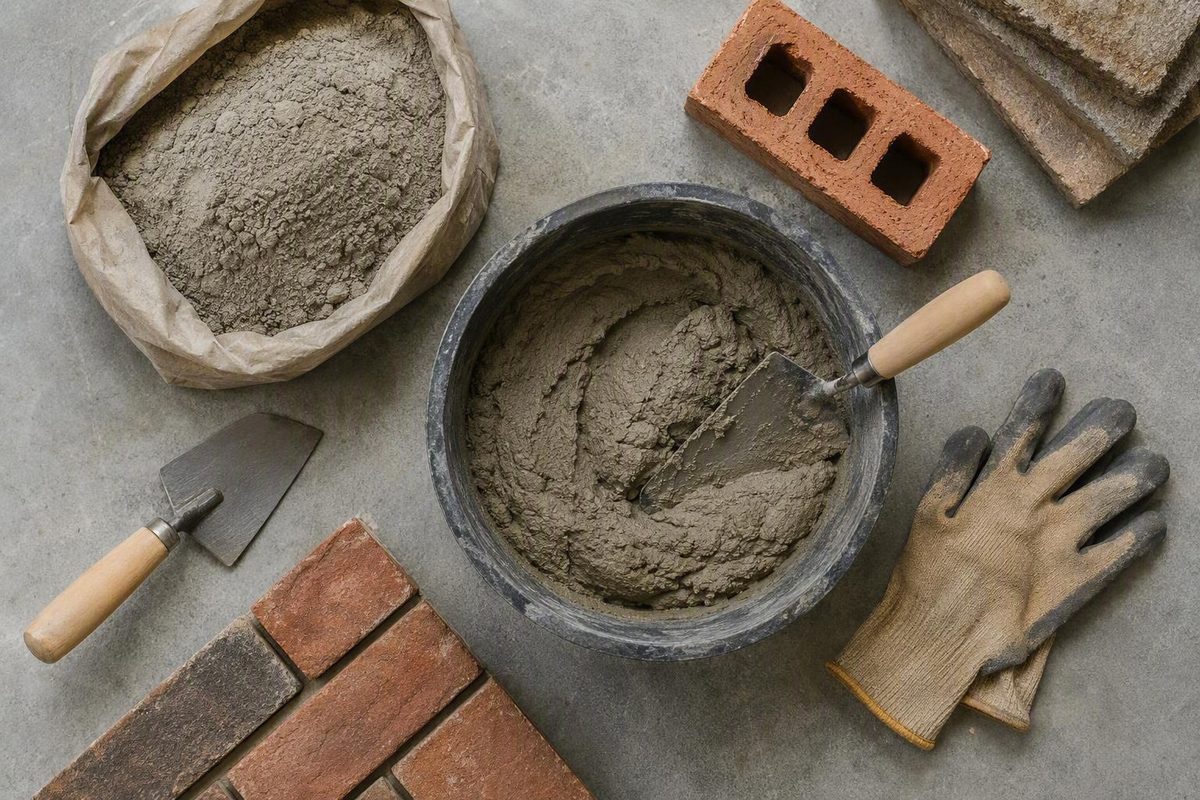
What “mason mix” means: identify the bag before using it
It can also refer to a specific branded product: QUIKRETE Mason Mix No. 1136. The meanings overlap, but the phrase alone does not identify the formulation, mortar type, water requirement, strength classification, or approved uses.
Use the bag label to place the product into one of three categories:
- Preblended mortar mix: Mortar sand and cementitious components are already proportioned. Normally, only the specified amount of clean water is added.
- Masonry cement: This is a binder for making mortar, not a complete sanded mortar. It generally requires separately supplied mortar sand and water in the proportions specified by the manufacturer or project documents.
- Branded Mason Mix: Confirm the manufacturer and product number, then follow that product’s current label, technical data sheet, and safety data sheet.
Masonry cement and preblended mortar are not interchangeable bag for bag.
The next check is the mortar type printed on the package—typically N, S, or M—not the informal phrase “mason mix.” Even two bags with the same mortar-type designation should not be assumed to have identical water requirements, yields, working times, or approved applications.
Quick answer: QUIKRETE Mason Mix No. 1136
QUIKRETE identifies No. 1136 as a dry, preblended Type S mortar made with sand and cementitious materials. Water must be added, but separate sand or cement is not normally added. The current bag and product documents remain controlling.
QUIKRETE Mason Mix No. 1136: verified product facts
QUIKRETE describes Mason Mix No. 1136 as a dry, preblended mixture of sand and cementitious materials that requires added water. The manufacturer classifies it as a high-strength, commercial-grade Type S mortar intended for structural masonry above and below grade. Listed applications include walls, columns, tuck-pointing, and brick or stone veneers.
The manufacturer lists 60 lb and 80 lb packages and states that No. 1136 meets ASTM C270 and ASTM C1714 requirements as Type S mortar. These are manufacturer-stated product and standards claims, not independent testing performed by this article. QUIKRETE’s current product page also provides access to the product data sheet and safety data sheet (review QUIKRETE Mason Mix No. 1136 product information).
Retail descriptions add purchasing context but do not replace the manufacturer’s documents, project specifications, or local requirements. Retailers describe the 80 lb product as a Type S mortar for laying brick, block, and stone, and some listings include walls, columns, and foundations among possible project uses. A foundation listing does not authorize changing a designed footing or foundation system, and mortar must not be substituted for specified concrete.
Some distributor descriptions contain conflicting language. They identify No. 1136 as Type S while also saying that it meets N, S, and M requirements, without explaining how that statement relates to the product’s classification. Because that wording conflicts with the manufacturer’s clearer identification, treat No. 1136 as Type S mortar unless current QUIKRETE documentation expressly says otherwise.
Do not fill gaps in the available product page with generic values. The evidence reviewed here does not establish a current product-specific water quantity, yield, working time, mixing duration, temperature range, retempering rule, or curing milestone for No. 1136. Obtain those details from the current bag, technical data sheet, project specification, or manufacturer before mixing.
Mason mix vs. masonry cement, mortar, cement, and concrete
Similar-looking bags can contain materially different products. Read the complete material description rather than relying on a prominent word such as “masonry,” “cement,” or “mix.”
| Product | What it contains | What must be added | General role |
|---|---|---|---|
| Preblended mortar mix | Proportioned dry mortar sand and cementitious components; formulation varies by product | Normally the specified clean water | Bedding, bonding, and jointing compatible masonry units |
| Masonry cement | A manufactured cementitious binder for making mortar; it is not complete sanded mortar | Specified mortar sand and clean water | Producing masonry mortar when batched with sand |
| Portland cement or another cement | Binder rather than complete mortar | Other ingredients required by the intended formulation | An ingredient used in mortar or concrete, not a direct substitute for either |
| Site-batched mortar | Cementitious binder combined with fine mortar sand | Measured water and any other specified components | Bedding and bonding masonry |
| Concrete mix | Cementitious binder, fine aggregate, and coarse aggregate | Usually the specified amount of water for a bagged product | Concrete placements such as appropriately designed slabs, piers, and footings |
Mortar uses fine aggregate and is formulated to remain workable enough to bed masonry units and form joints. Concrete also contains coarse aggregate and is formulated for different placement and structural functions. Cement itself is a binder, not complete mortar or concrete (see the material distinctions in Collomix’s cement-mortar guide).
Mortar mix therefore should not be substituted for concrete in slabs, concrete footings, piers, or other concrete placements merely because both products harden after water is added. The absence of coarse aggregate is not a minor packaging difference; it reflects a different formulation and intended use.
Preblending reduces onsite proportioning and can improve consistency between batches. It also simplifies purchasing because the user does not need to source and measure separate mortar sand. It does not eliminate the need to:
- identify the required mortar type;
- measure water accurately;
- mix for the required duration;
- follow weather and protection limits;
- use consistent equipment and batch sizes;
- comply with the current label and data sheet.
If the bag is preblended, do not modify it unless the manufacturer or project specification expressly permits the change.
Type N, Type S, and Type M: choose for compatibility, not maximum strength
Mortar types are not a simple good-better-best ladder. Published compressive-strength classifications help identify them, but strength alone does not establish compatibility with a particular brick, concrete masonry unit, stone, veneer system, or existing wall.
| Mortar type | Commonly published minimum 28-day compressive strength | Broad use association | Selection caution |
|---|---|---|---|
| Type N | 750 psi | Commonly associated with above-grade, general-purpose, or non-load-bearing work | May not satisfy structural or severe-exposure requirements |
| Type S | 1,800 psi | Commonly associated with exterior, structural, load-bearing, or below-grade work | Not automatically suitable for every unit, veneer, foundation, or repair |
| Type M | 2,500 psi | Highest-strength of these three; associated with demanding loads and selected heavy-duty work | Greater compressive strength may be undesirable with weaker masonry units |
The cited values are published minimum 28-day strength classifications, not predictions of field performance. Manufacturer guidance also emphasizes that mortar should generally be weaker than the masonry units so that movement or cracking is more likely to occur in repairable joints rather than in the brick or block (review Sakrete’s mortar-type and compatibility guidance).
Mortar selection can depend on:
- design loads and whether the assembly is load-bearing;
- above-grade or below-grade exposure;
- rain, wind, freezing conditions, salt, and soil exposure;
- bond and water-retention requirements;
- workability needed for the selected units and joint profile;
- the strength, suction, movement, and condition of the masonry;
- reinforcement, anchors, flashing, and wall-system details;
- project drawings and specifications;
- the locally adopted code and standard editions.
Those factors cannot be reduced to the compressive-strength number on the bag. Type S may be broadly associated with structural and below-grade work, but that does not prove that it belongs in every structural wall, foundation, chimney, veneer, or repair. Type M likewise is not automatically preferable merely because it has the highest listed strength.
This caution is particularly important in tuck-pointing. QUIKRETE includes tuck-pointing in No. 1136’s use list, but a marketed use does not establish compatibility with every existing wall. Existing masonry and mortar should be assessed, and the replacement mortar should be specified for the assembly rather than selected solely because Type S is available.
For structural walls, reinforced masonry, foundations, retaining conditions, chimneys, or code-governed repairs, follow the project documents and local requirements. If the required mortar is unclear, obtain direction from an appropriately qualified mason, architect, engineer, or preservation professional rather than choosing solely by strength.
How to mix preblended mason mix without guessing
The controlling rule is straightforward: use the current instructions for the exact product and package. The bag and technical data sheet should govern water quantity, loading order, mixing duration, any rest or slake period, permissible consistency adjustments, weather limits, and retempering policy.
Until those instructions are available, do not treat a generic mortar recipe as a substitute. A defensible general workflow is:
- Confirm the product. Check the manufacturer, product number, mortar type, bag weight, bag condition, and intended application.
- Read the documents before opening the bag. Locate the mixing instructions, technical data sheet, safety data sheet, and application-specific requirements.
- Prepare clean equipment. Use a suitable mixer or mixing container, a reliable measuring vessel, the appropriate mixing tool, a mortar board, and clean hand tools.
- Measure the specified clean water. Do not estimate water by bucket depth, hose time, or appearance alone.
- Load materials in the required order. Different products and mixing methods may prescribe different sequences.
- Mix for the stated duration. Incorporate dry pockets and material from container corners as appropriate until the batch is homogeneous.
- Adjust only if the instructions permit it. Add any permitted water gradually and record the total amount. Do not exceed the product limit.
- Observe any required rest and remix step. Do not assume every mortar requires the same slake period.
- Check consistency before application. The mortar should be smooth and workable, hold its shape, and cling to the tool rather than flow like soup.
- Repeat a measured process. Consistent water, equipment, mixing time, and batch size help reduce performance and color variation.
Water control matters. Excess water can weaken mortar and contribute to cracking, while insufficient water can produce stiff mortar and impair workability or adhesion. General guidance therefore recommends gradual adjustment toward a smooth, shape-holding consistency instead of uncontrolled water addition (see Consolidated Aggregates’ discussion of common mortar-mixing errors).
Research-conflict note
One generic Type S guide says some 80 lb premixes use approximately 5–6 quarts of water. That amount is not verified for QUIKRETE No. 1136 and must not be used in place of the current product instructions (see the generic premix example in context).
General sources also disagree about slaking. One generic procedure gives a 2–3 minute slake, while another recommends 10 minutes before remixing. The 10-minute recommendation appears in a general mortar guide, not product-specific instructions for No. 1136 (review the general Home Depot mixing procedure). This disagreement is why a universal slake period should not be prescribed.
Retempering rules vary as well. Some general guidance warns against adding water after full mixing, while SPEC MIX permits only limited replacement of water lost through evaporation for its own mortar. Neither rule should be transferred automatically to QUIKRETE No. 1136; the selected product’s current instructions control (see SPEC MIX’s product-specific mixing and retempering guidance).
Keep four timing concepts separate:
A generic estimate for one is not a product-specific promise for the others. Do not translate a broad drying estimate into permission to clean, load, seal, expose to freezing, or place masonry into service.
Applications, limitations, and common selection mistakes
A manufacturer or retailer use list tells buyers where a product is marketed for consideration. It does not replace confirmation that the mortar is compatible with the masonry units, substrate, reinforcement, exposure, wall system, plans, and local requirements.
Brick or block laying. No. 1136 is sold for laying brick and block, and QUIKRETE markets it for structural masonry above and below grade. Before use, verify the unit requirements, specified mortar type, reinforcement details, exposure, and wall design.
Stone work. Retail descriptions mention laying stone, while the manufacturer lists stone veneers. “Stone work” can include different materials and installation systems. Confirm whether the assembly calls for masonry mortar, veneer mortar, grout, setting material, or another system component.
Walls and columns. Both applications appear in product descriptions. For ordinary work, the mortar still must suit the units and exposure. For structural or reinforced walls and columns, a broad marketing statement is not a project-specific engineering determination.
Foundations and below-grade masonry. Type S is broadly associated with structural and below-grade applications, and retailer copy mentions foundations. That does not authorize a change to an engineered or code-governed design, nor does it mean mortar can replace concrete specified for a footing.
Veneers. The mortar listing does not prove compatibility with every adhered or anchored assembly, substrate, lath, fastening pattern, flashing detail, drainage cavity, weep arrangement, or proprietary component.
Tuck-pointing. The manufacturer lists tuck-pointing, but existing masonry must first be assessed. Inclusion on the use list does not establish that Type S is compatible with every existing wall. Obtain a compatible repair-mortar specification before removing old mortar or beginning extensive work.
Common mistakes include:
- assuming every product called mason mix has the same formulation;
- choosing the strongest mortar type by default;
- adding sand to a preblended mortar;
- failing to add sand to masonry cement;
- substituting mortar for concrete;
- using an unverified generic water ratio;
- assuming a veneer or foundation listing approves the complete design;
- applying new-construction mortar indiscriminately to existing masonry;
- treating retailer copy as a replacement for manufacturer documentation.
Pause and verify before proceeding when the work is load-bearing, reinforced, below grade, historically significant, unusually exposed, inspected, or governed by drawings and specifications.
Mortar Desk publishes general building-material reference information rather than project-specific contracting advice. Its published scope also directs structural work to qualified trades working under local code.
Bag sizes, standards, color, price, and quantity planning
Before ordering, check more than the words “mason mix.” Use this purchase checklist:
- [ ] Exact manufacturer and product number
- [ ] Mortar type printed on the bag
- [ ] Bag weight
- [ ] Current manufacturer data sheet and safety data sheet
- [ ] Compatibility with the masonry units and wall system
- [ ] Required quantity based on verified yield
- [ ] Required color and approved coloring method
- [ ] Current local stock and lead time
- [ ] Current delivered price, including pallet or minimum-order terms
QUIKRETE lists No. 1136 in 60 lb and 80 lb bags. The 80 lb package is common in the retailer listings reviewed, but local availability can differ. Some distributors list 42 bags per pallet or a 3,000 lb super sack; those are seller-specific formats rather than guaranteed national offerings (see one distributor’s listed package formats).
Price is local and time-sensitive. In the evidence snapshot supplied for this article, Live Oak Supply displayed an 80 lb bag at $12. No capture date was provided, so that figure is historical retailer context rather than a current quote (view the retailer listing).
A separate supplied snapshot from House of Rocks displayed an 80 lb bag at $13.50. Again, no capture date was supplied, and the amount should not be treated as a present national price or project budget (view the second retailer listing).
Confirm current stock, taxes, pickup or delivery charges, pallet terms, minimum orders, and breakage policies directly with the seller.
QUIKRETE states that No. 1136 meets ASTM C270 and ASTM C1714 requirements as Type S mortar. This is a manufacturer claim, not an independent certification performed by this article. For a submittal or inspected project, confirm that the current product documentation and required standard editions align with the plans and local authority.
For color, QUIKRETE says a compatible liquid cement color may be added, while distributor copy also mentions pigments. Do not assume a universal pigment dose or guaranteed match. Use an approved coloring product and method, measure batches consistently, and prepare a representative sample when appearance matters.
A dependable bag-count calculator cannot be built from bag weight alone. Quantity planning requires:
- verified yield for the exact product and package;
- brick, block, or stone dimensions;
- joint width and depth;
- whether the units are solid, hollow, irregular, or deeply bedded;
- wall thickness and project geometry;
- expected waste and spillage;
- crew technique and site conditions;
- extra material for samples, color continuity, or unavoidable losses.
“80 lb” identifies package mass, not the number of units the bag will lay. Use current product yield information tied to defined unit and joint assumptions, then round the purchase quantity appropriately for the project.
Safety, storage, and the final pre-mix checklist
Opening, pouring, and mechanically mixing dry mortar can release dust. Baseline precautions include gloves, eye protection, long sleeves, appropriate respiratory protection, and a mixing setup that controls the direction and spread of dust (review the general mortar-mixing safety guidance).
Those precautions are not a substitute for product-specific safety instructions. Obtain the current safety data sheet linked from the manufacturer’s product page before use. It should govern hazard identification, first aid, respiratory protection, ventilation, handling, storage, spill response, and disposal requirements.
Store bagged mortar dry, covered, and protected from weather and physical damage. General manufacturer guidance for preblended mortar specifies dry, protected storage (see SPEC MIX’s storage guidance). Do not use a torn, wet, hardened, or badly damaged bag without resolving whether its contents remain suitable. No product-specific shelf life for No. 1136 is established here; check the package, lot information, storage history, and manufacturer guidance.
Before opening the first bag, confirm:
- [ ] The manufacturer and exact product number match the order.
- [ ] The required mortar type is printed on the bag.
- [ ] The product is preblended and already contains sand—or, if it is masonry cement, the specified sand is ready.
- [ ] The current technical data sheet and safety data sheet have been read.
- [ ] The application is supported and compatible with the units and complete system.
- [ ] Plans, specifications, permits, and local requirements have been checked.
- [ ] Quantity is based on verified yield, project geometry, joints, and waste—not bag weight alone.
- [ ] Clean equipment and a reliable water-measuring container are ready.
- [ ] Applicable weather and protection requirements can be maintained.
- [ ] Structural, historic, below-grade, reinforced, or unusual work has received qualified review.
Exact water quantity, yield, working time, mixing duration, curing milestones, temperature limits, and retempering rules are product-specific. If the current instructions are missing or unclear, stop and obtain them rather than guessing.
Does mason mix already contain sand?
Usually, yes—if “mason mix” means preblended mortar mix. The dry bag contains proportioned sand and cementitious components, and the user normally adds the specified water. QUIKRETE specifically describes No. 1136 as a preblended mixture of sand and cementitious materials.
Do not apply that answer to a bag labeled masonry cement. Masonry cement generally requires separately measured mortar sand and water. Read the full product description before buying or batching.
How much water should I add to an 80 lb bag of QUIKRETE Mason Mix?
Use the quantity printed on the current 80 lb bag or stated in the current QUIKRETE technical data sheet. The product page reviewed here does not provide a water figure, so an exact amount cannot be responsibly stated from the available evidence.
Do not substitute a generic Type S water estimate. Measure the manufacturer-specified quantity and make only those consistency adjustments expressly permitted by the current instructions.
Is QUIKRETE Mason Mix Type S, or does it also qualify as Types N and M?
QUIKRETE identifies Mason Mix No. 1136 as Type S mortar. Some distributor pages ambiguously state that the same product meets N, S, and M requirements while also calling it Type S, but they do not explain the statement.
Use the manufacturer’s clear Type S classification unless current QUIKRETE documentation provides a different or more detailed designation. Do not treat one bag as freely interchangeable among Types N, S, and M.
Can Type S mason mix be used for tuck-pointing old brick?
It can be considered because QUIKRETE lists tuck-pointing among No. 1136’s uses, but that listing does not make Type S appropriate for every existing brick wall.
Have the masonry and existing mortar assessed, then obtain a compatible repair-mortar specification. For historically significant, fragile, deteriorated, or otherwise unusual masonry, consult an appropriately qualified preservation professional or mason rather than selecting Type S automatically.
Can mason mix be used instead of concrete?
No—not as a general substitution. Mortar and concrete are different formulations with different intended functions. Mortar uses fine aggregate and is designed principally to bed and bond masonry units; concrete also contains coarse aggregate and is formulated for concrete placements.
Do not use mason mix in place of concrete for a slab, concrete footing, pier, or other concrete element merely because both are bagged cementitious products. Use the material required by the plans and application.
The final decision rule is label-first: determine whether the bag is preblended mortar or masonry cement, confirm its mortar type and intended use, and let the current product documents govern water, mixing, weather, yield, and curing. QUIKRETE Mason Mix No. 1136 is manufacturer-identified as preblended Type S mortar, but that designation alone does not establish compatibility with every masonry unit or project. Verify the plans and local requirements—and obtain qualified review for structural, historic, or otherwise unusual work—before ordering or mixing.