 MortarDesk
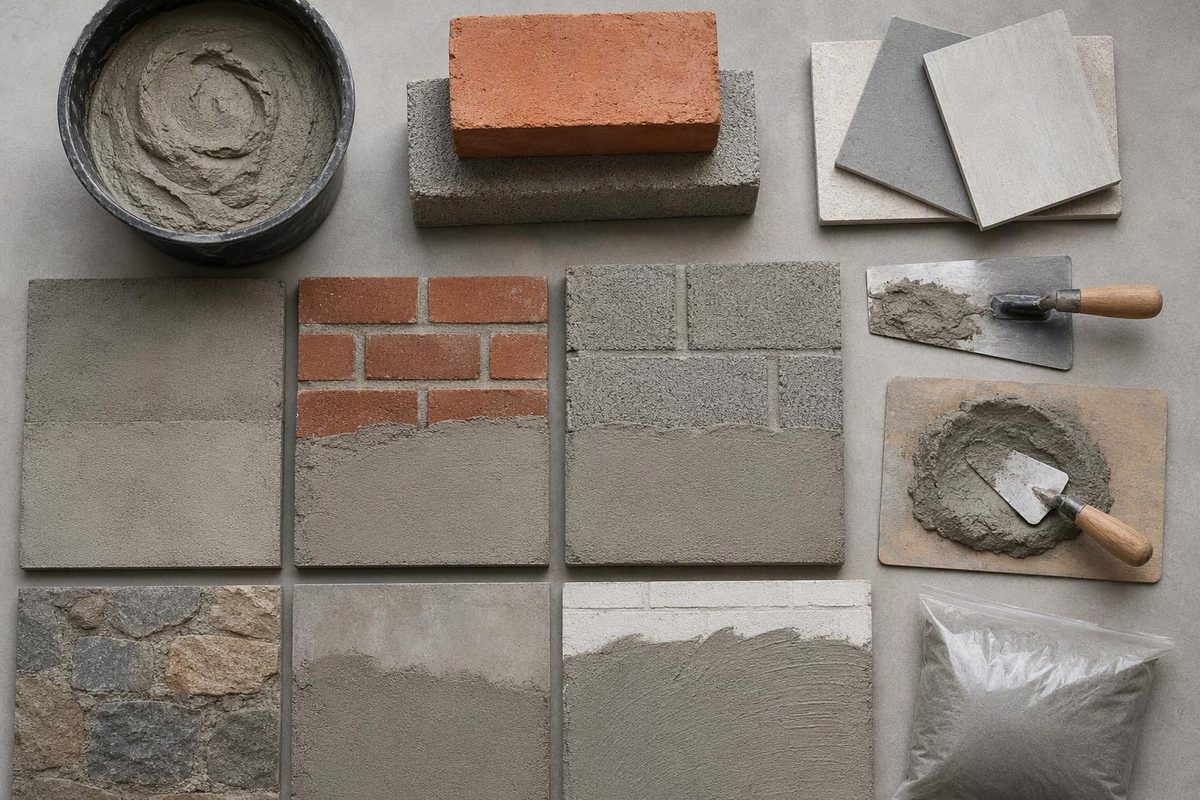
Surface bonding cement is a fiber-reinforced, cement-based wall coating, not ordinary masonry mortar. For dry-stacked concrete masonry unit (CMU) walls, it is applied continuously to both faces, commonly at a manufacturer minimum of 1/8 in. (3.2 mm) per face. A typical 50 lb bag covers about 50 ft² at 1/8 in., but the selected product’s instructions control.
Enter the wall dimensions and coated faces; adjust coverage and waste if the product or surface requires it.
Adjust product coverage and waste
Estimated Order
8 bags
Source: Quikrete lists ~50 ft² per 50 lb bag at 1/8 in.; Sakrete lists ~25 ft² per 50 lb bag at 1/4 in. Waste is user-selected. Always verify the purchased product.
Surface bonding cement can also serve as a parge coat, decorative masonry finish or product-approved vertical repair material. Coating an existing wall does not automatically turn it into an approved structural surface-bonded system.
For dry-stack construction, specify packaged surface-bonding mortar complying with ASTM C887 and construction complying with ASTM C946 where required. ASTM C887 covers packaged material for CMU that has not been coated or painted; it does not cover wall design or application (ASTM C887-20 scope). ASTM C946 covers applying the mortar to both sides of dry-stacked CMU but leaves grout, reinforcement, anchorage and control joints to the applicable masonry requirements (ASTM C946-23 scope).
The 2018 IBC references both standards in Section 2103.2.2. The locally adopted code edition and amendments control a particular project (2018 IBC Chapter 21).
Thickness And Coverage Depend On The Application
| Application | Thickness To Verify | Typical Coverage Example |
|---|---|---|
| Dry-stacked CMU | Commonly 1/8 in. per face | About 50 ft² per 50 lb bag |
| Masonry parge or finish | Product-dependent | About 50 ft² at 1/8 in. or 25 ft² at 1/4 in. |
| Deep vertical repair | Product-dependent; multiple lifts may be required | Use the product yield and permitted lift thickness |
Dry-stacked construction requires coating both wall faces, so a 100 ft² wall presents 200 ft² of coated area. A one-face parge or finish coat ordinarily uses the area of that face only.
The coverage figures are examples rather than a universal yield. Quikrete lists approximately 50 ft² per 50 lb bag at 1/8 in., while Sakrete lists 25 ft² at 1/4 in. for its 50 lb bag (Quikrete technical sheet; Sakrete technical sheet). Rough block, open joints, low spots and waste increase average thickness and reduce coverage.
Do not transfer one brand’s thickness limits, water quantity or curing schedule to another. Tenon, for example, permits repair layers up to 1/2 in. (13 mm) and gives a 25–35 minute working time. It separately requires at least 1/8 in. (3 mm) on both sides of its dry-stacked walls (Tenon technical sheet).
A 20-Foot Wall Requires Eight Example Bags
For a dry-stacked wall 20 ft long × 8 ft high, coated on both sides:
- One face is 20 × 8 = 160 ft².
- Both faces total 160 × 2 = 320 ft².
- At 50 ft² per bag, the base quantity is 320 ÷ 50 = 6.4 bags.
- A 10% allowance produces 6.4 × 1.10 = 7.04 bags.
- Rounding up to whole bags gives 8 bags.
The 10% allowance is an estimating choice, not a fixed product requirement. Increase it if the wall has deep joints or irregular block, or base the order on a measured test area.
At a uniform 1/4 in., nominal coverage falls to 25 ft² per bag. The same 320 ft² wall takes 320 ÷ 25 = 12.8 bags, or 15 bags after applying the example 10% allowance and rounding up.
Appropriate Uses Require A Sound, Compatible Substrate
Suitable candidates include:
- dry-stacked CMU walls designed and approved as a surface-bonded system;
- parging sound, bare block or masonry;
- textured or decorative cementitious wall finishes;
- vertical masonry repairs expressly listed by the product manufacturer.
Resolve the underlying condition or select another material when paint, sealer, oil, loose material or heavy efflorescence prevents a sound bond. Surface bonding cement also is not a remedy for moving cracks, bowed or displaced walls, or drainage, grading and flashing defects that continue to feed water into the masonry.
Do not use it where the surface is subject to hydrostatic pressure that the selected product does not permit. It is also not a substitute for materials intended for horizontal wearing surfaces, conventional bed-joint masonry or tile setting.
“Damp-proof,” “water-resistant” and “waterproof” are not interchangeable. Sakrete identifies its product as a damp-proof coating, while Tenon says its substrate must not be subject to hydrostatic pressure. Other products make different claims for particular assemblies. A bag labeled surface bonding cement should not be treated as a below-grade waterproofing system without a corresponding manufacturer approval.
Paint is another dividing line. ASTM C887 applies to uncoated, unpainted CMU, and Sakrete says not to apply its product over painted substrates. Quikrete and Tenon describe brand-specific additives and, in some coated-wall situations, expanded metal lath.
Do not add a generic bonding liquid unless the surface-bonding cement manufacturer permits it. The same compatibility rule applies when choosing a bonding agent for stucco.
Mixing Water And Curing Schedules Vary By Product
- Prepare a sound substrate. Remove loose material and bond-inhibiting paint, sealer, oil, dirt or efflorescence as the selected product requires. Complete necessary repairs first.
- Dampen absorptive masonry. Prevent the block from pulling water out of the thin coat, but do not leave free water unless the instructions permit it.
- Measure the mixing liquid. Quikrete and Tenon specify about 1 to 1.5 gal (3.8 to 5.7 L) per 50 lb bag. Sakrete specifies 5 to 6 qt (4.7 to 5.7 L). The current instructions on the purchased bag control; do not overwater.
- Avoid overmixing. ASTM C946 calls for full-bag multiples to limit ingredient-segregation effects and minimum mixing time because overmixing may damage the reinforcing fibers.
- Compact the coat. Trowel or spray the material to the specified thickness while filling pores and gaps. For dry-stack construction, coat both faces continuously because the coating is part of the wall system.
- Follow the named product’s curing schedule. Quikrete requires fog curing after final set. Sakrete calls for light spraying as needed in hot or windy weather. Tenon directs users to keep the surface damp for at least two days. Temperature and weather limits also differ by product.
Structural Walls Need More Than A Bag Estimate
A dry-stack wall still needs a level first course, adequate footing and bracing during construction. Reinforcement, grout, anchorage, openings and control joints require project-specific decisions; ASTM C946 does not design those elements.
Industry guidance also emphasizes that wall strength and stability depend on coating both faces (CMHA surface-bonded construction guide). A loadbearing, retaining, basement or high-wind wall is therefore a code-and-design question rather than only a bag-count exercise.
Dry cement can damage skin and eyes, while masonry preparation can create hazardous dust. OSHA states that cutting, grinding or drilling concrete, brick, block and mortar can generate respirable crystalline silica associated with silicosis, lung cancer, COPD and kidney disease (OSHA crystalline silica overview). Read the current safety data sheet and use its specified protective equipment and dust controls.