 MortarDesk
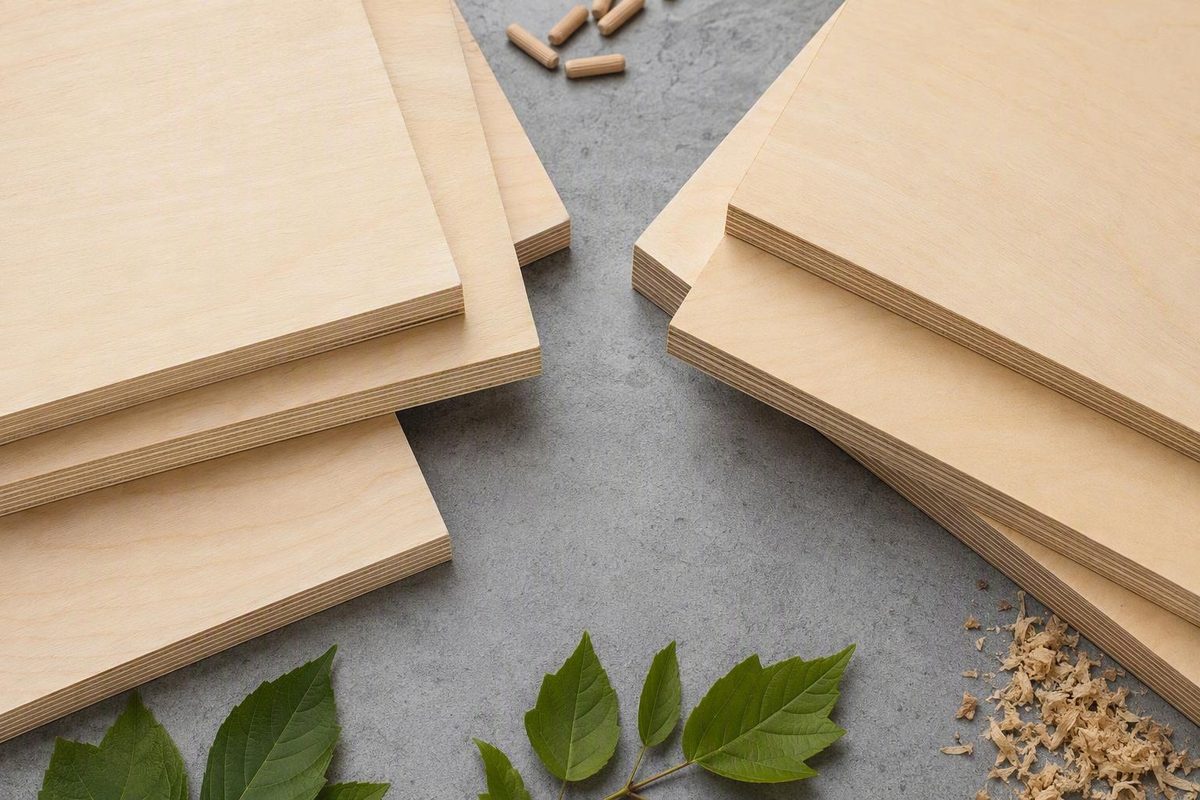
Neither birch nor maple plywood is universally better. Choose a high-grade maple-faced panel when a smooth, consistent visible face is the priority. Choose verified Baltic birch when exposed layered edges or plywood drawer boxes are central to the design. For concealed cabinet cases, compare generic birch-faced plywood with prefinished maple by full specification and installed cost.
In every case, the panel’s face grade, core, actual thickness, construction, bond or exposure classification, factory finish, and price tell you more than the species name alone.
The short answer: choose by project priority
Both categories can work for cabinetry and furniture. Use this table as a starting point, then verify the exact panel rather than treating “birch” or “maple” as a complete specification.
| Project priority | Likely starting point | What to verify |
|---|---|---|
| Smooth painted or clear-finished face | High-grade maple-faced plywood | Face grade, veneer quality, core, sample finish |
| Exposed layered edges | Genuine Baltic birch | All-birch construction, edge voids, actual thickness |
| Drawer parts | Genuine Baltic birch is a common choice | Flatness, edge quality, joinery, finish |
| Concealed cabinet cases | Generic birch-faced or prefinished maple | Core, interior finish, edge treatment, installed cost |
| Repeated CNC components | Either | Voids, tear-out, burning, tooling behavior, batch consistency |
| Minimum finishing labor | Prefinished maple may help | Coating, scratch resistance, protected face, price |
| Lowest material budget | Obtain matched local quotes | Grade, size, thickness, core, finish, usable yield |
Commercial sellers commonly position maple plywood for smooth visible faces and Baltic birch for drawers and exposed-ply edges. These are buying conventions, not independent proof that one panel performs better in every respect. One retailer, for example, distinguishes maple’s face-oriented construction from the multi-ply construction sold as Baltic birch while noting that either can be used for cabinets, depending on the desired surface and edge treatment (Berta Store comparison).
Treat every recommendation as conditional. Two sheets with similar species labels may behave differently if their cores, grades, thicknesses, adhesives, defects, or manufacturing quality differ.
First identify what the label actually describes
“Birch vs maple plywood” can refer to several materially different products:
- Generic birch-faced plywood has a birch decorative face over a core that must be identified separately. Do not assume it has birch veneers throughout.
- Baltic birch is commercially described as a multi-ply panel made with birch veneers throughout. Verify that construction on the product data sheet and inspect the edge rather than relying on “birch” in the listing.
- Unfinished maple-faced plywood usually means a maple face veneer over a veneer, combination, or other specified core. It is not necessarily made entirely from maple.
- Prefinished maple-faced plywood adds a factory-applied coating to one or both faces. The core can still vary, and the coating is a separate specification from the face species.
Retailer descriptions support the broad distinction between maple-faced panels and all-birch, multi-ply Baltic birch, but the description of one seller’s products should not be applied automatically to every sheet on the market.
The distinction changes the comparison. Panels with similar maple faces but different cores should be treated as different specifications. Likewise, generic birch-faced plywood should not inherit every characteristic associated with Baltic birch.
The species labels are broad as well. Birch and maple each encompass multiple species, and wood properties vary with species, source, growth conditions, and processing. The USDA Forest Products Laboratory recommends selecting wood by the physical characteristics required for the use rather than assuming the species name supplies the complete answer (USDA wood-characteristics overview).
The central buying principle is simple: the face species describes only part of the panel. Ask what is behind it.
Face appearance, edges, and finishing
Commercial comparisons commonly present maple faces as pale, smooth, tight-grained, and relatively uniform. Birch faces are often presented as pale to warm golden, with more visible grain, brown streaks, or mineral variation. These are broad market descriptions rather than guarantees for an individual sheet. Face grade, veneer matching, repairs, grain selection, and batch variation can matter more visually than the species name.
For a refined painted surface or a clear finish where consistency is the main goal, begin by inspecting high-grade maple-faced panels. For a warmer appearance with more natural variation, birch may better fit the design. Both can provide suitable paintable surfaces when the face grade and preparation are appropriate. Supplier comparisons generally support these appearance patterns, but they do not replace examination of the material you will buy (commercial maple-and-birch comparison).
Edges require a separate decision. Verified Baltic birch is often selected when its alternating veneer layers will remain visible. Ordinary birch-faced or maple-faced plywood may have irregular layers, gaps, color changes, or a different core at the edge. Those panels may need veneer tape, thicker banding, solid-wood edging, or a concealed joint.
Do not choose by a claim that one species always stains more evenly. The supplied commercial sources conflict: some warn about uneven stain on maple, while another associates blotching with birch.
Test the complete finish schedule before committing to a full order:
- Obtain a sample or offcut from the intended product and, if possible, the intended batch.
- Sand only as permitted by the manufacturer’s instructions.
- Apply the complete preparation schedule, including any specified sealer or conditioner.
- Apply the actual paint, dye, stain, clear coat, or factory-finish-compatible product.
- Inspect the face, veneer joints, patches, edges, and end grain under the project lighting.
- Approve the result before cutting all the parts.
Request the documented face-veneer thickness and do not assume that scratches, glue marks, low spots, or finish defects can be sanded out without exposing the layer below.
Hardness is not the same as panel strength
Published Janka figures in commercial birch-versus-maple comparisons generally refer to solid hard maple and solid birch. Janka hardness measures resistance to surface indentation under a defined solid-wood test. It does not establish the structural performance of a completed plywood panel.
A harder face veneer may suggest better resistance to small surface dents. It does not prove greater:
- bending strength or stiffness;
- shelf capacity;
- screw withdrawal resistance;
- edge strength;
- flatness;
- resistance to warping;
- bond durability; or
- service life.
Those outcomes depend on the complete panel: core material, thickness, number and arrangement of plies, grade, defects, adhesive, moisture condition, veneer quality, and manufacturing control. USDA veneer research also notes that veneer characteristics vary by species, site, log source, and processing conditions (USDA veneer research).
It is therefore unsound to rank maple plywood and birch plywood universally for strength, screw holding, shelf spans, warping, or durability. For shelving, heavily loaded components, structural parts, or tight-tolerance assemblies, obtain technical data for the exact manufacturer, product, thickness, orientation, and support arrangement. If those data are unavailable, face species is not an adequate substitute.
Best fit by application
Cabinet cases: Either category can work. Compare flatness, core quality, interior finish, edge treatment, actual thickness, fastening method, and cost. A concealed case may not benefit from a premium decorative face unless that face or factory finish improves the production workflow.
Visible cabinet ends and furniture faces: Consider high-grade maple-faced plywood when a smooth, consistent appearance is the main requirement. Birch may suit a design that benefits from warmer color, visible grain, or mineral variation. Select the actual sheet or approve a representative sample rather than ordering by color name alone.
Drawer boxes and exposed-ply furniture: Genuine Baltic birch is a common workshop and retailer choice because its layered edge can be part of the intended appearance. That convention does not prove that every Baltic birch panel is void-free or structurally superior, and it does not prevent maple-faced plywood from being used for drawers.
Prefinished cabinet interiors: Factory-prefinished maple can remove preparation, coating, and curing steps from cabinet production. Woodworkers report labor and consistency benefits, but those reports are product- and shop-specific rather than controlled tests (Sawmill Creek discussion). Any savings depend on panel price, finish quality, assembly sequence, scratch protection, and the finish the shop would otherwise apply.
CNC and repeated components: Do not assume birch is categorically easier to machine. Test the actual panel with the intended cutter, feed rate, spindle speed, hold-down method, and cutting direction. Inspect for internal voids, fuzzy edges, tear-out, face chipping, burning, tool wear, and dimensional consistency. A production sample is more useful than a species-wide machining claim.
Painted work: Prioritize a sound face grade, smooth repairs, suitable primer, clean preparation, and a compatible coating. Paint reduces the importance of grain color, but it does not conceal core voids, telegraphed patches, damaged veneer, or poor edge preparation.
These are selection patterns, not rules. Maple can be used for drawers, Baltic birch for cases, and generic birch-faced plywood for furniture. The right choice follows the design and the documented panel specification.
Compare price and labor on equal terms
The available evidence does not support a universal rule that birch plywood is cheaper than maple plywood. Prices vary with region, supplier, grade, core, factory finish, sheet format, availability, and quantity. Baltic birch also occupies a different product category from economical birch-faced panels, so combining them under one “birch price” is misleading.
Request quotes using the same specification:
- sheet length and width;
- nominal and actual thickness;
- face and back grades;
- core material;
- documented construction or ply count;
- unfinished or factory-prefinished faces;
- quantity and volume discount;
- delivery, handling, and minimum-order charges;
- allowance for damaged or rejected sheets; and
- expected usable yield after defects and part layout.
When comparing unfinished plywood with prefinished maple, include the entire finishing operation: abrasives, cleaners, sealers, coatings, application supplies, labor, drying or curing time, handling space, scratch protection, and rework. A more expensive sheet may reduce shop time, but prefinished material does not automatically deliver a lower installed cost.
Do not use whole-cabinet package estimates as plywood sheet prices. Cabinet prices include doors, hardware, design, labor, finishing, overhead, and other variables that cannot establish a material-level price difference. Obtain local quotes for matched panels and compare cost per usable sheet or finished component.
What to check before buying a sheet
Read the product data and inspect the material before payment or cutting. Check:
- exact category: generic birch-faced, Baltic birch, unfinished maple-faced, or prefinished maple-faced;
- face and back grades;
- core material;
- ply count, if documented;
- nominal and actual thickness;
- manufacturer’s thickness tolerance;
- face-veneer thickness;
- patches, repairs, grain matching, and color variation;
- flatness, bow, cup, and twist;
- edge gaps or voids;
- delamination or poorly bonded areas;
- face scratches, dents, sanding-through, or handling damage;
- damage to a factory-applied finish;
- adhesive or bond classification;
- exposure rating and intended environment;
- emissions labeling; and
- product-specific sourcing certification and chain-of-custody records.
Do not infer exterior or damp-location suitability from birch or maple. Verify the finished panel’s documented rating and manufacturer instructions, including any requirements for sealing edges, finishing faces, and protecting cutouts. Commercial guidance likewise treats outdoor suitability as dependent on the specific panel and protection system rather than the face species alone (supplier comparison).
For regulated hardwood plywood sold in the United States, check the applicable TSCA Title VI compliance documentation and labeling. An archived EPA consumer FAQ states an emission limit of 0.05 ppm for both veneer-core and composite-core hardwood plywood and describes certification and labeling requirements for regulated products (archived EPA guidance). Because that page reflects EPA material as of January 19, 2021, verify the current requirement through current EPA information and the supplier’s product documentation before purchasing. Compliance applies to the finished regulated panel; it does not mean formaldehyde-free or establish strength, veneer quality, moisture resistance, or suitability for every use.
Responsible sourcing cannot be inferred from species either. Request certification for the particular product and supporting chain-of-custody documentation. A general statement that wood is renewable does not identify where a specific sheet originated or how its timber was managed.
Before ordering, ask the supplier these five questions:
- What is the core?
- What are the face grade and documented veneer thickness?
- What are the bond or exposure classification and intended uses?
- What emissions label applies to this product?
- Can I inspect or finish a sample from this batch?
Frequently asked questions
Is Baltic birch the same as ordinary birch plywood?
No. Baltic birch is commonly sold as a multi-ply construction using birch veneers throughout, while ordinary birch plywood may describe only a birch face over another core. Verify the manufacturer, core, construction, actual thickness, and edge quality. “Birch” by itself does not establish Baltic birch construction.
Can birch or maple plywood be used outdoors?
Only when the specific panel’s bond or exposure classification and manufacturer instructions allow the intended conditions. Neither face species makes a panel exterior-rated.
Does a higher Janka rating make maple plywood structurally stronger?
No. A higher solid-wood Janka rating indicates greater resistance to indentation in the wood tested. It does not prove that a maple-faced plywood panel has greater bending strength, stiffness, screw holding, edge strength, or durability than a birch-faced panel. Use technical data for the complete panel.
What emissions label should U.S. buyers check on hardwood plywood?
Check the applicable TSCA Title VI compliance labeling and current product documentation for regulated hardwood plywood. The requirement applies to the finished composite-wood product rather than to birch or maple as species. Compliance should not be interpreted as formaldehyde-free or as proof of broader panel quality.
Final buying rule
Choose the face for appearance. Choose the core for panel behavior and edge treatment. Then verify the finish, exposure classification, emissions documentation, sourcing records, and installed cost for the intended use.
If two sheets carry different specifications, those differences are more useful than the words birch or maple alone.