 MortarDesk
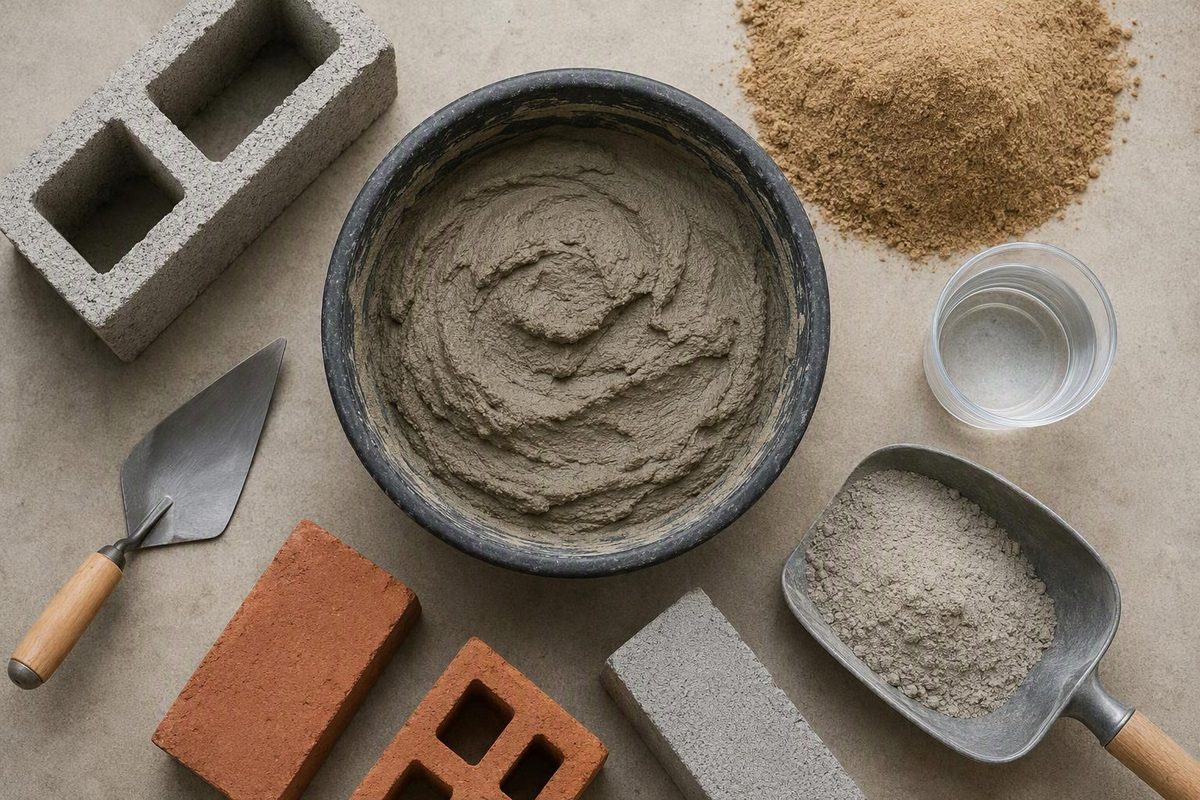
Under the ASTM C270 property specification, Type S mortar has a minimum average 28-day laboratory compressive strength of 1,800 psi (12.4 MPa). It is commonly selected for load-bearing or reinforced masonry and some severe exposures, but “Type S” alone does not say whether a bag contains sand or how much water it requires.
Check which product you are buying:
| Bag description | What it contains | What to add |
|---|---|---|
| Preblended, sanded Type S mortar mix or sanded mason mix | Cementitious binder and graded sand | Usually water only |
| Type S masonry cement | Cementitious binder, not finished mortar | Masonry sand and water |
For example, QUIKRETE Mason Mix No. 1136 is a sanded product meeting ASTM C270 and C1714 as Type S. QUIKRETE Type S Masonry Cement is a different product: its data sheet calls for 2.25–3 parts masonry sand per 1 part masonry cement by volume. Verify the exact bag and technical sheet rather than relying on “Type S” or “mason mix” alone. (QUIKRETE Mason Mix data sheet; QUIKRETE Type S Masonry Cement data sheet)
Type S specifications at a glance
| Property or buying detail | Reference value |
|---|---|
| ASTM C270 property-specification strength | 1,800 psi (12.4 MPa) minimum average at 28 days |
| Minimum water retention | 75% |
| Preblended bag sizes seen in current data sheets | 40, 60, 80 and 94 lb (18.1, 27.2, 36.3 and 42.6 kg); availability varies |
| Approximate yield from an 80 lb bag | 11–13 nominal 8 × 8 × 16 in. blocks or 35–45 bricks, depending on product and conditions |
| Water in two 80 lb preblend examples | About 5.0–5.3 qt (4.7–5.0 L); follow the selected product |
The current ASTM edition is C270-25. It contains separate proportion and property specifications; if project documents name neither, the proportion specification governs. ASTM also says field-sampled mortar strengths do not represent the C270 laboratory strength or the strength of mortar in the completed wall. The 1,800 psi figure is therefore a classification threshold—not a field-test target or the wall’s allowable load. (ASTM C270-25 scope)
Strength is not the only selection criterion. Bond, workability, water retention, masonry-unit absorption and exposure also matter. Brick Industry Association guidance recommends choosing the lowest-strength mortar that meets the project requirements rather than automatically buying the strongest mix. (BIA Technical Note 8B)
Where Type S mortar fits
Type S may be specified for:
- reinforced or load-bearing masonry above grade;
- brick, concrete block or stone work where the plans call for Type S;
- certain foundation or retaining-wall masonry where Type S is permitted; and
- compatible stucco, parging or repair work expressly listed by the product manufacturer.
It is not the default for every outdoor wall. BIA recommends Type N for most above-grade veneer and non-load-bearing brickwork, and Type S for above-grade reinforced or load-bearing walls. For foundation and retaining walls at or below grade, its table recommends Type M, with Type S as an alternative. Concrete-masonry guidance likewise notes that empirical foundation-wall provisions require Type M or S. Project drawings, the locally adopted code and masonry-unit requirements control. (BIA Technical Note 8B; CMHA, Mortars for Concrete Masonry)
Do not substitute Type S mortar for concrete, masonry grout or tile thinset. These have different uses and standards; see concrete mix ratio vs mortar type.
Type S is also not a default repointing mortar. BIA says a repointing mortar’s compressive strength should be equal to or lower than that of the existing mortar; Type O is often used for older brickwork and Type N may suit newer work. IMI similarly cautions that new pointing mortar should not be stronger, denser or less absorbent than the original mortar or masonry. (BIA Technical Note 8B; International Masonry Institute restoration guidance)
Mixing a preblended Type S bag
There is no universal water quantity. QUIKRETE starts an 80 lb (36.2 kg) bag of Mason Mix with approximately 5 qt (4.7 L) and says the maximum is expected to remain below 7 qt (6.6 L). Sakrete lists approximately 5.3 qt (5.0 L) for its 80 lb (36.3 kg) Type S mix. Do not transfer one brand’s limit to another. (QUIKRETE Mason Mix data sheet; Sakrete Type S data sheet)
- Confirm that the bag is a complete, sanded mix. If it is masonry cement, add the specified quantity of compliant masonry sand.
- Measure most of the manufacturer’s stated clean-water quantity into a clean mixer or mortar pan.
- Add the dry mix gradually and mix for the stated time. QUIKRETE specifies at least five minutes for Mason Mix; other products differ.
- Add the remaining water only in small, measured amounts until the mortar is workable and supports the masonry unit. Avoid a soupy mix.
- Keep water, mixing time and procedure consistent between batches, especially with colored mortar.
- Tool joints when thumbprint-hard and observe the product’s temperature, working-time and curing instructions.
See how to mix mortar mix for more batch-control detail.
Worked buying example: 100 concrete blocks
Assume the wall schedule specifies Type S and uses nominal 8 × 8 × 16 in. (200 × 200 × 405 mm) concrete blocks. QUIKRETE says one 80 lb bag of Mason Mix lays up to 13 such blocks.
With 10% allowed for handling loss and job variation:
100 blocks × 1.10 ÷ 13 blocks per bag = 8.46 bags
Round up to 9 bags of 80 lb preblended Type S mortar, or 720 lb (327 kg) of dry material. Check that result against the selected brand, joint dimensions and block configuration: Sakrete lists 12 standard 8 in. blocks per 80 lb bag, while SPEC MIX gives approximately 11–13. (QUIKRETE Mason Mix data sheet; Sakrete Type S data sheet; SPEC MIX yield table)
Wear impervious gloves and eye protection, work with dry powder in a well-ventilated area and avoid breathing dust. Cementitious mortar can irritate or burn skin and seriously damage eyes; use the current product safety data sheet for handling and first-aid instructions. (Sakrete Type S data sheet)